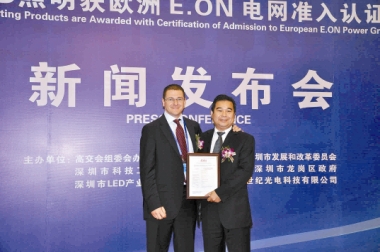
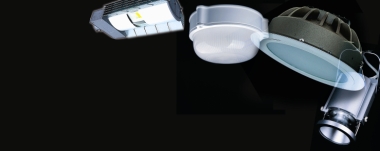
Helen Deng IT looks like an ordinary road lamp, with a pole, a large bulb and a light source at the center. If you look closer, however, you will find it is different from the road lamps above most of our urban roads. The lighting source is a board composed of many tiny chips. On both sides of the lamp, there are large wing-like metal pieces which are used to dissipate heat. This is an LED (Light-Emitting Diode) lamp. The 180w lamp gives illumination of a 400w traditional lamp, according to Savin Qiu, sales director of JEEJA Century Optoelectronics, at the exhibition booth of JEEJA in Hall 1 of the Shenzhen Convention and Exhibition Center. For cost reasons — the road lamp is priced at around 6,000 yuan (US$903), more than double the price of a traditional road lamp — LED road lamps are still not widely used in China. But more and more Chinese cities are using them. An LED road lamp consumes 60 percent less power than a traditional lamp, which is good news for Chinese cities facing an increasingly severe power shortage. A new study indicates that LEDs consume considerably less power than conventional light bulbs. JEEJA’s booth appears modest in the clamorous exhibition center, where a lot of companies are competing for attention with large LCD screens, loud music and even performances, but it attracted many visitors. On display at JEEJA’s booth are recessed down lights, ceiling lights, spot lights, pendant lights and street lights that range from 5w to 180w. All these contain only one light source. This is why JEEJA lights are competitive. Most high-power LED lamps on the market are made of multiple 1w or 3w light sources, which have a shorter life span and are less attractive than single-light-source LED lamps. With mature COB (chip on board) technology, JEEJA is able to produce LED light sources ranging from 5w to 180w. “Our products have few competitors,” said Feng Shuixing, chairman of the Shenzhen JEEJA Electronics Industrial Co. Ltd. JEEJA Century Optoelectronics is a subsidiary of Shenzhen JEEJA Electronics Industrial Co. Ltd. Established in 1999, Shenzhen JEEJA Electronics Industrial Co. Ltd. owns an 80,000-sqm technology park and a 36,800-sqm industrial park in Shenzhen’s Longgang District. The company hires over 2,000 workers, more than 150 engineers and over 200 managers, mainly producing self-designed TFT (thin film transistor) TV, security systems and LED lighting. JEEJA brand is already popular in China and more than 80 countries in the world, including those in Europe, America and Middle East, with sales turnover reaching several billion U.S. dollars per year. Feng realized the advantages of LED years ago. Power-efficient, environmentally friendly and durable, LED is widely regarded as the best lighting source for the 21st century. In 2003, JEEJA began to develop light source-LED chips and was awarded patents in more than 10 countries and regions. In 2006, JEEJA started producing LED lights, with more than 10 designs patented. In 2009, JEEJA Century Optoelectronics was established with a total investment of 100 million yuan. It engages in LED design, research, manufacturing and marketing of LED Lighting products. JEEJA Century Optoelectronics now has more than 200 staff and more than 30 engineers, and more than 50 patents. “We offer good-quality products and a two-year warranty. Our products are seldom recalled, so we have very loyal customers,” said Jennifer He, sales manager of the Export Department of JEEJA Century Optoelectronics. Earlier this year, it signed a framework deal worth US$200 million with a Hungarian company, Clean Light. It was the largest LED deal between a Chinese and a Hungarian company. According to the deal, Clean Light will be JEEJA’s exclusive agent in EU countries and the deal could amount to US$200 million in three years. “We will have no problem at all in realizing this sales target,” said Feng, revealing that the company was receiving orders worth hundreds of thousands of dollars from European customers. JEEJA Century Optoelectronics recently gained admission to the power grid of E.ON, the largest power service provider in Europe. JEEJA was the first Chinese company to be awarded certification of admission to the E.ON power grid. “The (admission) certificate is very important to our company,” said Feng. “Our products will have a great future in the European market.” After being in the manufacturing industry for over two decades, Feng, 51, now feels he has found a really exciting field. “I’ve been running manufacturing businesses for 20 years involving quite a few products. I feel that LED is a very good industry. It is power-efficient, pollution-free and is good for society,” said Feng. While exploring the foreign market, JEEJA is also doing quite well in the Chinese market. It has won several projects in Shenzhen, including the lighting for the Longgang government office building and the street lights on Baolong Road. Because LED lamps are more expensive than traditional lamps, they are still not so popular in China. However, because LED consumes much less energy than traditional lamps, LED lamps will be cheaper than traditional lamps in the long run. And as LED technology matures, LED prices would drop, said Feng. “The local government has been very supportive as the LED industry is strongly backed by the State Council,” he said. For more information about JEEJA, visit http://www.jeja-led.com/ or call 0086-0755-2880-8888. 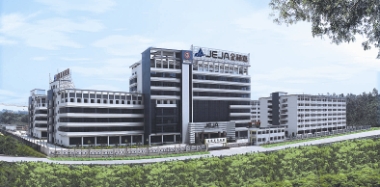
| 