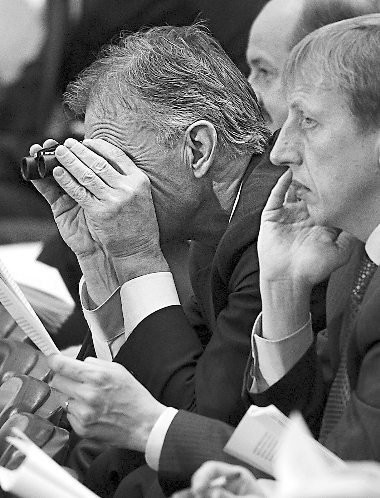
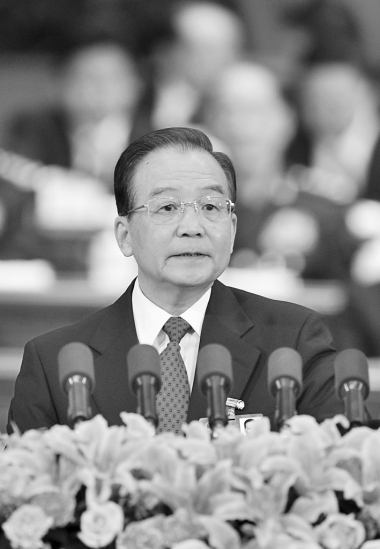
  THE Fourth Session of the 11th National People’s Congress (NPC), China’s parliament, opened at 9 a.m. Saturday in the Great Hall of the People in Beijing. Premier Wen Jiabao delivered a report on the work of the government at the opening meeting chaired by NPC Standing Committee Chairman Wu Bangguo. Nearly 3,000 national legislators were present at the opening meeting. According to Wen, the major focus of the government’s work this year would include reining in inflation and boosting the income of farmers and pensioners. The government would also try to increase consumer demand, enhance agricultural development and speed up economic restructuring. “Ensuring an adequate food supply for 1.3 billion Chinese people is always a top priority and we must never take this issue lightly,” Wen said. Wen listed measures that would ensure more people share in the fruits of reform and economic development. These include the creation of more than 9 million jobs, reducing the tax burden on low- and middle-income people and increasing government subsidies for the rural cooperative medical care system. 8% GDP growth China sets its GDP growth target at around 8 percent this year, according to Wen’s report. “Our main purpose is to create a good environment for transforming the pattern of economic development, and to guide all sectors to focus their work on accelerating economic restructuring and raising the quality and results of development as well as on increasing employment, improving the people’s well-being and promoting social harmony,” Wen said. Income Readjusting income distribution in a reasonable manner is both a long-term task and an urgent issue to address at present, Premier Wen said. According to Wen, three major measures will be taken in 2011: increasing basic incomes for low-income people in urban and rural areas, putting more effort into adjusting income distribution, and vigorously overhauling and standardizing income distribution. “We will steadily increase the minimum wage of workers, basic pensions of enterprise retirees, and subsistence allowances for both urban and rural residents,” Wen said, noting that a sound mechanism of regular pay raises for workers and a minimum wage system would be established. The government would also raise the individual income tax threshold on salaries, reasonably adjust the tax rate structure, and genuinely reduce the tax burden on low and middle-income people. “Through unremitting efforts, we will reverse the trend of a widening income gap as soon as possible and ensure that the people share more in the fruits of reform and development,” he said. Property prices The Chinese Government will firmly curb the excessively rapid rise of housing prices in some cities this year, Wen said, voicing the determination to cool the red-hot property market. “We will further implement and improve policies for regulating the real estate market and firmly curb the excessively rapid rise of housing prices in some cities,” Wen said. He said the government would formulate and announce an annual housing development plan, designate sites for building low-income housing when planning new construction projects, and make sure that all designated sites are used to develop low-income housing. Total number of units of new low-income housing and units in run-down areas that would undergo renovation would reach 10 million, and 1.5 million dilapidated rural houses would be renovated, Wen said. Emphasis would be placed on building more ordinary small and medium-sized commercial homes. The government would also give priority to developing public rental housing, with the allocation of 103 billion yuan (US$15.6 billion) in this year’s budget for subsidies to support the work, an increase of 26.5 billion yuan over last year. The premier said governments at all levels would be asked to raise funds through various channels and substantially increase spending in these areas. Corruption The government again demonstrated its strong resolve to combat corruption Saturday, vowing to end excessive concentrations of power and saying that supervision and transparency would be enhanced. Wen admitted that “rampant corruption” had flared in some areas and prescribed counter-measures to meet the “ardent hope” of the people. “We must make mechanisms for decision-making, enforcement and oversight check one another and function in concert,” he said while describing the tasks and goals of the coming five years. “We must make institutional changes to end the excessive concentration of power and the lack of checks on that power.” Economic restructuring “China’s economy needs to be quickly put on the path of balanced growth driven by innovation,” Wen said. The country will quicken the establishment of a modern industrial system and give impetus to industrial transformation and upgrading, he said. Global challenges “This year, our country still faces an extremely complex situation for development. The world economy will continue to recover slowly, but the foundation for recovery is not solid,” Wen said. He said economic growth in developed economies remained weak, their unemployment rates high, with some countries still under the threat of their sovereign debt crises. “Major developed economies have further eased monetary policies, global liquidity has increased greatly, the prices of major commodities and the exchange rates of major currencies have become more volatile in the international market, asset bubbles and inflationary pressure have grown in emerging markets,” the premier said. (SD-Xinhua) | 