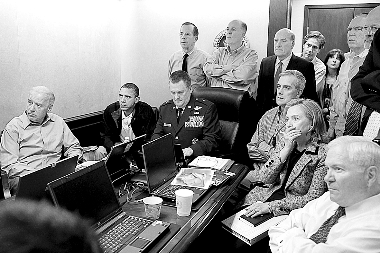
 OSAMA BIN LADEN’S final night began with a group of four helicopters slicing through the night skies over Pakistan, making their way toward Islamabad from a U.S. base in northern Afghanistan. The mission, approved by President Barack Obama on Friday morning, had been set for early Sunday local time but was delayed by poor weather. Pakistani officials did not know they were arriving. The small, elite force flew low and fast, using terrain-following radar to hug the folds and valleys to avoid radar detection. It was after midnight when the team of U.S. commandos descended on the al-Qaida chief’s Abbottabad lair. About two dozen Navy Seals and CIA enablers swooped down on the suburban compound in a pair of choppers, leaving a second pair lurking nearby in case they were needed. They came under fire almost immediately, giving U.S. forces all the justification they needed to amp up their firepower. Helicopters can be ungainly machines, easily downed by rocket-propelled grenades or a flurry of small-arms fire. Senior Administration officials said they had been monitoring the compound since August 2010, when a courier known to be trusted by bin Laden, as well as the courier’s brother, began living there. And so they went in. Twenty-four Seals fast-roped to the ground; a total of about 80 U.S. personnel took part, either in the air or below. Midway through the 40-minute mission, Pakistani military forces began scrambling to investigate the attack — U.S. officials feared a clash between the U.S. troops and their unknowing Pakistani allies. A woman, said to be bin Laden’s human shield, was shot. Then it happened. Back at the White House, a disembodied voice radioed, “We’ve ID’d Geronimo,” referring to the agreed-upon code name for America’s most wanted enemy. And then confirmation: Geronimo, Osama bin Laden, had been killed. It was 1 a.m. in Pakistan. No American casualties had been sustained. The three remaining helicopters took off bearing the commando team and the body of the slain al-Qaeda chief. After undergoing DNA verification in Afghanistan, bin Laden’s remains were flown to the U.S.S. Carl Vinson aircraft carrier. The body was washed, wrapped in a white sheet and placed in a weighted bag. A military official read a few religious passages in Arabic. And then, less than 24 hours after his death, and nearly a decade after the manhunt began, bin Laden’s body slipped into the North Arabian Sea. (SD-Agencies) | 