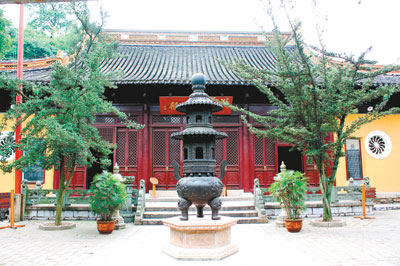
 James Baquet AFTER visiting Xiyuan, I took a bus to Changshu City, Jiangsu Province, and Yushan Xingfu Temple. It’s a shame I went so late in the day, because there’s lots to see in Changshu, a place whose name means “perpetual harvest.” Yushan itself is a national forest park and home to several other temples. And about five kilometers away, situated in a garden in the center of the city, is the Fangta (Square Pagoda) which was once part of Xingfu Temple. But alas! No time to see it all. So I went straight by taxi to the gates of the temple. Founded around 500 as Dabei (Great Compassion) Temple, it was renamed about 40 years later as the result of an interesting “accident.” In the midst of some renovations, a large stone was discovered inside the main hall, where it can be seen today. It has two unique aspects. On the left side as you face it are bumps said to resemble the Chinese character “Xing” (兴) or “flourishing,” and on the other side is supposedly “fu” (福) or “luck.” So the temple is now known as Xingfu, or Flourishing Luck, Temple. Frankly, I could make nothing of the bumps on the stone, nor could the monk attendant in the hall trace them out for me. I guess 1,500 years is a long time, even for a stone! The rest of the temple is new, with gardens on either side of the main compound around the base of the mountain. Some of the upper reaches were closed for relandscaping, including the tayuan (pagoda-filled cemetery). Someday, if time permits, I’d like to go back and explore more of the temple and the surrounding park. | 