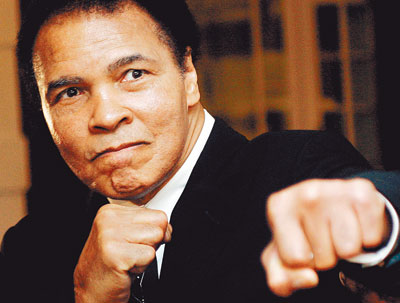
THE death of Muhammad Ali, the former heavyweight champion known as much for his political activism as his boxing brilliance, triggered a worldwide outpouring of affection and admiration for one of the best-known figures of the 20th century.
Ali, who had long suffered from Parkinson’s syndrome, which impaired his speech and made the once-graceful athlete almost a prisoner in his own body, died Friday at age 74.
The cause of death was septic shock due to unspecified natural causes, a family spokesman said Saturday.
“He’ll be remembered as a man of the world who spoke his mind and wasn’t afraid to take a chance and went out of his way to be a kind, benevolent individual that really changed the world,” the family spokesman, Bob Gunnell, said at a news conference in Scottsdale, Arizona.
Despite Ali’s failing health, his youthful proclamation that he was “the greatest” rang true until the end for millions of people around the world who respected him for his courage both inside and outside the ring.
Along with a fearsome reputation as a fighter, Ali spoke out against racism, war and religious intolerance, while projecting an unshakeable confidence that became a model for African-Americans at the height of the civil rights era and beyond.
Stripped of his world boxing crown for refusing to join the U.S. Army and fight in Vietnam, Ali returned in triumph by recapturing the title and starring in some of the sport’s most unforgettable bouts.
“I think when you talk about Muhammad Ali, as great an athlete, as great a boxer as he was, he was the greatest boxer of all time, he means so much more to the United States and the world,” said Ali’s long-time friend, boxing promoter Bob Arum.
Bursting onto the boxing scene in the 1960s with a brashness that threatened many whites, Ali would come to be embraced by Americans of all races for his grace, integrity and disarming sense of humor. “In the end, he went from being reviled to being revered,” civil rights leader Jesse Jackson told CNN on Saturday.
U.S. President Barack Obama, the first African-American to reach the White House, said Ali was “a man who fought for us” and placed him in the pantheon of civil rights leaders Martin Luther King Jr. and Nelson Mandela.
In New York’s Harlem district, fans gathered outside the famous Apollo Theater, where a marquee paying tribute to Ali read: “The greatest of all time. 1942-2016.”
Nearby, hundreds more gazed at projections of phrases and images most associated with Ali, such as “float like a butterfly and sting like a bee.”
Few could argue with his athletic prowess at his peak in the 1960s, with his dancing feet and quick fists. But Ali became much more than a sportsman. He spoke boldly against racism in the 1960s as well as against the Vietnam War.
Ali met scores of world leaders, during and after his championship reign, and for a time he was considered the most recognizable person on earth, known even in remote villages in countries far from the United States.
Ali’s diagnosis of Parkinson’s came about three years after he retired from boxing in 1981. Despite his failing health, he appeared at the opening ceremony of the 1996 Atlanta Olympics, stilling the tremors in his hands long enough to light the Olympic cauldron.
Flags were flown at half staff in Louisville, Kentucky, where Ali’s childhood home on Grand Avenue has been turned into a museum. Asked how he wanted to be remembered, Ali once said: “As a man who never looked down on those who looked up to him ... who stood up for his beliefs ... who tried to unite all humankind through faith and love.”
Ali was born in Louisville, Kentucky, on Jan. 17, 1942, as Cassius Marcellus Clay Jr, a name shared with a 19th century slavery abolitionist. He changed his name after his conversion to Islam.
(SD-Agencies)
|
