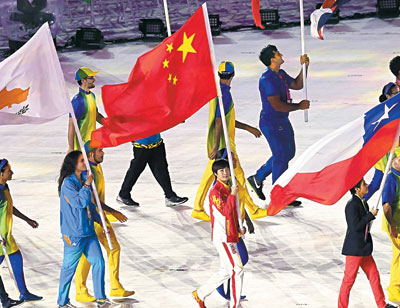
CHINA blamed fierce competition for their Rio flop and promised to examine “shortcomings” after the nation’s worst Olympic performance in 20 years.
China sent 410 athletes, their biggest team at a foreign Olympics, but they won just 26 gold medals, their fewest since Atlanta in 1996.
Worse still, China trailed not only the United States but also Britain on the medals table. China topped the table in 2008 and were second in 2004 and 2012.
Chinese Olympic Committee chief Liu Peng said Saturday that rising standards had taken them by surprise.
“There are a few problems we cannot overlook. In the Rio Games we didn’t win so many medals ... we didn’t assess objectively the challenges we might face at these Games,” said Liu.
“In recent years more countries have attached importance to the Olympic Games, so the level of play internationally has come up and the competition has become fierce.
“We need to employ a new mentality and new understanding of how to improve our performances and ability. We need more experiences and learning.”
Liu said inexperience, in particular, had cost China, whose team was young with three-quarters of them competing at their first Olympics.
“We have trained these athletes but the training isn’t enough,” he said.
“Because when these athletes are facing fierce competition and challenges they have too much to think about and too many mental burdens and they didn’t play at their highest level.”
But he had warm words for swimmer Fu Yuanhui, whose bubbly personality and frank comments — rare for a Chinese athlete — won hearts at home and abroad.
“Her happiness, starting from the bottom of her heart, fully demonstrated her spirit to continue to challenge herself and achieve excellence,” said Liu.
“This is something that touched audiences on the very deepest level.
“Her ‘prehistoric strength,’ as she put it, fully demonstrated the modern Chinese athletes — they’re confident, they’re active and they’re fully pushing forward.”
Liu also praised China’s athletes for competing in the right spirit and not appearing desperate to win at all costs. “We have fully demonstrated our Chinese spirit. We’re not arrogant when we win, we don’t give up easily and we continue to strive forward,” he said.
A once-feverish obsession with gold medals has slowly subsided among the Chinese public, which has shown more interest this year in lavishing adoration on athletes with personalities, such as bronze medalist Fu.
“Finally, the public desire for golds has returned to normal,” said Lu Yuanzhen, a professor of sports at South China Normal University who has long argued that a mature nation should have a more relaxed attitude toward wins and losses in athletic competitions.
The entire country was moved to tears when Xu Haifeng, a pistol shooter, won the first gold Olympic medal for the People’s Republic of China in Los Angeles in 1984. It was a huge boost to national pride.
The fever only grew as China sought better Olympic performances and the ultimate goal of hosting the Games. The Olympics was a national obsession, and gold medalists were household names and rewarded handsomely.(SD-Agencies)
|
