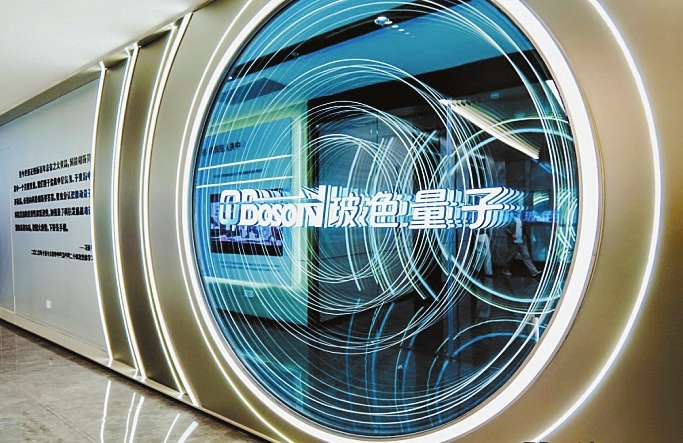
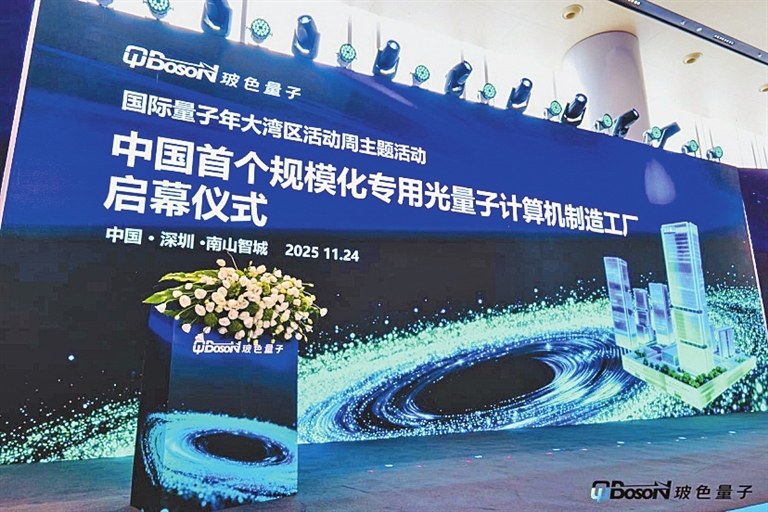
Editor’s note: Shenzhen is composed of nine administrative districts, one new area, and the Shenshan Special Cooperation Zone in Shanwei. While all 11 areas share Shenzhen’s defining spirit of innovation, each has its own unique characteristics. This page focuses on the latest developments in Nanshan District. Widely recognized as an economic, scientific, and technological powerhouse of both Shenzhen and China, the district is celebrated for its vibrant culture of innovation and entrepreneurship. A SIGNIFICANT milestone in China’s quantum computing industry was reached Nov. 24 with the inauguration of the nation’s first large-scale, dedicated optical quantum computer manufacturing facility in Nanshan District. Built by Beijing-based Boson Quantum Technology, the new factory marks a critical transition for practical, coherent optical quantum computers in China, moving from “proof-of-concept in the laboratory” to “mass production on the factory floor.” This advancement fills a key gap in the scalable production of quantum hardware, establishing a self-reliant “Made in China” capability in this cutting-edge field. Optical quantum computing leverages the quantum properties of light to perform computations and is considered a leading technical approach. Compared to other quantum computing methods, it does not require ultra-low temperatures and offers advantages such as larger qubit scale, stable operation at room temperature, and long coherence times. These characteristics make it suitable for near-term engineering and a promising form for commercial quantum computers. Located in the Liuxiandong Strategic Emerging Industries Headquarters Base, the 5,000-square-meter facility integrates R&D, manufacturing, and testing to enable the engineering, standardization, and scaled production of optical quantum computers. It is divided into two main functional sections: a clean production area and a comprehensive support zone. Wei Hai, chief technology officer of Boson Quantum, explained that the core clean production area functions like a “sterile operating room” for quantum computers. To maintain quantum stability, the company has implemented a five-fold protection system encompassing personnel purification, air cleanliness, precise microclimate control, specialized flooring, and strict behavioral protocols. The production of an optical quantum computer involves seven major processes, 223 distinct procedures, and over 1,000 specific work steps. The factory features two core equipment production zones: a southern zone dedicated to the nanometer-level precision alignment and fixation of optical modules and a northern zone responsible for integrating the qubit initialization and readout systems. Together, they form a complete, closed-loop manufacturing process for the quantum computer’s core. “The role of the quantum computer is to solve complex problems that are currently intractable or inefficient for classical computing,” said Ju Jiangwei, vice president of Boson Quantum. “It can be applied across numerous industries, including biopharmaceuticals, finance, energy, and communications.” He added that Shenzhen’s complete electronic information industry chain and rich talent pool were key factors in locating the factory there, which is expected to drive the development of the entire upstream and downstream industrial chain. The company has already initiated in-depth collaborations with partners such as the Guangzhou Laboratory, China Mobile, XtalPi, Shenzhen Metro, and Ping An Group, validating the significant advantages of its optical quantum computers in solving complex problems across various scenarios with greater efficiency and quality. Wen Kai, founder and CEO of Boson Quantum, stated that the factory aims to achieve an annual production capacity of dozens of dedicated optical quantum computers. With the anticipated expansion of the domestic market for these machines, further scaling up of production is already planned.(Zhang Yu) | 