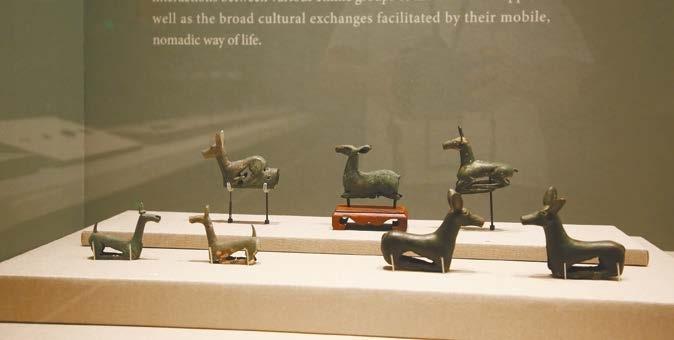
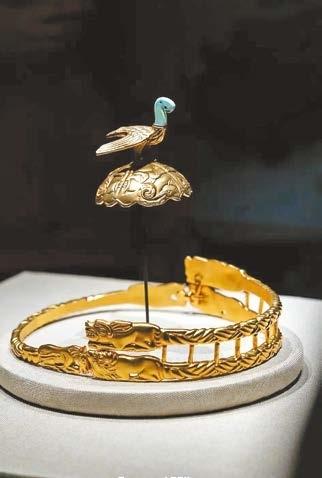
ANCIENT bronzeware from China’s Central Plains is familiar to many, but examples from Inner Mongolia are rarely seen. Now history lovers can view more than 300 pieces at the “Steppe Treasures” exhibition at Nanshan Museum. The items are on loan from the Ordos Museum in the Inner Mongolia Autonomous Region. Ordos sits in the southwest of the region, with Shanxi and Shaanxi provinces and Ningxia Hui Autonomous Region to the south. As a borderland between the nomadic steppe and the agricultural Central Plains, Ordos became a natural crossroads for these two great civilizations. Around 3,500 years ago, an early steppe bronze culture — represented by the Ordos bronzes — took shape here. Unlike the intricate, solemn bronzes of the Central Plains or the mysterious bronzes of the ancient Shu Kingdom in the southwest, Ordos bronzes — whether household utensils, weapons, or ornaments — tend to favor simple forms and natural compositions. Steppe artisans inscribed their experiences and observations into finely worked patterns, giving us vivid glimpses of their daily lives and sentiments. Animal motifs are a hallmark of Ordos bronzeware: horses, deer, eagles, and rhinoceroses appear as knife handles, sword patterns, and decorative fittings. At the exhibition, small details reward close inspection. A hollowed bronze scabbard with a bird motif is remarkably delicate. A boar-pattern ring ornament looks plain at first glance, but its five boars are arranged in an interlocking design that required careful geometric planning. A crane-beak-shaped bronze staff head symbolizes a wish for longevity, and a deer ornament is especially adorable. Ornamental plaques from Ordos bronzeware reflect the life and culture of the northern nomadic tribes. The exhibition juxtaposes plaques from the steppe and the Central Plains: One shows animals locked in fierce struggle, while another depicts humans and animals living harmoniously — a vivid contrast of styles. Don’t miss the replica of a gold crown, whose band features reliefs of a tiger, a sheep, and a horse, connected by tenon-and-mortise joints. The canopy-shaped middle section shows wolves devouring sheep, while an eagle of gold and turquoise perches above as if surveying the scene. The original is housed at the Inner Mongolia Museum. Weapons play a prominent role among Ordos bronzes. Swords often bear beast-head motifs and long-range arms attest to the nomad’s ingenuity in horseback warfare. Bronze dagger-axes are exquisitely crafted, and numerous metal fittings on horse heads served both decorative and protective purposes. Through these objects, the steppe people’s survival wisdom, warfare, rituals, and beliefs come alive. The bronzes convey a civilization that was simple, bold, and vibrant — preserved in an enduring artistic language. Dates: Through Jan. 4, 2026 Venue: Nanshan Museum, Nanshan District (南山博物馆) Metro: Line 12 to Nantou Ancient City Station (南头古城站), Exit E3(Cao Zhen) | 