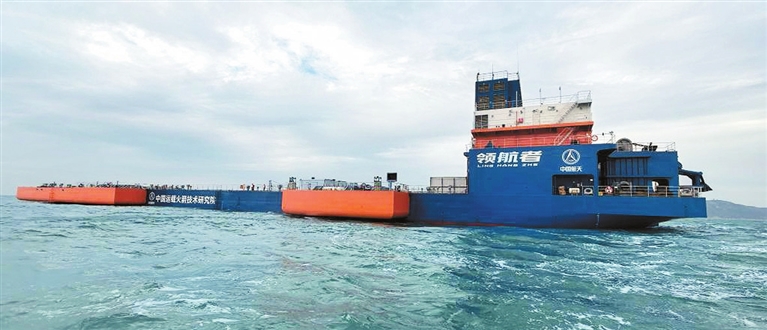
CHINA has delivered its first sea-based platform designed to retrieve rockets using a net system, marking a significant step in the nation’s push for reusable launch vehicle technology. The platform, named Linghangzhe (or Pathfinder) and certified by the China Classification Society, was delivered Sunday by the China Academy of Launch Vehicle Technology (CALT), a key subsidiary of the State-owned China Aerospace Science and Technology Corp. (CASC). With a length of 144 meters, a beam of 50 meters, and a draft of 5.5 meters, the vessel has a full-load displacement of 25,000 tons and features DP2 dynamic positioning capability. According to CALT, the platform will enhance the efficiency and reliability of key technologies for sea-based recovery of reusable rockets, supporting China’s goals of achieving rapid and low-cost access to space. Globally, the dominant recovery method for reusable rockets is vertical take-off and landing (VTOL), which requires rockets to be equipped with grid fins and landing legs, explained Xu Xuelei of CASC. The net recovery system represents a variant of VTOL technology. Similar to arresting cables used on aircraft carriers, the system uses a net to catch a descending rocket at a specific altitude. “When the rocket is secured by the net, most of its kinetic and potential energy is absorbed by a ground-based buffer mechanism,” Xu said. “This greatly reduces the design demands on the rocket’s own buffer structure.” He added that the net system offers greater adaptability to landing deviations by adjusting ground equipment parameters, thereby relaxing precision requirements for rocket thrust control. Unlike traditional VTOL, which requires rocket-mounted landing gear tailored to each vehicle, the net approach can accommodate different rocket sizes and simplifies onboard design. The Linghangzhe platform follows other recent advances in China’s reusable rocket infrastructure. In August, commercial firm i-Space launched its recovery vessel Xingjiguihang (or Stellar Return), equipped with a 40-by-60-meter deck to retrieve the first stage of its reusable SQX-3 rocket. Chinese aerospace companies are also accelerating reusable vehicle development. In September, the new-generation Long March-10 manned launch rocket — being developed for lunar missions before 2030 — conducted a second static fire test to verify first-stage propulsion and recovery capabilities. In June, a commercial firm, LandSpace, successfully conducted a ground ignition test for the first-stage propulsion system of its reusable Zhuque-3 rocket. To date, multiple Chinese rocket makers have completed essential VTOL tests, underscoring the sector’s rapid progress toward full reusability. (SD-Agencies) | 