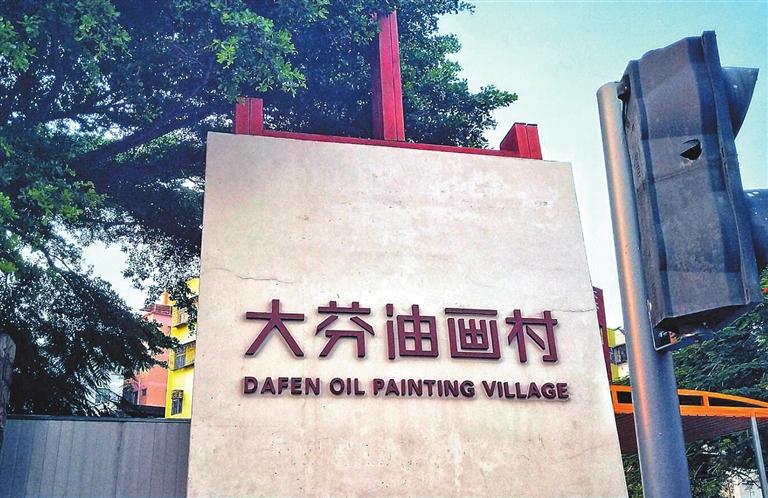
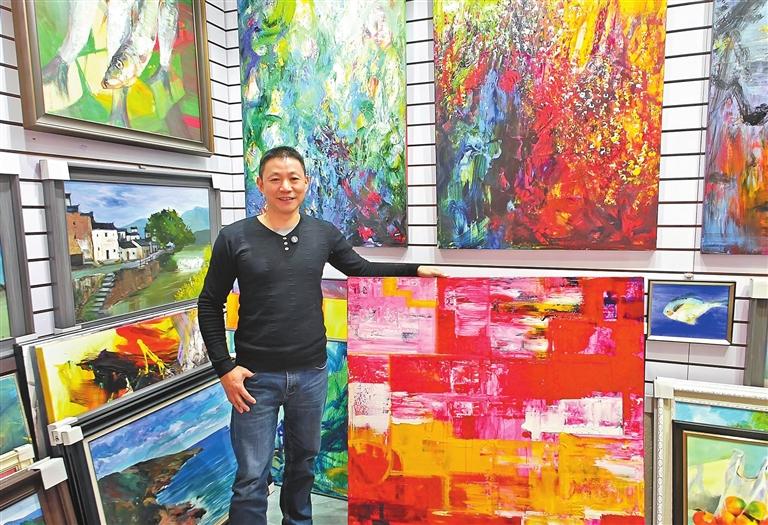
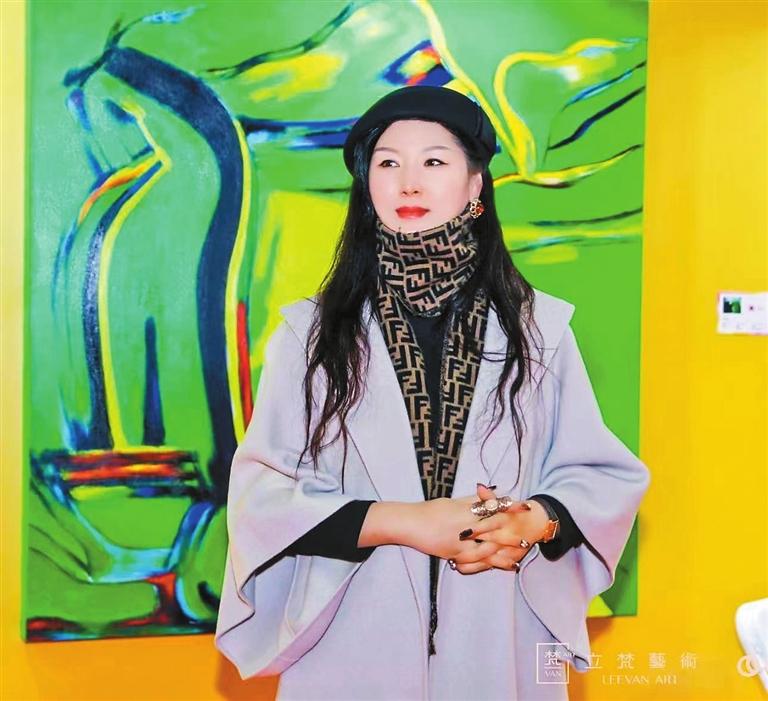
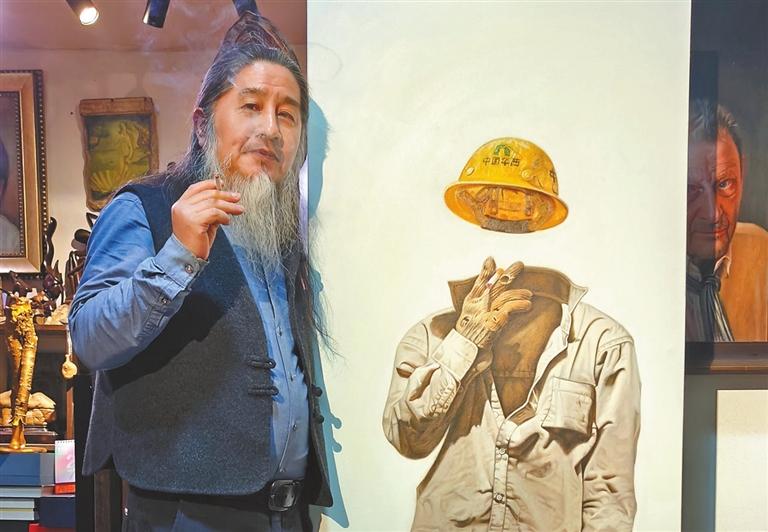
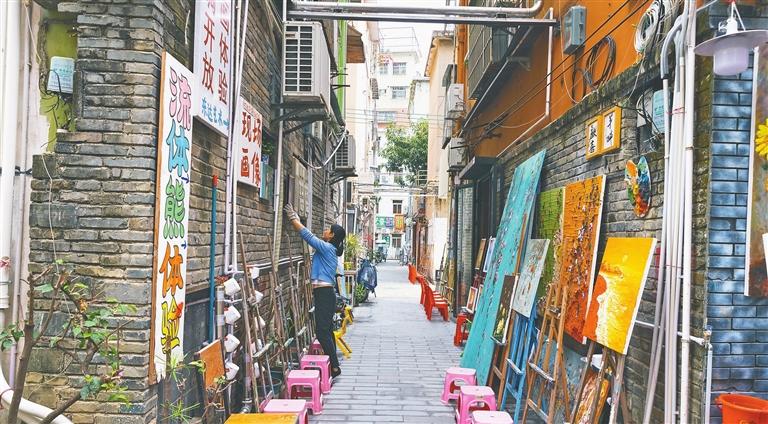
Zach Mills szdaily@126.com YOU have probably seen a copy of a Van Gogh painting in your hotel room or furniture stores, no matter which country you were in. At its height, an estimated 60% of the world’s reproduction oil paintings were made in Dafen, an urban village in Shenzhen. It was a place where “production” mattered more than “creation,” where production lines comprised of art workers specializing in one element of a painting quickly churned out work. As I first browsed bins of paintings on Dafen’s thoroughfare, I marveled at how affordable the semi-passable copies were. At the same time, perhaps I blamed Dafen for subverting art and creation into another mass-producible commodity of modernity. But as I wandered through its alleys, losing my way, the “assembly line” reputation began to feel like a half-truth. It is at this point one stumbles upon unbridled creativity. While the smell of turpentine still hangs in the air, the stacks of drying Van Goghs are thinning out and slowly being replaced by personal galleries. What follows is a portrait of three artists producing original works in Dafen. Their stories highlight that Dafen is no longer just a curiosity for tourists seeking affordable souvenirs, but a destination for genuine artistic discovery. Liu Jianhui Liu Jianhui loved painting as a child. As a university student and adult, he had to pursue a paying career and choose interior and landscape designs. Liu ran a successful design business for over a decade. However, a desire for personal reinvention and economic shifts led him to trade interior design for a paintbrush — which he always enjoyed. His walls display a dizzying array of styles that defy easy categorization, skirting impressionism, expressionism, and abstract. To Liu, this variety is not a lack of focus, but a philosophy. “An artist should not be too singular,” Liu said. “It is like drinks: sometimes you want wine, and sometimes liquor.” When he needs to release his emotions without the constraints of realistic forms, he plays blues music to enter a cathartic state of flow and paints abstracts. Then, when he wants to go outside, breathe fresh air, and face nature, he ventures into the country’s many beautiful places and creates sketches. Liu has been practicing xieyi (写意) — traditional Chinese freehand brushwork — on Western oil canvas. It is a durable fusion. Beyond abstracts, one of Liu’s most powerful works is firmly grounded in reality. A centerpiece in his studio is a tender oil painting of his wife knitting for their child on a sofa. “I thought it was a beautiful moment.” His eclectic range has garnered validation far beyond the village. Liu has moved steadily from local and provincial exhibitions to a solo exhibition before an exhibition at the Oil Painting Institute of the China National Academy of Arts. Notably, in 2019, his work was selected for a Los Angeles exchange. That painting of his wife validates a quieter, confident philosophy. Rather than chasing trends, Liu trusts that staying true to his own creative impulses will eventually find its own audience. “I paint what I want to paint,” he asserted. “If there is a connection with a buyer, they will buy it.” He Ting (Y.N. Helen) “To model is to seek validation outwardly; to paint is to build a world inwardly.” He Ting was once a figure on the runway, but a passage from Napoleon’s autobiography changed her trajectory. Struck by the Emperor’s desire to leave a legacy that would resonate a century after his death, she realized she had been chasing the fleeting. To leave behind something that endures, He turned to the canvas. “God is partial to artists,” He told me in her studio. She believes an artist has a special dispensation to strip away the mask of sanity that society demands. “If you are not an artist, your intensity might be seen as abnormal,” she said, with the confidence of one who has found her sanctuary. In person and in her art, she unleashes her feelings with a candidness that evokes a quiet envy — she is a study of intensity. Her abstracts possess striking individuality but are profound in contrast. Within her studio, I felt the timeless dichotomies of life: bliss and sadness, masculinity and femineity. For He, possessing that emotional range and the capacity for “androgyny” — every pigmented shade of existence — is the ultimate achievement for an artist. To be herself in all of her shades, He decided to exist in solitude. She rejects the “Bohemian” chaos often found in artist enclaves, where commiseration replaces creation. When her spirit wanes, she does not seek the comfort of crowds. Her aspiration — the unearthing of one’s human spirit in a mundane world — demands a devotion that can only come from within oneself. Instead, He retreats to her studio and performs a ritual of self-resurrection. “I lock myself in the room,” she said, “I read, drink wine, listen to jazz... and when the inspiration comes, I paint.” To He, “Dafen is a window.” Through Dafen, through art, and with her perseverance, she received a level of recognition that transcends the village’s commercial roots. Her artwork was selected for inclusion in the Limited-Edition Commemorative Stamp Albums honoring the U.N.’s 80th Anniversary and Singapore’s 60th National Day. In October 2025, her abstract painting exploring light and life was auctioned in New York. Supported by international certification, the work achieved a recorded hammer price of US$15,620. Yet, these accolades are merely the echoes of her true mission – to leave a legacy of art that remains long after the applause has faded. Huang Haifan Stepping into Huang Haifan’s studio feels like stumbling into the private studio of a modern-day Da Vinci. The space is filled with sculptures, relics, and creative design products collected for their aesthetic value — a dried palm leaf reminiscent of Gaudi’s La Sagrada Familia cathedral, river rocks that resemble shoes, dried grapefruit skins squeezed into faces, etc. This “organicness” is a manifestation of Huang’s philosophy of “art returning to essence.” His down-to-earth demeanor aside, Huang holds a reputation for high-level commissions, painting subjects ranging from Alan Greenspan to a Princess of the Netherlands and the King and Queen of Malaysia. Yet his journey to this status was defined by a friction between art and commerce that many in Dafen know well. In 1996, Huang abandoned a secure State-sector job and moved south to Shenzhen to work in gift design, creating products like Christmas decorations for export. In 2004, he resigned to come to Dafen, believing it to be a hub for original artistic creation. Instead, he discovered a commercial assembly line. Bosses offered him a steady income to work as a ghost painter, churning out mass-produced replicas of classical figures. “They were doing pure commerce — producing cheap, mass-market copies for export,” Huang recalled. “If I copy others forever, won’t I just be a money-making machine?” he stated. “There is no freedom in that.” For a young artist trying to survive, the temptation was real, but his resistance was stronger. When CCTV inadvertently interviewed him in 2005, Huang boldly vowed that “when you come back to interview me in the future, my studio will be filled with only my personal works.” He kept that promise. In 2010, a German curator selected him for the “Most Wanted Art” project, exhibiting his work in opera houses in Hamburg and Vienna. “Standing on that stage in Germany gave me confidence,” Huang said. “I realized people could appreciate my own vision.” Today, the self-described “perpetual student” applies classical rigor to tackle what he calls “the hardest bone to chew” in art — the human figure. He said he aspires to match the skills of haunted artists, and, if he is lucky, perhaps even improve upon that heritage. Some of his powerful paintings are a haunting, surrealist exploration of Shenzhen’s migrant laborers — the bodies of delivery drivers and construction workers rendered invisible, leaving only their uniforms. “There are souls moving inside the shells,” Huang explained. “I hope that by capturing them in art, people might respect them more,” he said. “Maybe be a little more tolerant if a delivery driver is late.” The window and the mirror To the outside world, Dafen is often reduced to a statistic — a relic of mass production. But spending time with Liu, He, and Huang revealed that the commercial industry has fertilized a rich soil where new talent is blooming. These three artists represent a shift mirroring Shenzhen itself: a pivot from the “factory of the world” to a center of innovation. They came here with the dream of creating original art; they are actively building what comes next. For the visitor, Dafen is now a treasure hunt. If you are willing to get lost in the maze, you can find the authentic soul of the city. These artists show that Dafen is no longer just a place for producing copy art — it is a place where artists make themselves. | 