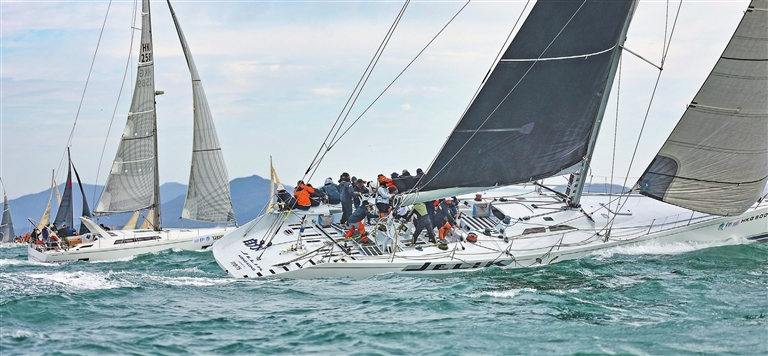
Chen Siqi vankochensq@163.com SATURDAY brought wind and clouds to Shenzhen, Hong Kong, and the waters between them, yet it proved a perfect day for sailing. Over 1,200 competitors from nearly 30 countries and regions, forming 242 teams, completed the Hong Kong-to-Shenzhen leg of the competition. They finished in waters off Daya Bay, Dapeng New Area, before clearing entry into Shenzhen to continue the subsequent two days of the China Cup International Regatta. This leg followed the round-Hong Kong Island race held Friday. The China Cup International Regatta, which began Friday, runs through today. This year marks the first time the round-Hong Kong Island race has been integrated into the event, creating a single regatta across two cities under three racing formats — an innovation that has heightened the excitement and appeal for both participants and spectators. After completing Saturday’s race, Chen Jinhao, a sailor aboard the Jelik — one of the boats in the Hong Kong-Shenzhen leg — recalled the day’s challenges. “When we first set sail, the average wind speed was around 18 knots, with gusts reaching up to 26. The wind was strong initially but died down as we neared the finish off Sanmen Island. We lost time dealing with wind shifts and calm patches, which stretched out that part of the race. Still, overall, it was incredibly enjoyable and rewarding. Racing alongside our competitors created truly memorable moments.” American sailor Audrey Fulk also shared her experience. “Today’s competition was really fun and very windy. The trickiest decision was whether to reef the mainsail. Conditions were sporty — I was trimming the mainsail, the biggest sail onboard, so my arms are pretty tired.” Fulk sailed with The Way, a team made up of sailors from the Chinese mainland, Hong Kong, and the U.S. Despite language differences, they cooperated seamlessly. Fulk remarked that all sailors share a common “sailing language.” She explained, “Though we speak Mandarin, Cantonese, and English, we all communicate through sailing. Knowing how to sail a boat is the same anywhere in the world, so we work together smoothly.” That sentiment was echoed by Spanish sailor Toni Massanet of Team Rampage 88, a crew with members from Spain, Italy, the U.K., and China that cooperated effectively. He stressed that sailing hinges on teamwork. “It has to be about teamwork. Sometimes you don’t even talk — you just know what to do to help each other. That’s what moves a team forward, not just in sailing but in any sport. You have to support one another constantly.” For Massanet, sailing’s appeal lies in its unpredictability. “When you’re on a boat, you never know what’s going to happen. That uncertainty — whether the wind will come or not — is what makes it exciting,” he said. He further reflected on the broader lessons of the sport. “Sailing teaches you a bit about how to be a person on land. You take what you learn in the sailing world — teamwork, working with people from other countries.”
| 