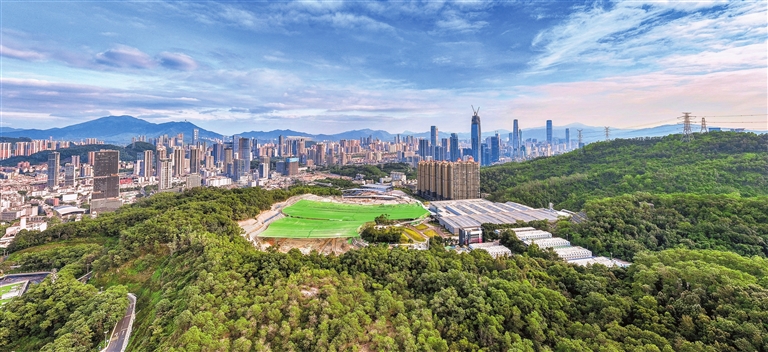
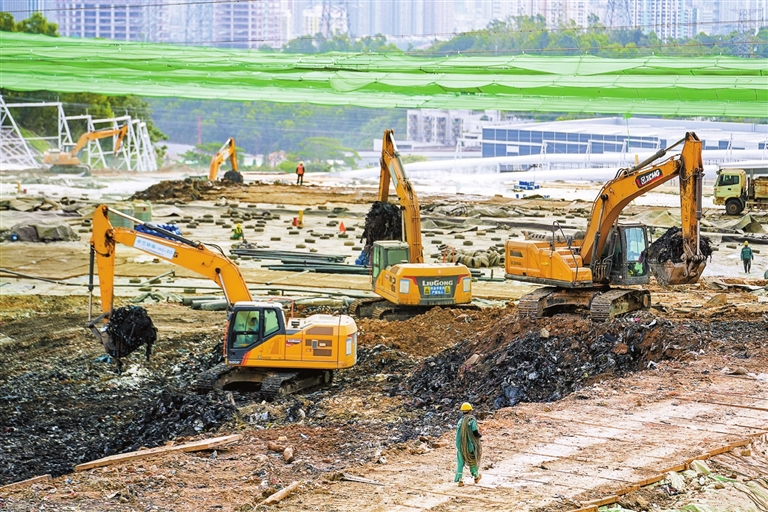
The Yulong project represents a potential paradigm shift in how megacities deal with their industrial legacies. As the excavators continue their work under the green tent, feeding the furnaces that power the city’s lights, the Yulong Landfill offers a glimpse of a cleaner, more efficient future. Sterling Platt sterlingplatt@qq.com IN the foothills of Yinhu, a lush area in Shenzhen’s Luohu District, the morning mist lifts to reveal a jarring contrast. On one side stand high-end residential towers, the symbols of China’s rapid modernization. On the other sits a structure that looks like something out of a science fiction film: a massive, emerald-green “Sky Curtain” hovers above the ground like a giant surgical drape, covering over 116,000 square meters of land. Inside this colossal tent, excavator operator Chen Jinguo sips tea and maneuvers his heavy machinery. He is not digging a foundation for a skyscraper — at least, not yet. Rather, he is digging up the past. Beneath him lies the Yulong Landfill, a site that served as the city’s primary waste repository from 1983 to 1997. It holds 2.55 million cubic meters of “legacy waste” — enough to fill 1,000 Olympic swimming pools. For twenty years, this trash silently sat under layers of soil and vegetation. But in a city where land is more precious than gold, silence is no longer enough. Shenzhen has embarked on a radical US$300 million (2.17 billion RMB) experiment — a “full excavation” project designed to physically remove the landfill. While the project is an environmental triumph, experts and officials alike admit it hinges on a single, critical prerequisite: Shenzhen’s massive Waste-to-Energy (WTE) infrastructure. Without the furnaces to digest the past, this surgery would be impossible. A time bomb and gold mine To understand why a city would spend billions of yuan to dig up trash it already buried, one must look through the eyes of Ye Bin, deputy director of the Luohu District Urban Management Bureau. For Ye, the Yulong Landfill represents a dual crisis — it is both an environmental “time bomb” and an economic “negative asset.” “The Yulong Landfill is a product of its time,” Ye explained during a recent interview. “Formed in the 1980s when the city was just starting, the filling method was extensive and rough.” Unlike modern sanitary landfills, which are lined with sophisticated geomembranes to protect the water table, Yulong was a “primitive” dump. It lacks bottom liners and effective leachate collection systems. For decades, the decomposing waste has generated a toxic soup of leachate and pockets of methane gas. While the site was capped and greened in 2005, Ye argues that this was merely a “Band-Aid” solution. “The deep-seated pollution and safety hazards have not been eradicated,” Ye said. “The risks of biogas leakage and groundwater pollution exist like a time bomb buried underground.” However, safety is only half the equation. The other driver is market-based logic. The landfill sits at a strategic choke point between the Qingshuihe and Hongling areas. It is a 30-hectare “scar” in the heart of the city, blocking infrastructure connectivity and depressing property values in the surrounding area. In Shenzhen, a metropolis of 17 million people where the supply of land is virtually exhausted, leaving such a massive parcel of land frozen as a “wasteland” is not economically feasible. “If we do not completely clean it up, it will hinder the contiguous development and efficient use of this land,” Ye noted. The decision to excavate was driven by a strategic necessity to transform this “negative asset” into a high-tech hub. The WTE key The logistical reality of digging up 2.5 million cubic meters of trash is brutal: you have to put it somewhere. If a city simply relocates waste to a new landfill 50 miles away, they have achieved nothing but moving a liability from one area to another. This project is possible only because of Shenzhen’s decade-long investment in WTE technology. By pivoting aggressively from landfilling to incineration, Shenzhen has built enough excess capacity to absorb this legacy waste, allowing the Yulong project to function not as a relocation, but as a complete cleanup. “The key is the ‘screening’ process,” explained Zhao Lichao, a project manager with Shenzhen Energy Environment. Inside the processing workshops, excavated material undergoes rigorous mechanical sorting. Trommel screens and air classifiers separate inert soil from the “light fraction”— plastics, fabrics, and wood — converting 1980s refuse into fuel. “The combustible materials are transported to the Energy Eco-Park for incineration,” Zhao said. “After full combustion at temperatures exceeding 850°C for at least two seconds, we ensure the thorough decomposition of dioxins.” The project estimates roughly 330,000 tons of this combustible waste will be sent to the city’s incinerators, generating 100 million kilowatt-hours of electricity — enough to power 26,000 households for a year. By feeding the “urban mine” into the WTE grid, Shenzhen breaks the zero-sum game of waste management. The landfill isn’t moving; it is being metabolized. Operating under the dome Digging up 40 years of rotting garbage located just 100 meters from luxury apartments presents a visceral challenge — the smell. Primitive landfills are biological reactors. Even decades later, they are filled with hydrogen sulfide and ammonia. Opening the “lid” risks releasing a cloud of stench that could trigger complaints in the densely populated neighborhood of Yinhu. To prevent the “Not in My Backyard” (NIMBY) phenomenon that plagues similar projects globally, the engineers at Yulong deployed the “Green Sky Curtain.” This 116,900-square-meter membrane structure is the largest of its kind in China. It completely encapsulates the active excavation zone, creating a physical barrier between the rotting waste and the residents’ balconies. But the tent is just the “skin.” The real work happens underneath, through what the engineers call the “respiratory system.” Before a shovel even touches the ground, the team inserts pipes into the landfill to inject oxygen. This “aerobic pre-treatment” accelerates the degradation of the remaining organic matter, stabilizing the waste and sucking out the methane before the earth is moved. “It’s like giving the landfill a new pair of lungs,” says Zhao Wenfa, a technical lead at the site. “We utilize air circulation to accelerate degradation, lowering the concentration of methane and odors.” Inside the tent, mist cannons spray plant-based deodorizers continuously. The air pressure is kept negative, ensuring that any leaking air flows into the tent, not out toward the city. The results have been validated by the most sensitive instrument available — the nose of the environmental monitor. Cheng Houbing, a young monitor at the site, points to his attire as proof of the technology’s success. “Our standards are stricter than the national average,” he says. “I can wear a white shirt here all day, and the collar won’t even get dirty.” Residents, too, have noticed the difference. Lin, a resident of the Yinhu Mid-Levels community just 600 meters away, admitted she used to keep her windows sealed shut during humid weather. “Although construction is happening now, the air is actually better,” she told local reporters. “You can see they are using a lot of equipment. The smell is under control.” From liability to ‘gold mountain’ The price tag for this technological marvel is high: approximately 2.17 billion yuan (roughly US$300 million). For most cities in the West, spending hundreds of millions to clean up a site that is already capped would be fiscally unfeasible. But Shenzhen operates with a different economic calculus. In a low-density region, a landfill is a permanent dead zone. In Shenzhen, it is a dormant asset waiting to be unlocked. The 2.17 billion yuan cleanup cost is viewed not as a sanitation expense, but as a land development cost — an entry fee to unlock billions in future value. “This is not just about fixing the environment,” says Ye Bin. “It is about the ‘re-birth’ of the land.” Once the 2.5 million cubic meters of trash are screened, burned, or treated, the 30-hectare site will be released as “clean” land. The district government has already drawn up plans for the “Yinhu Valley Digital Innovation Center.” They project that the site will attract over 15 billion yuan in fixed asset investment, housing industries focused on artificial intelligence, life sciences, and the digital economy. The calculus is simple — spend 2 billion yuan to clean it up and generate 15 billion yuan in investment, turning a “trash mountain” into a “gold mountain.” End of the ‘burying’ era The Yulong project represents a potential paradigm shift in how megacities deal with their industrial legacies. For decades, the global standard for old landfills has been “containment” — put a cap on it, stick a pipe in it, and monitor the groundwater for thirty years. Shenzhen is proving that “containment” is a relic of an era when land was cheap, energy recovery was inefficient, and environmental impacts could be ignored. “This governance goes beyond simple environmental restoration,” said Xu Qiyong, an associate dean at the School of Environment and Energy at Peking University. “It is reshaping the underlying logic of urban development. It is like performing a precise surgical operation on the city, completely removing a lesion.” As the excavators continue their work under the green tent, feeding the furnaces that power the city’s lights, the Yulong Landfill offers a glimpse of a cleaner, more efficient future. | 