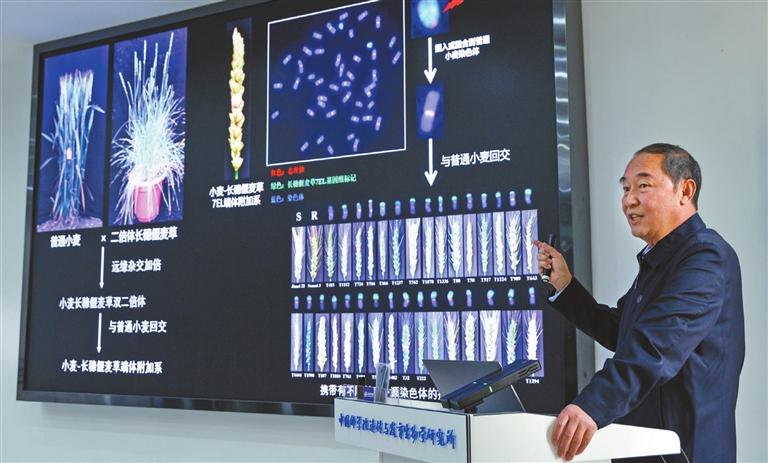
A MAJOR Chinese research program is using precision gene design to boost crop yields and resource efficiency, advancing food security and sustainable agriculture. Launched in 2019, the Chinese Academy of Sciences’ (CAS) Strategic Priority Research Program on “Precision Seed Design and Breeding” has identified key genes linked to higher yields, better quality, efficient fertilizer use, and stronger resilience. Researchers have developed 37 pilot crop and aquaculture varieties designed to increase output while reducing input costs. These have been promoted across about 965,000 hectares nationwide, said CAS academician Li Jiayang, the program’s chief scientist. In collaboration with about 30 institutions, the program focuses on staples like rice and wheat, as well as aquatic species. It targets yield increases of 10-20%, with 15-20% reductions in fertilizer and pesticide use. “We have uncovered key genes and regulatory networks for high yield, quality and resilience,” Li said. “This lets us create varieties that perform better with fewer resources.” One breakthrough identified a gene allowing rice to maintain stable yields even with 20-30% less nitrogen fertilizer. According to CAS academician Chong Kang, the TCP19 gene improves nitrogen-use efficiency, helping farmers cut costs and pollution without losing output. In wheat, researchers developed disease-resistant varieties to reduce pesticide use and secure harvests. The high-yield, scab-resistant variety Zhongke 166, for example, has been planted across nearly 100,000 hectares. A team led by Gao Caixia created a genome-editing approach that breaks the usual trade-off between disease resistance and high yield. They produced a high-yielding wheat variety resistant to powdery mildew, which in 2024 earned China’s first biosafety certificate for a genome-edited staple crop. The program has also improved aquaculture, developing silver crucian carp strains that grow faster, survive better, and use feed more efficiently. Future research will focus on effectively combining multiple traits and improving climate adaptation by overcoming technical challenges in genetic transformation and regeneration. (SD-Agencies) | 