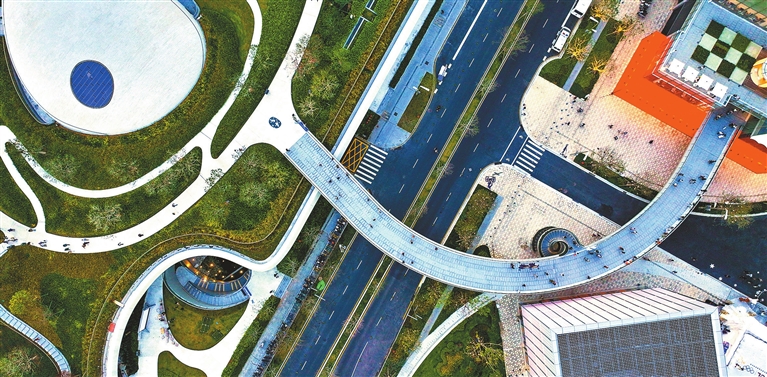
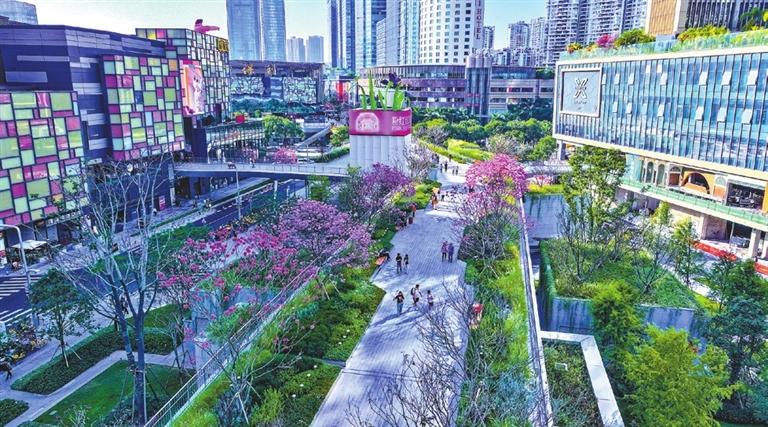
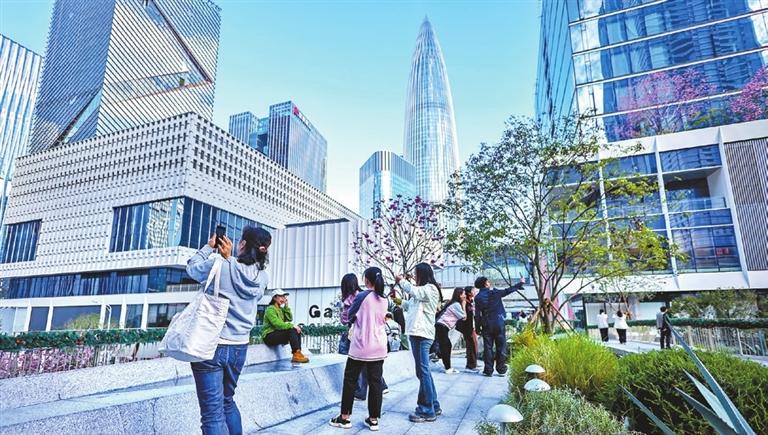
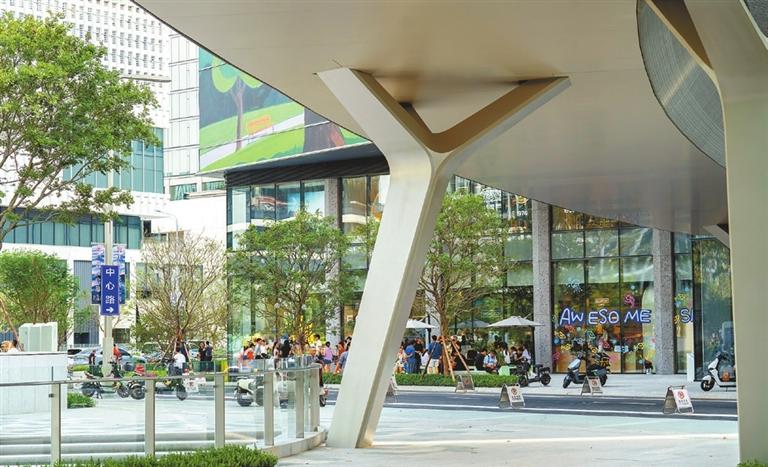
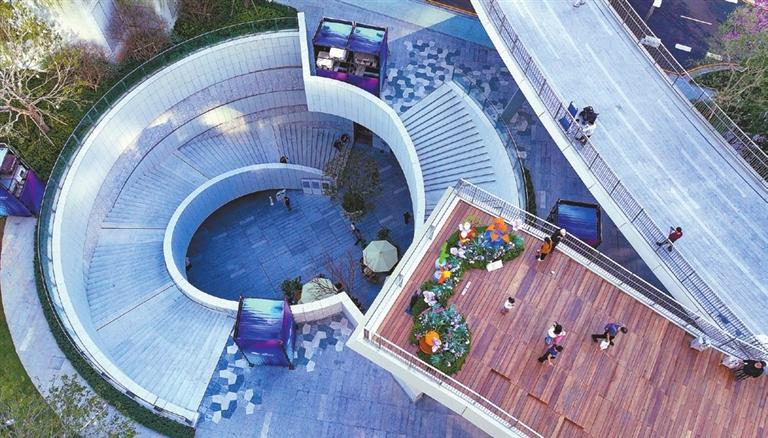
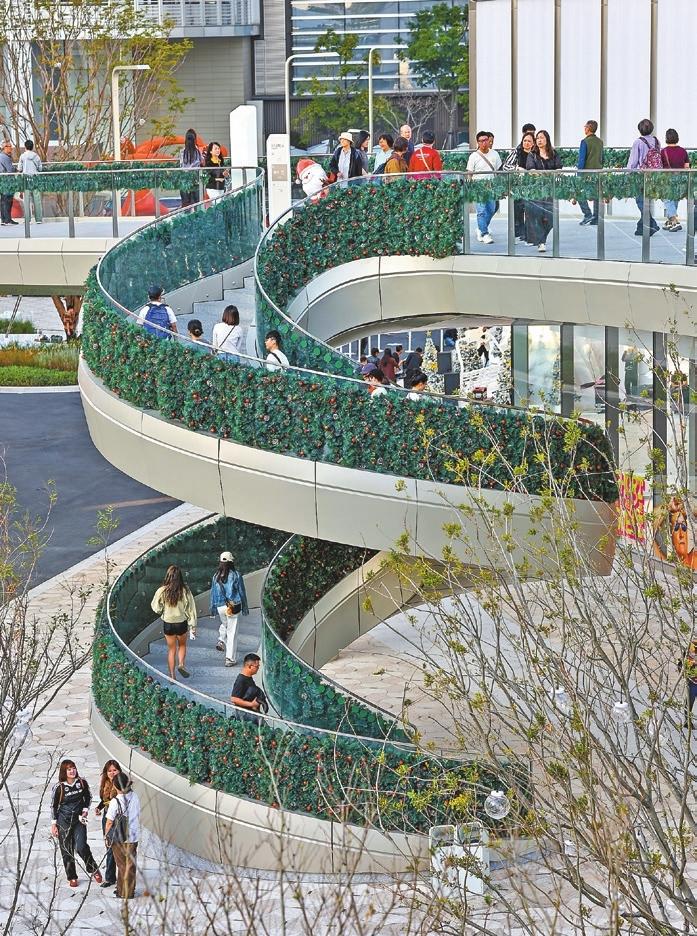
Zach Mills szdaily@126.com IN many high-density urban areas, walking can be an ordeal: waiting at crosswalk lights, watching for careless drivers, and navigating the noise and scale of the arterial roads. What looks like an easy walk on a phone map is, in practice, a journey of interruptions, sensory assault, and anxiety. Consequently, many pedestrians retreat into headphones and screens, mentally checking out of a disconnected urban environment. But this mental detachment comes at a cost, denying us the full richness of city life. Human needs extend beyond the basics of survival and sustenance; we crave a diverse array of experiences including culture, social interaction, and a connection with nature. Shenzhen’s Houhai area — the city’s financial business hub — promises to meet these desires within a compact 2-kilometer radius. The area packs a dense mix of corporate headquarters (such as Alibaba and Tencent), residential towers, and massive retail complexes like The MixC, alongside cultural anchors like the Poly Theater, the bayside Talent Park, and Shenzhen Bay Cultural Square, an exhibition space with an urban garden as its roof. However, these urban assets are disconnected by a grid of busy arterial roads — three cutting east-west and one north-south — that fracture the pedestrian experience. This friction reveals an inherent contradiction in mega-cities: the clash between logistical efficiency and human experience. Central business districts (CBDs) are efficient because businesses are concentrated in high-rises within a small area. Yet, this concentration necessitates a dense road network for vehicles to facilitate the rapid transit of people and goods. In this arrangement, walking is viewed as a utilitarian necessity. Pedestrian sidewalks, crossings, tunnels, and footbridges are designed around efficiency and costs. There is no view from which to appreciate or remember the city, and one can hardly have a conversation without worrying about blocking others. It makes walking feel like the movement of cargo. The newly completed Shenzhen Bay Avenue project aimed to change that situation by literally elevating the pedestrian experience. Stretching 2 kilometers across the Houhai CBD, the project is a network of above-street-level walkways that spans major roads, creating a continuous “second ground” and reviving the very human experiences lost at the street level. The ‘second ground’ Two lead designers of the project — Liu Xiaoqi (刘晓琦), the creative director of Integrated Planning and Design (IPD), and He Jiakun (何嘉堃), a partner at Z Design Group (ZDG) — outlined their vision for the project during a recent interview. Liu acknowledged that “in high-density areas like Houhai, where land is at a premium, public space is often relegated to an afterthought,” and “vehicles and pedestrians compete for space on the street level.” Her colleague concurred. He traced the tension to a “structural contradiction” between CBDs’ need for efficiency and the human need for public space. Both designers noted that high-density, mixed-use development brings a level of economic efficiency that is indispensable to a CBD. Nevertheless, they wanted to achieve a balance between that “efficiency narrative” and a human-centric “experience narrative.” When we only think of efficiency, He said, pedestrian infrastructure is conceived as merely “a tool for passage.” To Liu, pedestrian infrastructure should be “a vessel for public life… When people linger, meet, speak, and share a view of the city,” our social network is restored. In this way, Liu said, the walkways become “a social catalyst.” To foster the pedestrian experience, He explained, the design team methodically deployed four spatial techniques: linking, dwelling, framing, and figuring. First, the walkways link the various contexts in which human beings reside — the workplace, the retail district, the museum complex, and the ecological parks — penetrating barriers of roads and elevation differences. Second, the walkways widen to up to 40 meters at key nodes to create plazas conducive to micro-events — street performances, pop-up stalls, and casual meetups. Instead of a transient corridor, the walkways are a “public living room” that engenders a sense of belonging. Third, by deliberately widening, narrowing, turning, and folding the walkways, the designers curated memorable views of the city skyline and the bay for pedestrians. Finally, the design ensures the walkways are memorable urban sculptures; its distinct organic silhouette and expressive structural “branches” stand out against the backdrop of glass towers. Delivering the vision At first glance, the walkways appear to float effortlessly. They snake through Houhai with fluid curves, resting on columns that branch out like trees and are often tilted. It is easy to dismiss the winding path and the forked or tilted columns as mere aesthetic flourish. However, according to He, this “organic” geometry was necessary. As it turns out, creating a “second ground” is easier said than done. The project had to thread its way through a dense web of immovable street-level obstacles — garbage collection sites, bus terminals, and other utility structures — and navigate a rigid, jagged canyon of buildings and skyscrapers. However, the most critical challenge was invisible. Beneath Houhai’s streets lies a “minefield” of infrastructure, including three intersecting subway lines, vast parking structures, and dense utility networks. This subterranean congestion made finding suitable drop points for structural support columns a geometric puzzle, He explained. In several instances, the only usable column drop points were not even located directly under the walkways, requiring inclined columns. Imagine trying to hold up a tray on a single fingertip at a tilt. To hold up and balance the deck, He’s team designed columns that branch out at the deck — utilizing advanced simulations and prototyping. In other words, instead of one fingertip, He’s team had five fingertips holding up the tray. It was the team’s rigorous, rational, and original design that actualized the “second ground” vision. The designers credited the project owner, China Resources, as an indispensable, careful orchestrator of the complex project. For example, the owner and He’s team worked closely on the customized columns — from design to quality assurance. “Without the owner’s close coordination, rapid iteration and efficient decision-making — balancing multiple specialized teams, timetables, and on-the-ground constraints — it would have been unthinkable to realize the project’s vision on time,” He said. A prototype for future urbanism As Shenzhen evolves from a manufacturing hub to a global innovation and financial capital, the Shenzhen Bay Avenue project stands as a physical manifestation of its new urban philosophy. Challenging the “vertical city” narrative that dominated the early 21st century, it suggests that the future of the metropolis is not just about how high we can build, but the sophistication of the connections between the buildings. “We are moving past the era of efficiency-at-all-costs and entering an era in which infrastructure must also be a place of comfort, beauty, and connection,” the design team observed. By harmonizing the demands of high-density urban transit with the human need for slow, quality space, the Shenzhen Bay Avenue project offers a reference case for megacities worldwide. It proves that even in the busiest areas, the city can be healed, the flow can be seamless, and the physical barriers can finally be removed. | 