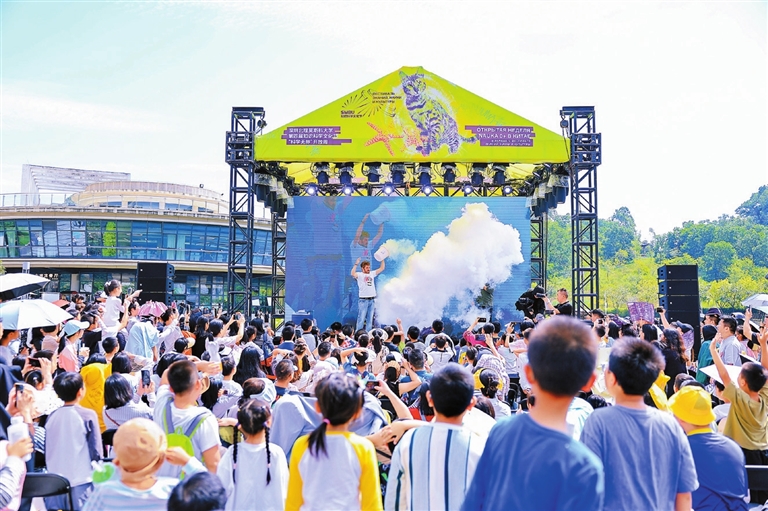
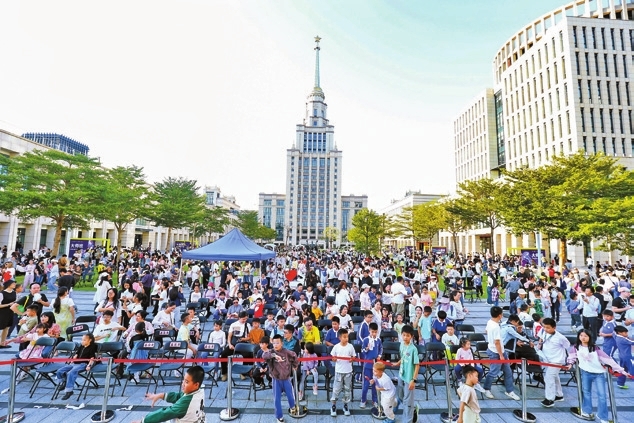
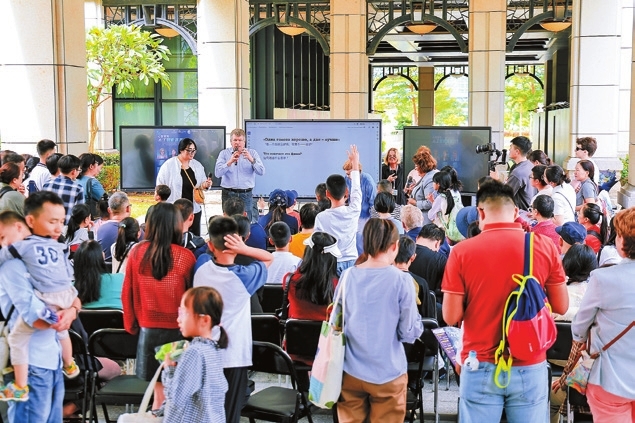
SHENZHEN MSU-BIT University (SMBU) held its fourth Science and Culture Festival from Sept. 13 to Oct. 26, featuring over 200 events that drew more than 200,000 participants. Themed “Your Quantum Universe,” the festival included academic discussions, cultural exchanges, and popular science initiatives involving students, faculty, and the general public. At the opening ceremony, SMBU President Li Hezhang noted that the festival — co-curated by Lomonosov Moscow State University (MSU) and the Beijing Institute of Technology (BIT) since 2022 — serves as an open educational platform. It deepens China-Russia exchanges in education, science, technology, and culture while broadening students’ horizons, fostering friendship, and inspiring innovation. A highlight of the festival was Open Week, which hosted over 100 popular science events between Oct. 20-26. The last two days were accessible to the public. Russian Deputy Prime Minister Dmitry Chernyshenko delivered a video address to mark the launch of Open Week. Titled “Science Without Borders,” the event serves as a prelude to the China-Russia Year of Education 2026-2027, a joint initiative proposed by Russian President Vladimir Putin and Chinese President Xi Jinping. The minister explained that during Open Week, the public could attend lectures by leading scholars and join hands-on workshops, masterclasses, and various creative activities. In his video message, MSU President Viktor Sadovnichy described Open Week as a gift to all who believe “scientific and cultural progress is the foundation and goal of international cooperation.” He outlined the week’s academic agenda, including forums and roundtables on cutting-edge scientific topics, noting these discussions would showcase the interdisciplinary evolution of modern science and its close links to daily life. During Open Week, academicians and top scientists from China and Russia gave lectures spanning quantum science, space exploration, life sciences, and sponge cities. Andrey Naumov, corresponding member of the Russian Academy of Sciences, delivered a lecture on quantum and photonic technologies. Starting with everyday applications of quantum technology, he guided the audience through its development history and highlighted its potential to revolutionize future life. Pan Gaofeng, deputy director of China’s FAST Operation and Development Center, gave a lecture titled “Listening to the Pulse of the Universe.” He shared the arduous construction process of, and the landmark achievements brought by, the Five-hundred-meter Aperture Spherical Radio Telescope (FAST). Located in Guizhou Province and open to global astronomers since early 2021, FAST is the world’s largest filled-aperture radio telescope. Abstract scientific theories came to life as interactive games in on-campus experience zones, allowing the public to explore science through hands-on activities. A gasp swept the crowd when a science show host poured hot water into liquid nitrogen, creating a billowing cloud of white mist. At the central campus plaza, curious onlookers stopped to experiment with non-Newtonian fluid, a substance that changes thickness or flow resistance when you stir, squeeze, or hit it. In the Chemistry Kitchen zone, visitors conducted their own experiments to observe the magic of color-changing solutions. Elsewhere, children cheered as they shook hands with agile robotic dogs. “This is more fun than an amusement park,” one parent commented. On the evening of Oct. 25, Russian cosmonauts Oleg Novitsky and Marina Vasilevskaya, clad in their signature blue spacesuits, took the main stage by the lake, triggering an immediate wave of enthusiastic applause and cheers. Audiences raised their hands to ask questions like “What does space feel like?” “How do you sleep in space?” and “What does it take to become a cosmonaut?” The cosmonauts responded with candid, humorous answers and later signed autographs for a long line of attendees after the sharing session. In 2024, SMBU hosted festival events at the Longgang Children’s Park and MixC Universiade World. Building on last year’s outreach efforts, this year’s festival expanded to additional venues including the Shenzhen Science and Technology Museum in Guangming District and Gankeng Hakka Town in Longgang District. Designed as a science gala for all, SMBU’s Science and Culture Festival has planted seeds of curiosity for scientific exploration in the public — especially in children. | 