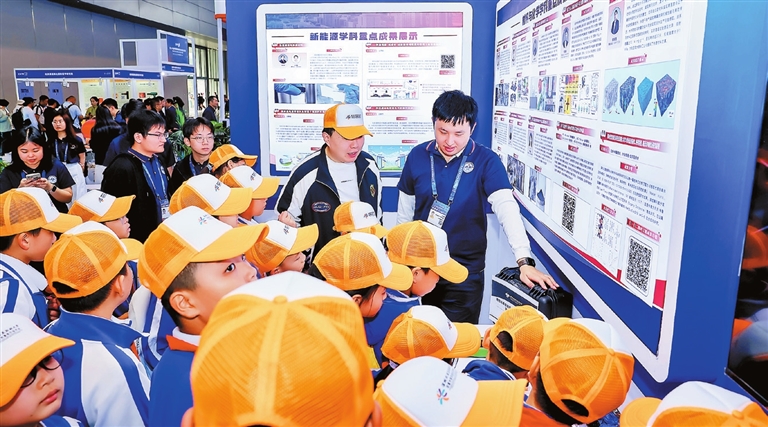
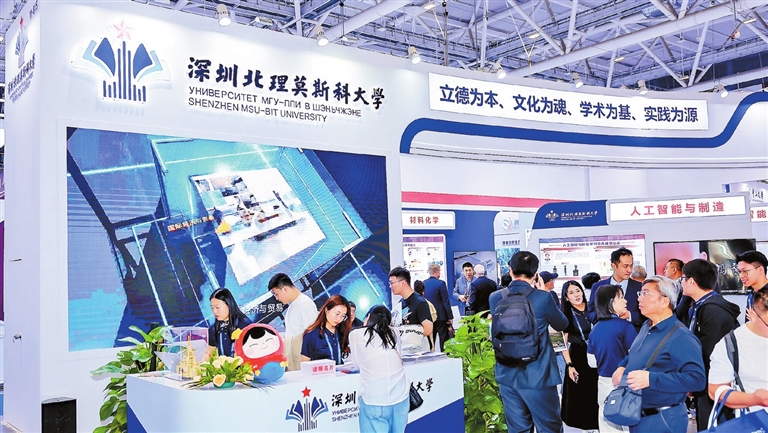
ON Nov. 14, the opening day of the 27th China Hi-Tech Fair (CHTF), Shenzhen MSU-BIT University (SMBU) staged a high-visibility pavilion under the theme of “Sino-Russian Cooperation, Cross-disciplinary Innovation,” exhibiting 50 technological innovation projects developed in collaboration with Russian partners at the Shenzhen World Exhibition and Convention Center in Bao’an District. The sci-tech showcase drew heavy domestic and international visitor traffic and frequent media attention. Showcasing cross-border innovation The displayed innovations spanned materials and chemistry, artificial intelligence (AI) and advanced manufacturing, the digital economy, and new energy and biotechnology, highlighting the Longgang-based university’s strength in interdisciplinary research and global cooperation. Interactive demonstrations and technical briefings at the university’s booth became one of the fair’s highlights as professionals and the public engaged directly with researchers. Several projects on exhibit emerged as focal points. The Engineering Department’s “human-face robot,” praised for its highly lifelike interactive experience, became a crowd favorite. The Institute of Artificial Intelligence demonstrated two application-oriented systems — a soft-shaft-driven surgical robot and an integrated wireless body-area network that combines sensing and energy transfer — illustrating AI’s front-line uses in medical care and wearable devices. The Faculty of Economics’ Digital Innovation Laboratory showcased an interdisciplinary platform that fuses multi-modal brain-science data with financial models to help enterprises design and simulate complex digital-asset trading and investment strategies. Cutting-edge manufacturing and materials results also attracted industry attention. The Institute of Advanced Interdisciplinary Technology presented the Benchtop AFP 3D Printer, a desktop carbon-fiber ply-placement additive manufacturing system that merges agent-based algorithms with engineering advances to enable high-end, lightweight composite production. A Materials Science team unveiled a novel powder-mixing method for preparing oxide solid electrolytes, opening new directions for lithium battery testing and high-performance cell development. Innovations, such as a three-dimensional hierarchical porous adsorbent addressing seawater uranium extraction challenges, were shown alongside other multidisciplinary breakthroughs. In a separate development, nine projects developed by Shenzhen MSU-BIT University were honored at the CHTF “Outstanding Scientific Research Achievement Innovation Award” ceremony held in Hall 13 on the afternoon of Nov. 14. The winning projects included a human-face robot, a low-altitude drone anti-electromagnetic-interference functional material and engineering technology, and the Benchtop AFP 3D Printer. By showcasing 50 Sino-Russian collaborative innovation projects at the CHTF and earning multiple innovation awards, Shenzhen MSU-BIT University underscored its growing role in cross-border scientific cooperation and the practical application of advanced research. Forging pathways from lab to market In the presence of Chinese and foreign officials and guests, SMBU signed 15 cooperation agreements at a major industry-academia-research-use signing ceremony on the sidelines of the CHTF on Nov. 14. The ceremony also hosted the 2025 “Belt and Road” International Industry-Academia-Rearch-Use Cooperation Conference, at which the university formally launched a series of collaborative platforms that marked a new phase in its coordinated development of research, production, and education. These platforms included the initiation of two national-level and three provincial-level key laboratory/base projects. On-site signings of the 15 cooperation agreements comprised one university–local government cooperation agreement, two joint university–enterprise laboratories, seven enterprise R&D commission agreements, and additional partnerships. The agreements were intended to accelerate technology transfer, support national strategic priorities, and deepen international research collaboration — particularly within the Sino-Russian framework that underpins SMBU’s international drive. A materials-focused session of the 2025 “Belt and Road” conference, organized by SMBU’s Faculty of Materials Science under the guidance of the Chinese Ministry of Education, convened the same afternoon. Six leading scholars from top domestic and international institutions delivered keynote reports and engaged in discussion with an audience of more than 100 participants. Presenters represented the Institute of Silicate Research, Chinese Academy of Sciences, Inner Mongolia University of Technology, AECC Hunan Power Machinery Research Institute, Shenzhen University, The Hong Kong Polytechnic University, and Loughborough University of the U.K. Keynote topics covered frontier areas of materials science and engineering, including solid-state battery materials, low-altitude advanced technologies, advanced aerospace engine materials, black-scale biomaterials, intelligent soft manufacturing, and fuel cell technologies. The session combined high-level technical presentations with active audience exchanges, underscoring the conference’s emphasis on translating research into practical applications. The year 2025 marked SMBU’s second participation in the CHTF with a coordinated program of parallel activities. Leveraging its Sino-Russian cooperative and internationalized education model, the university assembled showcases and agreements that demonstrated its capabilities in basic research, technology development, and the commercialization of scientific results. SMBU said these initiatives aimed to support regional economic transformation, advance global scientific collaboration, and contribute practical outcomes to Belt and Road construction through strengthened industry-academia-research linkages. | 