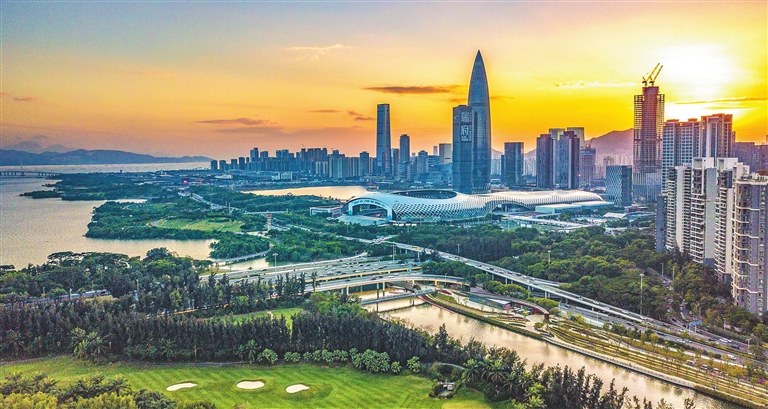

FOR years, the relationship between European startups and Shenzhen has been described with a reassuring yet ultimately limiting word — cooperation. Delegations, exploratory missions, pilot projects, soft landings. All useful, but rarely decisive. That model belonged to a different phase of globalization, when innovation could be fragmented and value chains neatly separated. Today, in a world defined by speed, scale, and strategic uncertainty, cooperation is no longer enough. The real step change is co-creation. Shenzhen is no longer simply an advanced manufacturing hub. It has become a city where innovation happens end to end: Research meets engineering, hardware converges with software, capital moves fast, and public policy actively supports experimentation. This is not accidental. It is the result of a deliberate choice to treat the city as a living innovation system — one that learns, adapts, and scales. Europe, for its part, brings equally critical assets: deep industrial expertise, world-class research, trusted standards in sustainability and safety, and access to one of the world’s most demanding markets. The real opportunity lies not in exchanging these strengths sequentially, but in combining them from the very beginning. It is in this context that Nanshan District emerges as the ideal starting point for European startups in Shenzhen. Nanshan is not merely a successful technology district; it is the strategic core of Shenzhen’s innovation economy. Global technology leaders, fast-growing startups, top universities, venture capital, and accelerators coexist here within a compact and highly interconnected urban environment. For a European founder, this means immediate access to industrial partners, supply chains, investors, and decision-makers — dramatically reducing the critical time, capital, and execution risks of international expansion. What truly sets Nanshan apart, however, is not only the density of its ecosystem, but the modernity of its leadership. The district’s governance reflects a sophisticated understanding of how contemporary innovation works. Rather than attempting to control it, local institutions focus on enabling it. They act as ecosystem architects, creating the conditions for startups, large companies, universities, and investors to collaborate in a fluid, fast, and results-oriented way. The approach is pragmatic, open, and deeply international. Policies are designed to reduce friction, accelerate decision-making, and support innovation throughout its entire lifecycle — from early experimentation to global scaling. For European startups, this institutional modernity is a strategic asset as important as access to capital or advanced manufacturing. It means operating in an environment where the public sector speaks the language of entrepreneurship, technology, and risk and public–private collaboration is the norm rather than the exception. At a time marked by geopolitical uncertainty and regulatory fragmentation, Nanshan offers something increasingly rare: predictability, vision, and operational trust. Co-creation fundamentally changes the rules of engagement. It replaces parallel efforts with joint teams, isolated pilots with shared roadmaps, and simple market presence with genuine dual-market design. Products are conceived from day one for both China and Europe, rather than adapted later at high cost. Shenzhen’s ability to compress iteration cycles combines with Europe’s strength in systems engineering, regulatory compliance, and long-term reliability. Speed is no longer achieved by cutting corners, and scale does not come at the expense of trust. The resulting business opportunities are tangible. In deep tech, European startups working in robotics, sensors, photonics, and industrial AI can combine scientific depth with Shenzhen’s unparalleled hardware ecosystem to move from lab to factory at a pace that is difficult to replicate elsewhere. In green technologies, Europe’s leadership in climate solutions and energy efficiency naturally complements Shenzhen’s capacity to industrialize and deploy clean technologies at scale. In smart mobility and urban innovation, autonomous systems, EV components, and intelligent logistics can be co-developed, tested in real, dense urban environments, and then deployed across European cities. In healthtech and medtech, co-creation enables the development of certification-ready devices and AI-powered diagnostics that merge European clinical rigor with Shenzhen’s digital and manufacturing capabilities. In this landscape, the role of bridge-builders between Europe and China becomes essential. ChinaEU intends to actively support the co-creation model between European startups and startups based in Nanshan, moving well beyond the facilitation of contacts or occasional projects. The objective is to foster joint teams, companies built together, and growth strategies designed from the outset on a global scale. Supporting co-creation means accompanying startups throughout the entire journey — from partner selection and balanced governance models to access to industrial, financial, and institutional ecosystems on both sides. In an era of fragmented value chains and intensifying technological competition, co-creation is not an idealistic vision. It is industrial realism. For European startups, it offers global relevance in a world where staying local increasingly means staying small. For Shenzhen, it reinforces its role as a global innovation partner rather than a mere execution hub. And for Nanshan, it confirms its position as a place where international innovation is not just attracted, but truly built. The future of Europe–Shenzhen relations will not be measured by the number of cooperation agreements signed, but by the number of companies that are co-designed, co-funded, and co-scaled from day one. For European startups ready to make that leap, the starting point is clear. The future does not begin with cooperation. It begins with co-creation, and it begins in Nanshan. | 