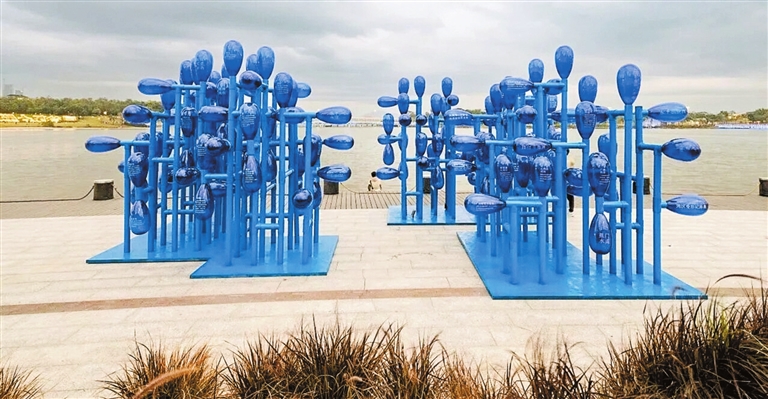
Zhang Yu JeniZhang13@163.com THE 10th Bi-City Biennale of Urbanism\Architecture (Shenzhen) opened Friday, transforming Shenzhen into a global stage for exploring the future of cities. The exhibition, known as UABB, is themed “City Theater” this year, featuring 489 works by more than 800 contributors from 21 countries and regions. It highlights the convergence of technology, art, and public life. With the main venue at Shenzhen Talent Park and a parallel venue at Hetao Science and Technology Innovation Center, the event will run through March. Nine additional satellite sites are active across six districts in the city. The biennale, first held in 2005, is the world’s first international exhibition dedicated solely to the theme of city and urbanization. This year’s UABB is curated by architect Zhu Tao, artist Shen Shaomin, and scientist Ding Ning. The “City Theater” concept frames the metropolis as a shared arena where artificial intelligence (AI) and digital tools are breaking down traditional social and professional barriers, fostering a new form of collective experience. According to the curators, “City Theater” is not merely about theatrical tension. It allows the exhibition to unfold as a fluid, “unfinished” dynamic process, remaining open to diverse possibilities and the future. At the main venue, a special section titled “Ten Acts, Ten Realms” revisits the themes of all 10 biennales through installations, creating an interactive journey through a decade of urban discourse. The parallel venue in Hetao focuses on speculative futures, with sections like “Robot Theater,” which examines human-machine coexistence, and “Off-World Theater,” an immersive mixed-reality experience simulating a Martian landscape. In addition, the Hetao venue has set up four special pavilions — the UABB Pavilion, Hong Kong Pavilion, the Netherlands Pavilion, and Hetao Pavilion. | 