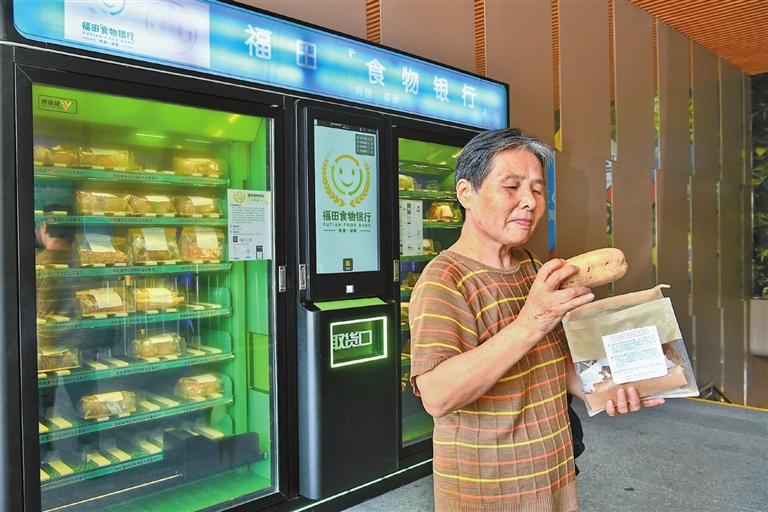
WHEN evening falls in a residential block in Futian District, a phone tends to prove very useful if you are hungry. A green metal cabinet on a sidewalk can be seen glowing in the fading dusk light. Via a scan of a QR code, its doors slide open and reveal neatly packed food such as vegetables, fruit and bread — free for the taking. No cashier, no counter and no conversation is required in this process. This locker is not a convenience store, nor is it a soup kitchen. Instead, it is one of Shenzhen’s food bank terminals, part of an expanding welfare effort which redirects surplus but safe-to-eat food to people who need it, while also reducing waste in one of China’s most affluent cities. Since its launch in May 2022, this program has installed 22 smart lockers across Futian, with these lockers operating around the clock. More than 400 meals are distributed each day in this manner, with roughly half a million people having benefited over the past three years. The system is based on a simple but deliberate structure. Access during the day is reserved for those deemed most vulnerable: low-income families, people with disabilities, elderly residents, disadvantaged children, and sanitation workers. Once verified by neighborhood authorities, eligible users can reserve one free meal per day and collect it within a three-hour window. After 8 p.m., any unclaimed food becomes available to the general public. Behind these cabinet doors is a rigorously managed supply chain. Most donations come from nearby supermarkets that have passed safety and quality assessments. Only low-risk items such as vegetables, fruit, and bread are accepted. Perishable foods and common allergens, including meat and soy products, are excluded. Before reaching the lockers, the food is sorted again, checked for safety, and repackaged under hygienic conditions. Temperatures in the lockers are kept below 10 degrees Celsius, preserving freshness throughout the day. Every step is subject to regular oversight. To date, 87 firms have joined the network, including retailers such as Freshippo and Yonghui Superstores, as well as imported-goods supermarkets like Olé. For some people, the lockers provide immediate relief. A man surnamed Hu, who is currently unemployed, said he learned about the program through a short video online. Being able to count on one free meal a day, he said, has helped him get through a difficult period. “The entire process is online and contactless,” said Sun Yue, the program’s operations manager. “It protects privacy and reduces the psychological burden that often comes with traditional forms of assistance.” Futian also introduced the “Futian M Meal” program, with the letter “M” drawn from the Chinese pinyin initials for mei (tasty) and mian (free), offering meals that are both appealing and free of charge to unemployed graduates, newly arrived jobseekers, and others facing temporary hardship. The world’s first food bank was founded in 1967 in Arizona in the U.S. Since then, the model has spread widely, taking root across the U.S., Europe, and Japan. China’s first food bank opened in Shanghai’s Pudong District in 2014 under the name Green Food Bank. Scholars say Futian’s approach offers a model for densely populated cities seeking more refined forms of social governance. “The food bank responds to a global challenge in an innovative way,” said Xie Hai, executive director of the Department of Industrial Economy of China Development Institute. “More importantly, it helps cultivate a culture of thrift, environmental awareness and mutual support.” (Xinhua) | 