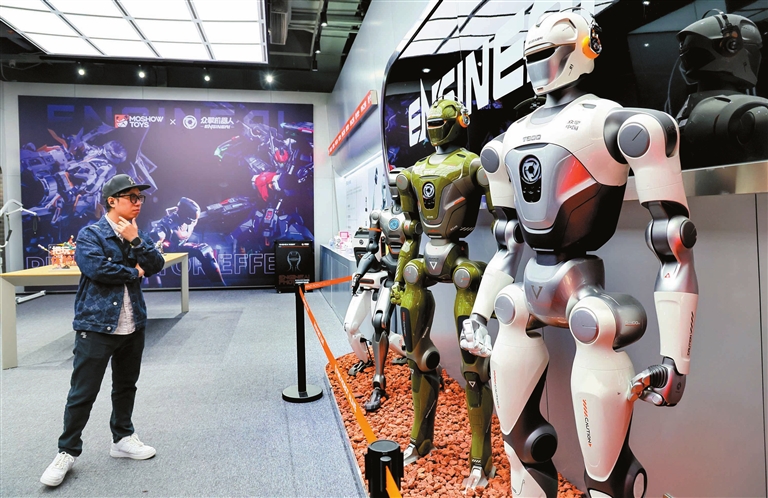
THE world’s first free humanoid robot combat league has officially launched in Shenzhen, the event organizer — local robotics company EngineAI — announced earlier this week. Named the Ultimate Robot Knockout Legend (UKRL), the league will feature participants deploying EngineAI’s T800 robots, provided free of charge. According to the company, the league aims to refine core capabilities — including motion control, balance algorithms, perception and decision-making, power systems, and structural durability — through real-world competition. The winning team will be awarded a gold championship belt valued at US$1.44 million. EngineAI founder and CEO Zhao Tongyang stated that the competition will run through December. Open to universities, enterprises, and research institutions worldwide, the league will select 16 teams to advance to the main tournament. EngineAI released the T800 humanoid robot in early December last year, accompanied by a video showcasing the robot performing flawless combat moves, which earned widespread praise online. According to the company’s website, the robot can execute martial arts maneuvers such as side kicks and a 360-degree aerial rotation. The T800 features aviation-grade aluminum panels and a streamlined exterior, offering durable, lightweight performance. It is equipped with an active cooling system between its leg joints, enabling continuous high-intensity operation for up to four hours, powered by a solid-state lithium battery architecture. The robot also integrates a multi-modal sensing system that combines 360-degree LiDAR, stereo cameras, and ultra-fast environmental processing to ensure real-time situational awareness and obstacle avoidance. For robotics companies, combat serves as an extreme testing ground. It demands peak strength, speed, and reaction time. Robots must exhibit explosive power, high motor torque, and rapid response during attacks and evasive maneuvers, as well as quick recovery after heavy impacts or falls — all of which validate motion control algorithms and structural robustness throughout the match. In particular, the event will monitor key metrics such as motion control, dynamic balance, and impact resistance. Critical components — including reducers, lead screws, and dexterous hand tendons — will be thoroughly tested. Beijing-based analyst Pan Helin said such competitions help raise public awareness of humanoid robots and broaden their potential applications. According to him, real-world deployment is a key step in overcoming the practical and technological bottlenecks that humanoid robots currently face. Tian Feng, former dean of SenseTime’s Intelligence Industry Research Institute, noted that combat testing in real-world environments can reduce technology development cycles by over 30%, while accelerating the validation of lab-based simulation results against real-world performance. (Li Jing) | 