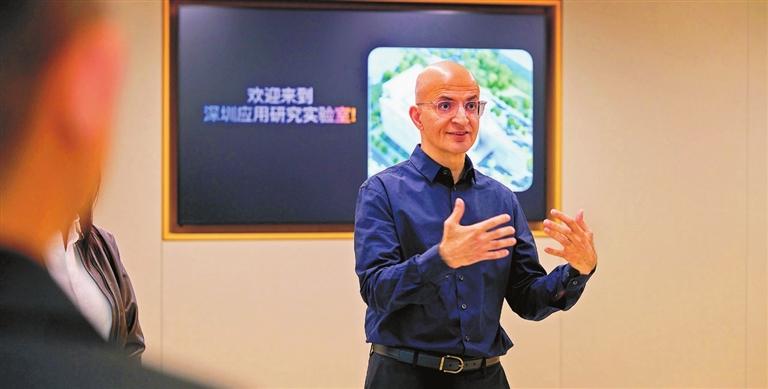
U.S. tech giant Apple’s applied research lab in the Shenzhen Park of the Hetao Shenzhen-Hong Kong Science and Technology Innovation Cooperation Zone opened to journalists for the first time Tuesday. Sabih Khan, Apple’s chief operating officer, and Isabel Ge Mahe, vice president and managing director of Greater China, briefed journalists on operations of the facility, which officially commenced operations last October. “Engineers here are graduates of world-class universities, many with doctoral degrees,” Ge said. Collaborating with global peers, they use advanced lab equipment to create exceptional products for consumers in China and around the world. Among the lab’s many precision tools, the laser Doppler vibrometer (LDV) system is a standout. It can detect micron-level vibrations on product surfaces — essentially allowing engineers to “see” sound. The LDV fires a laser at an object; vibrations alter the reflected light, and the system translates that data into precise vibration maps. Housed in a custom anechoic chamber to eliminate background noise, it captures even the faintest movements. When developing the MacBook Air, for example, engineers use the LDV to quickly trace unexpected noises to their exact source. This non-invasive capability helps Apple identify hidden defects early, ensuring issues are resolved long before a product reaches consumers. Apple has deep roots in Shenzhen. It was here that the company produced the first iMac G3 in 1998, and here, nearly a decade later, that the revolutionary first-generation iPhone was born — a device that changed the mobile phone industry forever. “Our initial supply chain was established in Shenzhen,” said Khan. “Shenzhen means a lot to both me and Apple.” Ge highlighted the strategic advantage of the lab’s location within Hetao park: “The biggest benefit is speed. When an anomaly emerges during product development, our team can quickly retrieve samples, bring them to the lab for analysis, and feed solutions back to the production line. This responsiveness is critical in global supply chain management.” This efficiency is driven by deep supply chain integration. Apple currently works with nearly 200 key suppliers in Guangdong Province, many of which host joint labs with the company. “We help our suppliers strengthen their R&D teams’ problem-solving capabilities,” said Khan. Through these collaborations, Apple embeds its own R&D expertise into the local supply chain, accelerating innovation and speeding the commercialization of next-generation technologies. Apple is not alone in choosing Hetao. The zone has attracted a constellation of high-profile names, including the Greater Bay Area International Clinical Trial Collaboration Platform, the Greater Bay Area Quantum Science Center, Starbucks’ innovation center, and STMicroelectronics’ global assembly and testing center. The Hetao Shenzhen Park now houses 52 advanced research institutions and corporate R&D centers, as well as six international industry and standard organizations, according to official data. (Debra Li) | 