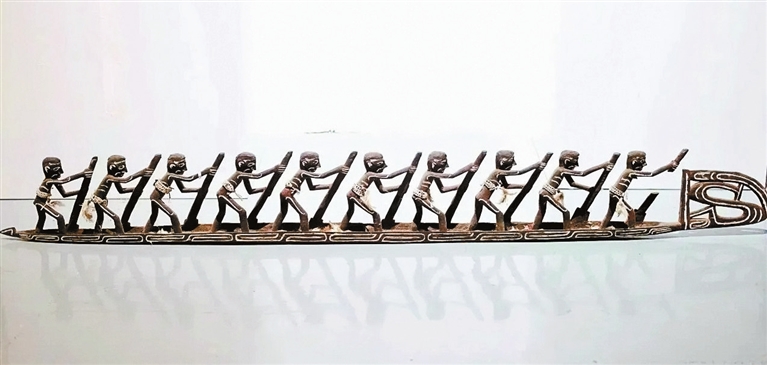
THE lands surrounded by vast oceans contain some of humanity’s oldest artistic expressions. Now, the OCT Contemporary Art Terminal (OCAT) is inviting audiences to experience the primordial charm of Oceanic art firsthand. “Life Poetics: The Primal Vitality of Oceanic Art” has opened at OCAT Hall A, presenting for the first time a collection of precious artifacts amassed by Yuan Jixin over nearly two decades of exploration throughout Oceania. As the world’s smallest continent, Oceania and its cultural traditions have exerted a profound influence on the development of modern art. The exhibition spans a rich array of indigenous artifacts including canoes, ancestor figures, totem poles, masks, musical instruments, ladders and ornaments. These pieces carry the history and civilization of Oceania’s island peoples, such as Austronesian-speaking communities, inviting viewers to look back at humanity’s ancient past while contemplating essential questions about vitality and what constitutes civilization. The global fascination with Oceania began with Western imaginings of a “southern continent.” While 18th-century explorer Captain James Cook’s three voyages unveiled Oceania’s mysteries to Europeans, the region’s first islanders likely migrated to these ocean-ringed lands tens of thousands of years ago. Who were they? Why did they cross the seas? How did they arrive? What did they create? These unanswered questions have fueled centuries of human exploration and pursuit of knowledge. “Life Poetics” seeks through the imagery of Oceanic art to explore humanity’s primal vitality. This life force manifests in how indigenous peoples connected with the stars and seas, and how their artistic expressions conveyed their understanding of the ocean, the world and humanity. The exhibition runs alongside a parallel project, Oceanic Art Market, in which young artist Wu Haoting creates an installation based on Yuan’s collection and fieldwork materials. Inspired by Aby Warburg’s “Mnemosyne Atlas,” the work uses two display tables as fluid interfaces to reconstruct the stories behind the objects and reconnect the present with the past through an imaginative narrative of Oceanic culture. Dates: Until June 27 Venue: OCAT, South Area, OCT-LOFT, Nanshan District (华侨城当代艺术中心) Metro: Line 1 to OCT East Station (侨城东站), Exit A(Tang Li) | 