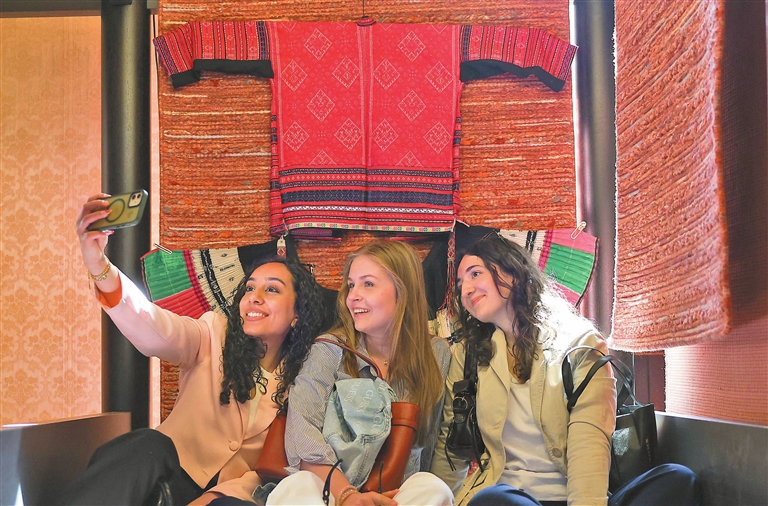
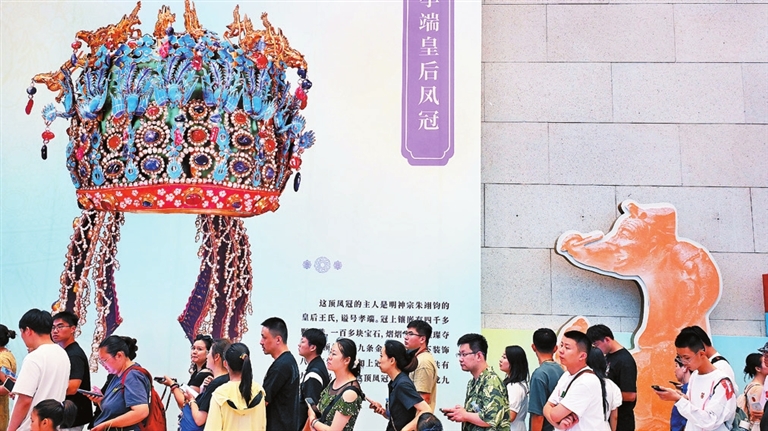
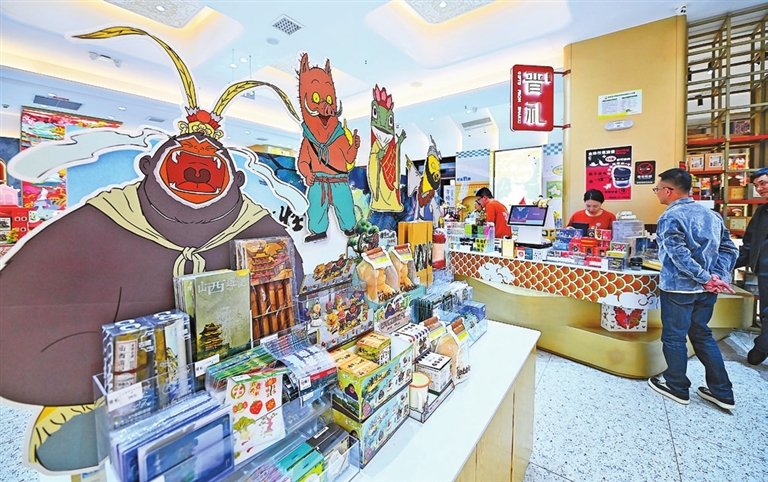
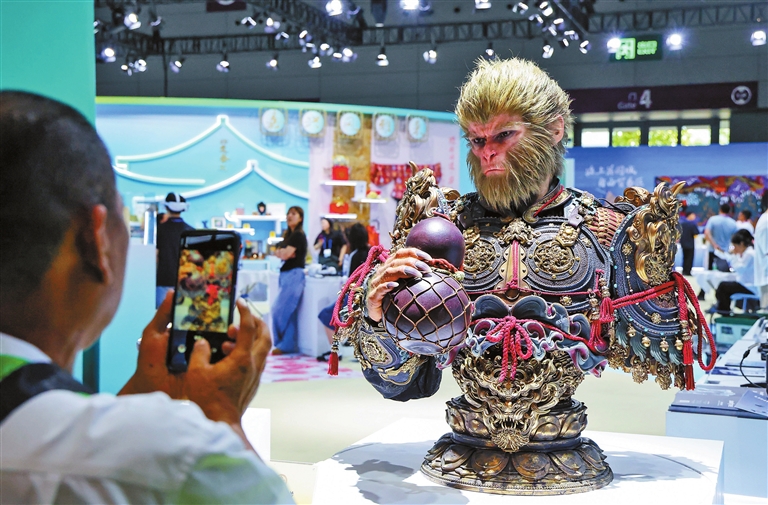
AT Milan Design Week last week, Chinese designers wowed international audiences by turning intangible cultural heritage into contemporary carpets and wrapping buildings in painted scrolls that connected Chinese and Italian histories. Nearly 6,000 miles away, in a cosmetics section of a department store in Lanzhou,, northwestern China's Gansu Province, Wang Xiaoxia, a resident of Zhangye City, bypasses the gleaming counters of international prestige brands. Her destination is Maogeping, a Chinese makeup brand renowned for its “Eastern aesthetics.” While in Beijing, white-collar professional Dew Zhang observes that passing by the Lao Pu Gold store in Wangfujing invariably means navigating a snaking queue, drawn by the brand’s handcrafted gold jewelry featuring traditional Chinese motifs. “People say they love its craftsmanship,” she said. A decade ago, such scenes would have been hard to imagine. Today, a subtle but profound shift is underway. A new generation of consumers and the creative industries that serve them are quietly rewriting the rules of cultural engagement, turning inward for inspiration while going outward with unprecedented ambition. Chinese design goes West During Milan Design Week, Chinese designs made frequent appearances across the city. At Palazzo Litta, traditional Hong Yao weaving techniques were reimagined in contemporary carpets. In the city's historic Chinatown, a 100-meter painted scroll titled “Bridge of Civilizations” told the story of Matteo Ricci, the 17th-century missionary who linked East and West. “Chinese design today is not just about products — it's about ideas, creativity, and a sense of cultural continuity,” Stefan Antoni, founder of South African architecture firm SAOTA, said at the event. Antoni said that China has become “a very exciting country to follow.” Unlike past years when Chinese participation was limited to standalone booths at the design week, this year's presence reflected a shift toward integrated spatial solutions, material innovation, and cross-sector collaboration — a sign that China's cultural confidence has matured from spectacle to substance. Another visible symbol of Chinese culture's renaissance is cinematic. “Nobody,” a 2D animated film about four lowly monsters clumsily impersonating the legendary heroes of “Journey to the West,” became China’s highest-grossing 2D animation by focusing on the mundane struggle for dignity. “I want to live the way I like,” declares its pig monster, a line that resonated with millions. This “grassroots mirror,” as moviegoers call it, reflects a cultural confidence secure enough to deconstruct its own myths and find heroism in everyday life. This impulse may find its purest form in the “New Popular Literature and Art,” a wave of amateur creativity where delivery drivers, cleaners, veterans and others from all walks of life turn lived experience into art, whether through poetry, prose or performance, finding their voice and audience on digital platforms. Wang Jibing, a “delivery rider-poet,” recounted in a December People’s Daily article that one of his poems, born from observing a tired shop owner and her child, was later translated and published in Italy. “We have caught the golden age of New Popular Literature and Art,” he wrote. His experience captures a broader truth: this is a bottom-up democratization of storytelling, where cultural confidence is built from authentic, individual experience. Alchemy of objects and ecosystems This cultural sentiment is also materializing into a formidable commercial ecosystem. The “China-chic” or Guochao is no longer a niche aesthetic but a sophisticated engine of consumption. The proof is in objects that bridge centuries: a refrigerator magnet replicating the Ming Dynasty Empress’s phoenix crown has sold over 2.28 million units in just over a year. That same alchemy is now scaling across industries, transforming cultural heritage into contemporary chic. It has given rise to a cohort of Chinese affordable luxury brands in perfume, makeup, accessories and jewelry that are captivating local consumers and, as industry observers note, beginning to challenge Western luxury incumbents. This sentiment is echoed by consumers like Wang Xiaoxia, who argued, “The development of domestic brands should aim for high quality and high value. Otherwise, we can never compete with first-tier brands.” Simultaneously, entirely new cultural symbols are being born and going global. Labubu, the snaggle-toothed, wide-eyed figurine created by Hong Kong artist Kasing Lung and marketed by Chinese mainland pop culture giant Pop Mart, has become a global Gen Z obsession. Its potential film adaptation by Sony Pictures signifies a reversal: a Chinese-originated IP feeding the Hollywood content machine. Beyond products: systemic exports This cultural confidence is expressed on the global stage. China is moving beyond exporting singular products to deploying what Shi Anbin, director of the Israel Epstein Center for Global Media and Communication at Tsinghua University, calls “clustered exports.” The spearhead is the digital “New Trio” — web novels, online games, and web dramas. They form a complementary cluster: web novels attract audiences from Southeast Asia to North America; web dramas are rapidly expanding overseas, finding engaged audiences; and games like “Black Myth: Wukong” have become global blockbusters. This digital ecosystem is amplified by Chinese-born global platforms like TikTok and Xiaohongshu, which provide the infrastructure for organic, peer-driven cultural diffusion. As The Economist noted in a 2025 piece titled “How China became cool,” this grassroots, commercial charm offensive is reshaping the country’s international image effectively. It’s increasingly a case, analysts say, that China has stopped anxiously comparing itself to external benchmarks and started building a new language of cultural creativity and confidence. Its codes are written in record-shattering box office numbers, in sold-out museum souvenirs, in viral web dramas, and in the quiet choice of a domestically crafted scent. China's 15th Five-Year Plan has laid out concrete steps to further cultural development. The country aims to foster new forms of literature and art for the Internet era, encourage Chinese cultural products and enterprises to go overseas, and strengthen people-to-people exchanges across borders. As renowned sculptor Wu Weishan, also a national political advisor, put it: “In the social media era, the works of art enthusiasts can now reach a wide audience. Many are stepping out of the audience and onto the stage — shifting from spectators to performers, and from admirers to creators.” (Xinhua) | 