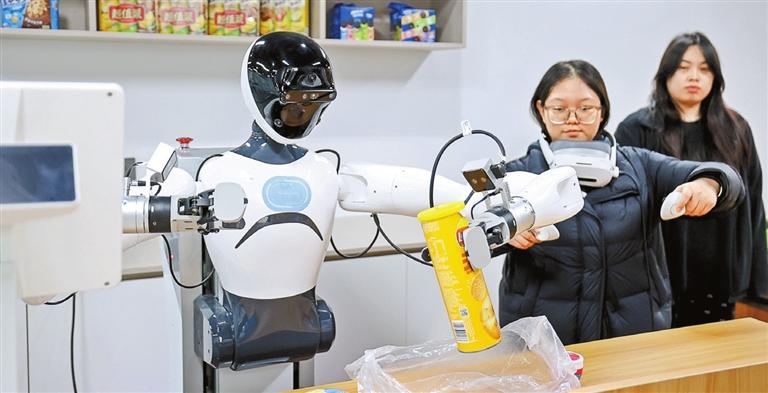
IN a film and TV studio in Shanghai’s Lingang New Area, Lu Guozong sits alone before a computer screen, with no heavy cameras, lighting crews, or bustling set assistants in sight. Yet, with a few keystrokes on an AI workflow platform, he turns a spark of imagination into a high-definition cinematic video with fluid camera movements. “AI is a productivity tool, but more importantly, it is a partner working alongside me,” Lu said. Lu is part of a growing wave of “AI content creators,” one of the many new professions emerging as artificial intelligence reshapes China’s labor market. From humanoid robot “teachers” to “translators” bridging human language and machine code, these roles are redefining what it means to work in the world’s second-largest economy. In 2020, China officially recognized “artificial intelligence trainer” as a new profession in its occupational classification code. These specialists act as “translators,” using data labeling, algorithm optimization, and system maintenance to help AI better understand human intent. In Shanghai, the role has been classified as a “critically undersupplied high-skill profession.” Data shows that in 2025 alone, Shanghai saw 16,300 participants in AI trainer evaluations, with nearly 11,000 receiving vocational certificates. At the data collection center in AgiBot, an intelligent robot manufacturer in Shanghai, rows of humanoid robots perform tasks under the watchful eyes of young workers wearing VR goggles and holding remote joysticks. These are “humanoid robot data collectors,” the “teachers” who manually guide robots through thousands of repetitions of pouring water or grasping objects under varying lights and weights. Peng Zhihui, co-founder and CTO of AgiBot, noted that the center has collected over a million high-quality data points covering home, catering, industrial and office scenarios. “Technological progress is not about replacing humans, but about opening up more creative spaces,” said an intern at AgiBot. For filmmakers like Chen Xiaoyu, AI is a tool for “returning to the essence of creation.” By delegating repetitive, mechanical tasks to AI, Chen can focus on narrative, aesthetics and emotion. “AI can generate a frame quickly, but whether that frame expresses something meaningful depends on daily observation, thinking and reading,” Chen said. “AI is the executor, not the creator. It allows directors to regain creative autonomy, no longer constrained by limited budgets or on-site conditions.” Over the 2021-2025 period, the Ministry of Human Resources and Social Security has released 72 new professions, more than 20 of which are AI-related. Experts estimate that each new profession can drive employment for 300,000 to 500,000 people in the short term. (Xinhua) | 