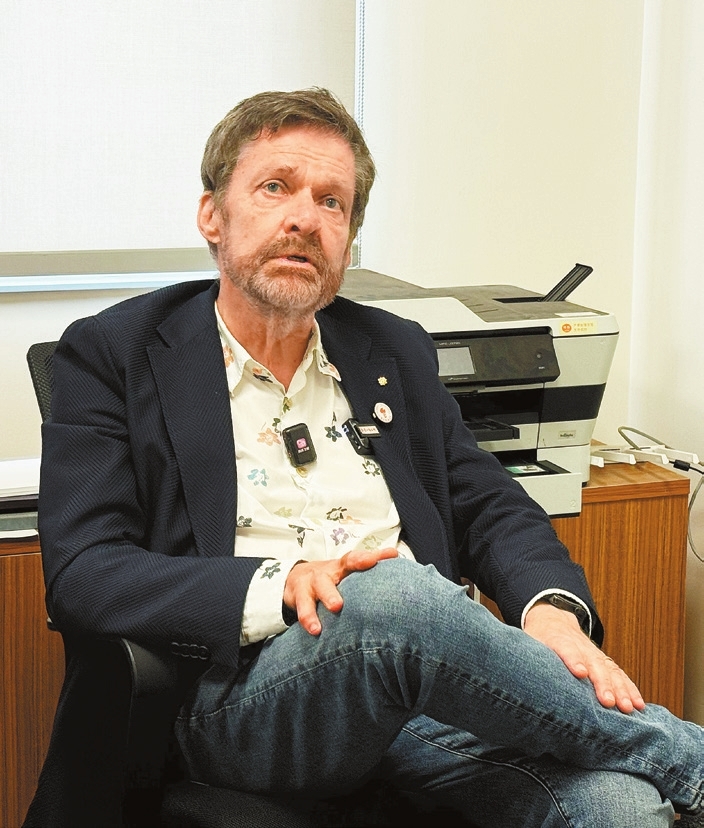
HOW many possibilities can a single, microscopic nanomolecule unleash? This is the question that Lars Ivar Samuelson, chair professor at the Southern University of Science and Technology (SUSTech) and dean of the Institute of Nanoscience and Applications, contemplates every day. Exploring the “no-man’s land” of original innovation often leaves scientists facing a wall of unknowns. While breakthroughs require rigor, Samuelson admits they sometimes require a bit of luck. Since joining SUSTech in December 2021, Samuelson has realized that Shenzhen has brought him far more “luck” — in the form of opportunity and momentum — than he ever imagined. “I’m too busy!” Samuelson exclaimed when asked to sum up his life in Shenzhen. His tone, however, is far from a complaint; it is one of pure exhilaration. A titan in condensed matter physics, Samuelson is one of the world’s most distinguished scientists in semiconductor nanomaterials, particularly nanowire growth. He pioneered an epitaxial growth method that fuses “top-down” and “bottom-up”approaches, creating perfectly ordered nanowire arrays. This breakthrough has paved the way for advanced applications in nanoelectronics, nanophotonics, solar cells, and solid-state lighting. His accolades are global. In 2022, he was awarded the Great Gold Medal — the highest honor from the Royal Swedish Academy of Engineering Sciences — and in 2023, he was elected as a foreign member of the Chinese Academy of Sciences. Despite receiving offers from the world’s most prestigious institutions, including UC Berkeley, Samuelson chose Shenzhen. At SUSTech, he found more than just a position; he found a world-class laboratory ecosystem and a cohort of ambitious colleagues. “I feel very happy here,” he said. “In a sense, I have realized my dream.” In his former office in Sweden, a motto hung on the wall: “Thank you for never doing research that others have already done.” This spirit of radical independence aligns perfectly with Shenzhen’s identity as a pioneer of innovation. “That motto reminds us to forge new paths rather than follow old ones. China, and Shenzhen in particular, has been remarkably successful in expanding technological frontiers,” Samuelson observed. Though the physical sign is no longer on his wall, the philosophy remains. “I tell my students: You must be the ones to pioneer new fields and create new opportunities.” Samuelson is not just a theorist; he is a bridge-builder between the lab and the market. In Sweden, he successfully incubated four semiconductor nanomaterial startups, some of which have grown into sizable international corporations. This entrepreneurial background gives him a unique appreciation for Shenzhen’s industrial depth. “The Asia-Pacific region offers superior conditions for both fundamental research and industrialization compared to the rest of the world. Within this region, Shenzhen’s capacity for industrialization is world-leading. Fifty years ago, the ‘Holy Land’ of semiconductor development was Silicon Valley,” Samuelson remarked. “Today, that ‘Holy Land’ is Shenzhen and the Guangdong-Hong Kong-Macao Greater Bay Area.” Samuelson’s fascination with nanowires — one-dimensional nanostructures — began decades ago. What started as a niche exploration by his team in Sweden has now grown into a global field involving tens of thousands of researchers. Now, he sees Shenzhen as the ultimate catalyst for the next generation of energy solutions. “China recognized the significance of renewable energy decades ahead of the rest of the world, making early strategic moves in solar and wind power. Furthermore, its investment in power-battery technology preceded the global curve by 10 to 15 years, fueling the current momentum of the electric vehicle industry. This visionary strategic layout has built an exceptional platform for future growth — a forward-looking spirit that is even more palpable here in Shenzhen,” Samuelson noted. Outside the lab, Samuelson finds harmony in music. Shortly after arriving in Shenzhen, he formed a band, finding a striking parallel between a tight rhythm section and a high-performing research team. “Scientific innovation and music creation both require listening to others and relying on teamwork,” he said. “Sometimes you lead; sometimes you support someone else’s solo. Shenzhen’s greatest strength lies in its ability to act as a magnet — attracting ambitious, well-educated people from diverse backgrounds and uniting them to get things done.” As he looks toward the future, Samuelson believes the city’s story is just beginning. “With its abundance of capital, investment opportunities, and talent, Shenzhen opens doors for everyone to advance their careers. I believe the APEC meeting presents a premier stage for the city and the Greater Bay Area to showcase their prowess to the world.” (Li Jing) | 