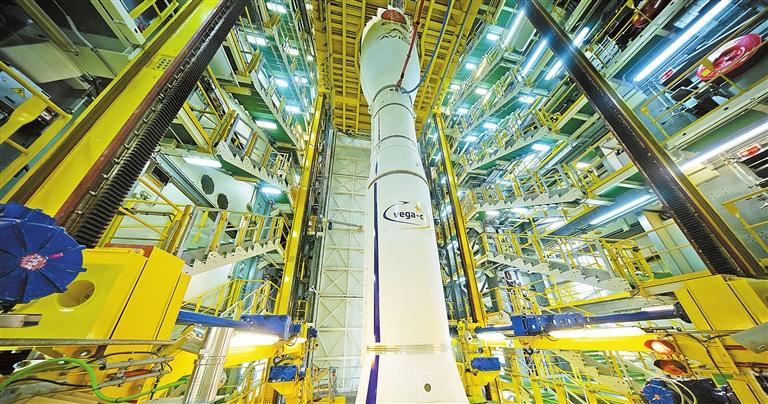
CHINA and Europe have jointly launched the Solar wind Magnetosphere Ionosphere Link Explorer (SMILE) satellite aboard a Vega-C rocket from Europe’s Spaceport in French Guiana. Following liftoff, the satellite entered its planned orbit, with solar arrays deployed and all systems operating normally. The mission, a collaboration between the Chinese Academy of Sciences (CAS) and the European Space Agency (ESA), aims to study how the solar wind interacts with Earth’s magnetic environment. The successful launch marks a major milestone in China-Europe space cooperation. With SMILE now in orbit, scientists will, for the first time, conduct panoramic imaging of Earth’s magnetosphere — a curved boundary sculpted by the solar wind that resembles a smile, echoing the mission’s name. The mission will also quantitatively describe the physical processes governing solar wind-magnetosphere interactions, improving space weather forecasting capabilities. To achieve these goals, SMILE carries four advanced instruments. The centerpiece is the space-borne Soft X-ray Imager, developed by the University of Leicester, which detects X-rays emitted when charged particles from the solar wind interact with neutral particles in Earth’s upper atmosphere, allowing scientists to visualize previously invisible magnetospheric boundaries. Complementing this are three additional payloads: an Ultraviolet Aurora Imager for capturing auroras over Earth’s polar regions, a Light Ion Analyzer for measuring charged particles, and a Magnetometer for monitoring magnetic field changes. Together, they provide simultaneous global-scale imaging of magnetospheric dynamics and in-situ solar wind measurements. CAS assumed primary responsibility for the satellite platform and mission operations, while ESA provided the payload module and launch vehicle. Following launch, SMILE will spend 42 days maneuvering into its final science orbit, then undergo a two-month commissioning phase before beginning its three-year routine mission. (SD-Agencies) | 