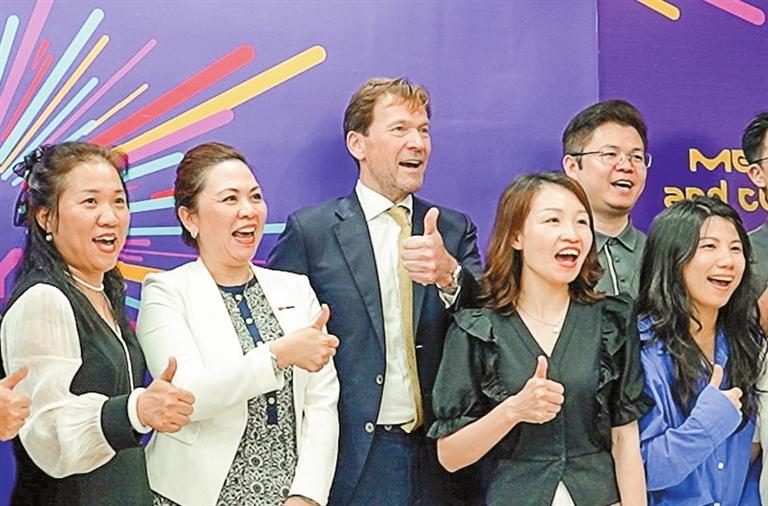
Zhang Yu JeniZhang13@163.com GERMAN tech giant Merck inaugurated its GBA Innovation and Collaboration Center in Nanshan District on Monday, marking the company’s latest and most technology-focused addition to its China footprint. The 2,500-sqm facility is a joint project with the Chinese Academy of Sciences and the Shenzhen government. According to Merck, it will contribute global technological resources, equipment and lab supplies to help local enterprises strengthen R&D capabilities and align with international standards. “The question was not whether or not we were to come to Shenzhen. The question was when,” Rogier Janssens, president of Merck China, told Shenzhen Daily in an exclusive interview Monday. “Shenzhen is really the capital of science and technology, so we need to be here.” Unlike the Beijing center, which focuses on clinical science and trials, and the Shanghai hub, which emphasizes drug development, the Shenzhen site will prioritize science and technology — leveraging the city’s strength as a global hardware and innovation powerhouse. Janssens, who led Merck’s healthcare business in China from 2017 to 2022, returned to the country earlier this year. He said the most striking change he has observed is China’s rapid development and a newfound openness to collaboration among universities, companies, and the government. “I would have never imagined that a country can develop and change so rapidly,” he said. “We are much more open to partnership and to collaboration.” When asked to rank Merck’s aspirations for China over the next decade, Janssens put innovation at the top, followed by manufacturing and supply chain resilience. “Innovation will probably drive the health of ourselves, our children, and many more generations to come,” he said. “If we nail innovation and manufacturing resilience, then sustainable growth will be a logical result.” The Shenzhen center will help local biotech startups cross the so-called valley of death — the difficult transition from research to commercial production — particularly in fertility, oncology and rare diseases, areas where Merck has deep expertise. “Drug research is not something which is about logic,” Janssens said. “It is sometimes also a lottery.” He noted that only about 10% of products that move from preclinical to clinical phases end up as commercialized medicines. Merck traces its roots back 357 years. Shenzhen is just 47 years old — a fishing village turned tech powerhouse. “Ideally, I would like to see a beautiful marriage between that 357-year historical company and this beautiful, newly built city,” Janssens said. The center will also help local companies navigate global supply chain disruptions, a growing concern for multinationals. “The world is not becoming simpler. I think the world is becoming a bit more complex,” Janssens said. “That’s why partnerships and collaboration are becoming a very important part of how we need to move things forward.” Merck has invested nearly 7 billion yuan (€885 million) in China over the past decade, according to company statistics. The company, which operates across healthcare, life science, and electronics, reported net sales of €21.1 billion (US$24.5 billion) in 2025. | 