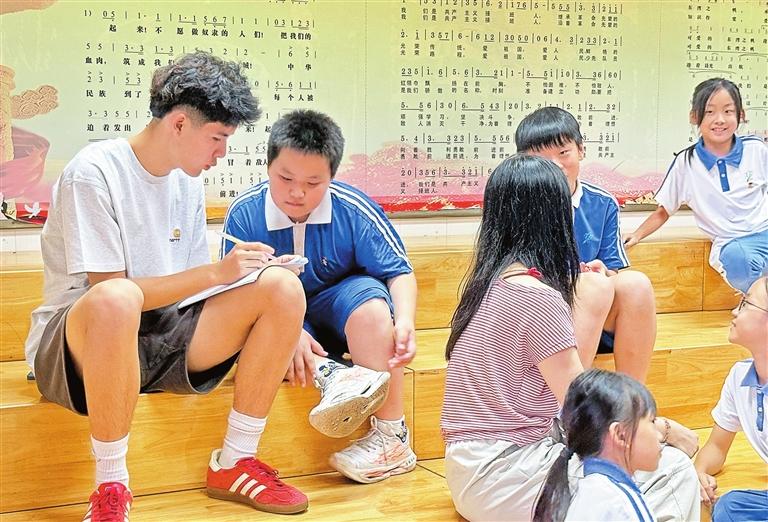
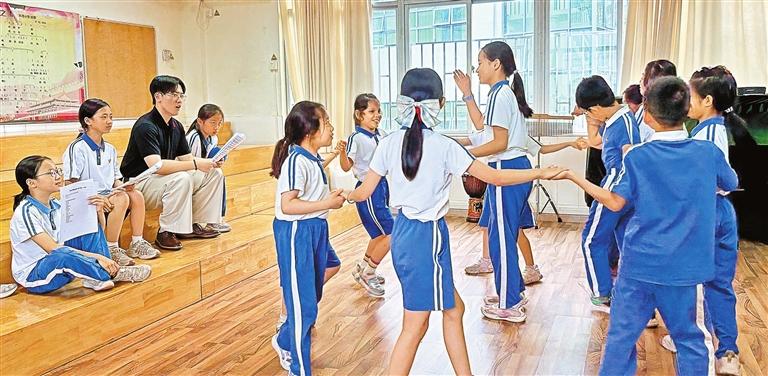
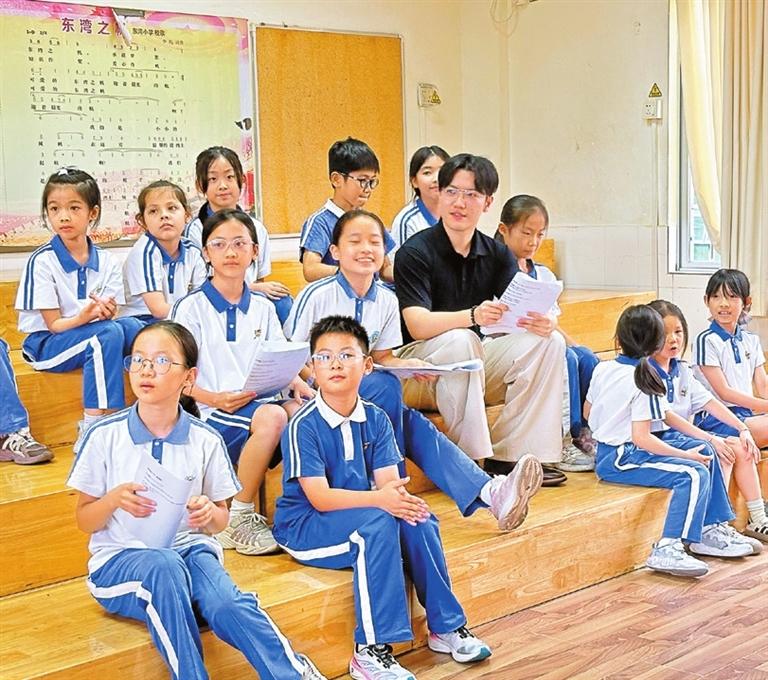
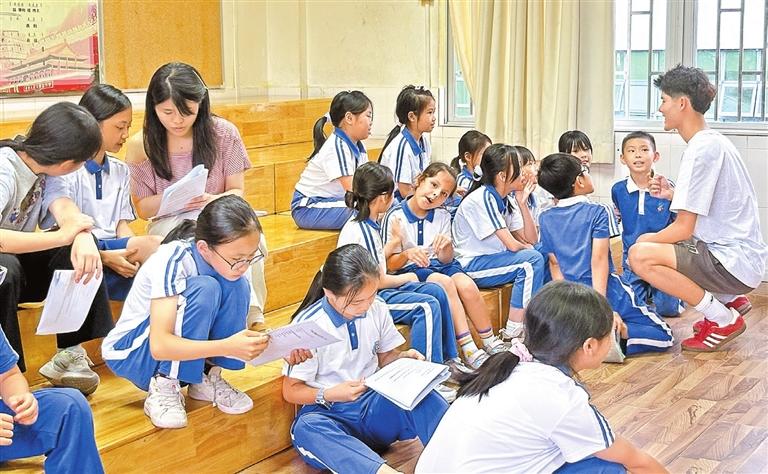
Zhang Yu JeniZhang13@163.com ON a recent Friday afternoon at the Dongwan Primary School in Nanshan District, a group of primary school students stood in a circle, their voices filling the classroom as they rehearsed English lines from “The Wizard of Oz.” Among them, a girl playing the Wicked Witch spoke loudly, gestured boldly, and seemed completely at ease — a striking contrast to the “gentle and shy” child that her teacher described just weeks ago. Watching from the sidelines were a group of young volunteers. They are not professional drama therapists, but high school students from several of Shenzhen’s international schools. This unusual scene is part of “Youth Lighthouse,” a drama therapy initiative launched in January by the Shenzhen Youth Extracurricular Education Association. Unlike traditional charity programs, this project is designed, managed, and executed almost entirely by teenagers. An alternative form of expression The high school volunteers first identified the need for such a project not in a classroom, but in an urban village. While teaching English in an urban village in Nanshan District in 2024, they noticed something troubling. The children there didn’t lack material resources — Shenzhen is, after all, a wealthy metropolis — but they lacked guidance and companionship. “I spoke with several children and learned that many of their parents don’t return home until 1 or 2 a.m.,” said Zhang Weiyong, one of the project’s core organizers. Zhang, a 17-year-old student now at Tsinglan School, previously studied at Avenues Shenzhen. Zhang observed that without positive role models at home, some children picked up crude language from social media as their primary mode of communication. Having been involved in theater since 2023, Zhang believed drama could offer a solution. “Drama provides a different way of communicating — not just through words, but through body movement, facial expressions, and eye contact,” he explained. “When you step into a role, even if you flub a line, it’s the character’s mistake, not yours. That significantly lowers the psychological barrier to speaking up.” From shrinking back to stepping up The Dongwan Primary School is a private school serving mostly children of migrant workers. Many parents work long hours and cannot afford extracurricular activities or tutoring. For these children, opportunities to perform on stage — or even speak English in public — are rare. Miss Zheng, a second-grade Chinese teacher who has observed the program for its first five weeks, said the transformation in participating students is tangible. “Some of these children are outgoing in private, but they freeze when they have to perform in front of others,” she told Shenzhen Daily. “Now, they are slowly opening up.” She pointed to Yihan, the girl playing the Wicked Witch. “Originally, she was very timid. But her character is loud and strong-willed. She has truly inhabited that role.” Zhang has witnessed the same growth. “In the beginning, they were nervous. When we cast roles, they stepped back. Now, the girls encourage one another and the boys perform with confidence,” he said. “Their courage has grown tremendously.” ‘They don’t criticize — they teach’ The volunteers’ teaching style has also resonated deeply with the younger students. Fifth-grader Wu Zhiqing, 11, said she has learned to “understand the character’s feelings and think through their logic.” Her classmate Chen Shuotong, also 11, contrasted the volunteers’ approach with traditional instruction. “They don’t just give us lines to memorize,” she said. “They use games to help us get into the role. And when we make mistakes, they are patient and never criticize.” For Chen, that patience is key. “The teachers here have a kind of charisma,” she said. “Their approach is entirely different from the traditional way of teaching.” Not charity, but connection The high school volunteers are careful to distinguish their approach from traditional charity models. “I’ve been doing public welfare work since 2022,” Zhang said. “Back then, I thought the most important thing was not to look down on the people we help. But now, I realize the real issue is the groups that are easily overlooked — even in a city as developed as Shenzhen.” Of the 20 students currently in the program, most are second-graders. Their English is basic. One student is a sixth-grade transfer student named Li Yitian, who was encouraged to join so he could feel a sense of belonging in his new school. He plays a tree. “But he’s very happy,” teacher Zheng said. “He feels a sense of achievement.” Another student is Anna Zeng, a Chinese-Hungarian mixed-race student with limited English. The program has given her a rare opportunity to shine. “I find it so much fun,” she said. Teenagers leading teenagers One of the most unique aspects of the Youth Lighthouse is that the volunteers are not just helpers — they are the designers and decision-makers. The core team of eight students from the Tsinglan School and the Shenzhen College of International Education (SCIE) designed the entire curriculum themselves. This includes a “protective entry and exit” ritual intended to manage the psychological aspects of drama therapy safely. “There are risks when you touch on emotions,” Zhang acknowledged. “We built our course to avoid those risks as much as possible.” The student-led model has clear advantages. “We‘re closer in age to the primary school kids,” Zhang said. “Communication is easier.” But there are challenges, too. “Managing a team, such as coordinating schedules and communicating across schools, requires skills we’re still learning,” he said. As most of the core members prepare to graduate and head to universities abroad, sustainability is a real concern. Plans are already in place to recruit new volunteers from campus theater troupes and through campus workshops. “My vision is for this to be a long-term, sustainable project,” Zhang said. “Shenzhen is big. China is bigger. There are many children who need guidance. We want the Youth Lighthouse to be an anchor connecting more schools and more communities.” More than just a performance For the volunteers, the rewards have been unexpected. Anthony Ding, a recent SCIE graduate who has been with the project since week one, said: “I think we’re gaining more than the children are. These kids have a pure love for learning — no need for material rewards. We feel needed. That warmth keeps us coming back.” Ding Ning, another volunteer who studied drama as a child, added: “Drama helps you relax and open up. It’s an artistic way to release emotions.” Anthony also noted the broader value of exposing migrant children to a diverse range of older role models. “The circle of adults these kids know is often very limited. Meeting different high school and college students gives them a new perspective on who they might become. That’s an important life lesson,” he said. A June debut The project is now preparing for its first public performance this June at the SCIE theater. The goal, Zhang insists, isn’t perfection. “The priority is simply for them to get through the play smoothly,” he said. “But more importantly, I want these children — who have never had stage experience — to feel the power of expressing themselves.” As the Friday rehearsal ended, the children packed up their schoolbags and headed to the playground. A few boys were still shouting lines from the play, laughing as they ran. For at least some afternoons in the Dongwan Primary School, the Wicked Witch was no longer shy, the Tin Man was no longer afraid, and a group of teenagers proved that sometimes, the best teachers are not much older than their students. | 