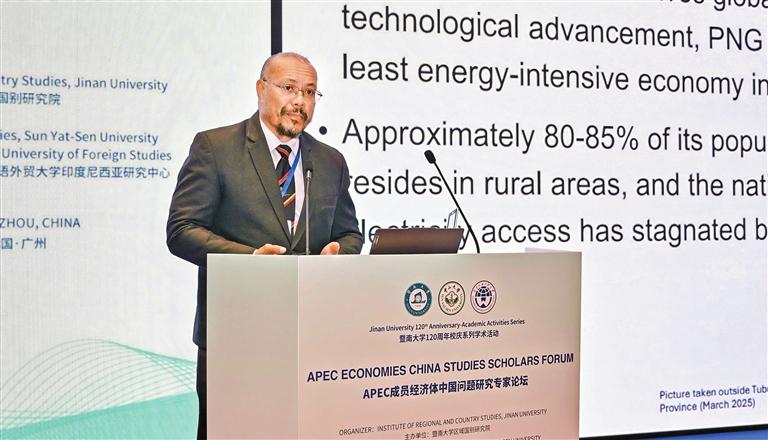
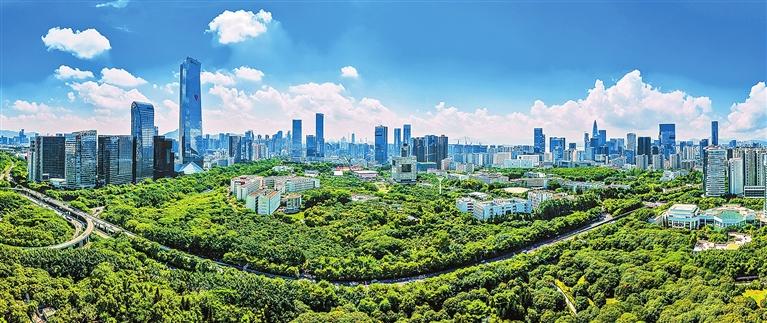
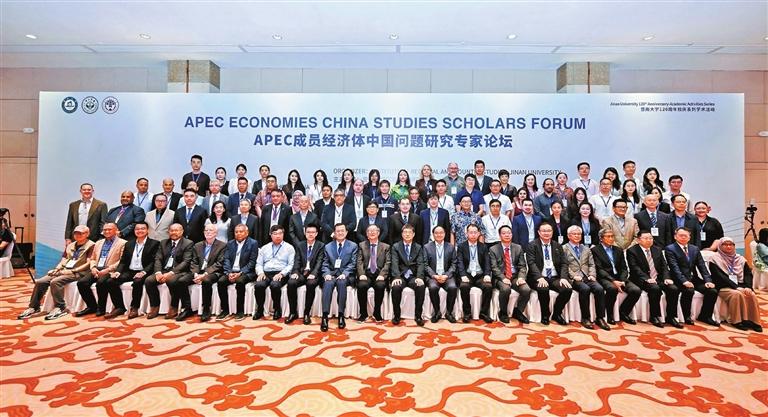
SIX thousand kilometers and seven hours of flight time separate Guangdong from Papua New Guinea (PNG). Yet, despite the vast distance across the South Pacific, the bond between these two regions has never been closer. At last week’s APEC Economies China Studies Scholars Forum in Guangzhou, Lahui Ako, chief of staff to the PNG prime minister and senior advisor for APEC 2033, described his nation as “APEC’s last rural frontier.” While more than 80% of PNG’s population lives in rural areas, electricity access remains as low as 15%. PNG has emerged as Guangdong’s largest trading partner in the Pacific Islands. In 2025, bilateral trade reached 3.07 billion yuan (US$453 million), and the first quarter of 2026 saw a 66% year-on-year surge to 920 million yuan. As China and PNG mark the 50th anniversary of their diplomatic relations this year, the two countries will co-host their first national-level business forum and trade expo in October. Looking ahead to the upcoming APEC meeting in Shenzhen, PNG aims to deepen ties with China to drive long-term, win-win development. Set to host APEC in 2033, PNG faces the unique challenge of having the lowest energy consumption among APEC economies, according to Ako. “Most of our people live in remote regions, and their livelihoods depend on crops,” Ako noted. “We urgently need greener, resilient energy to achieve sustainable development.” Ako emphasized that PNG hopes to leverage China’s strengths in economy and technology to foster cooperation and connectivity in fields such as photovoltaics, new energy vehicles, green finance, and digital economy. “Many Asia-Pacific countries can draw inspiration from China’s development experience,” he said, adding that he also hopes to facilitate scholar exchanges, such as sending PNG civil servants to study at the Guangdong University of Foreign Studies. As the first Pacific island nation to sign a Belt and Road cooperation agreement with China, PNG has already seen success with landmark projects like Juncao technology — a Chinese technology that uses specially cultivated grass to grow edible and medicinal mushrooms — and Independence Boulevard. Addressing over 200 entrepreneurs at the China-PNG Business Roundtable in Guangzhou this April, PNG Prime Minister James Marape encouraged Guangdong firms to “take root” in PNG by expanding from raw material extraction into downstream processing of agriculture and minerals — a move that would yield robust returns for investors and shared prosperity for local communities. Guangdong companies are already responding. Guangdong Rising Holdings Group is planning a full-industry-chain layout for the Frieda River copper-gold project. Meanwhile, Shenzhen Vivafounder Investment Holdings is partnering with global industry leaders to establish a world-class pulp supply base in PNG. “The lamp lit in underdeveloped areas represents APEC’s opportunity and dignity,” Ako said. “No economy, regardless of size, should be left behind. Larger economies must reach out to smaller ones to strengthen cooperation, ensuring that together we can overcome the challenges of regional integration and achieve shared prosperity.” The upcoming APEC meeting in Shenzhen marks a pivotal moment for this partnership. As one scholar put it at the forum: “This is not just about trade or technology — it is about the future of the regional order in the world’s most important economic region.” In an era of profound regional reshaping, the synergy between Guangdong’s industrial might and PNG’s green energy needs offers a compelling model for APEC’s vision of high-quality, inclusive growth. (Li Jing) | 