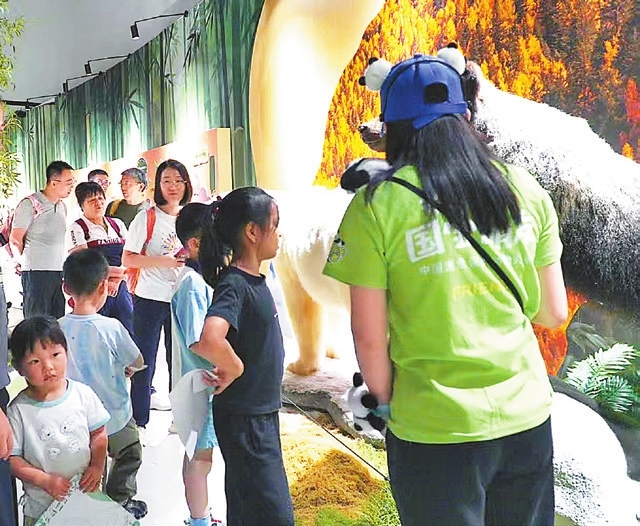
Shao Jingfeng windysjf@hotmail.com WHY do giant pandas remain chubby on a nutrient-poor bamboo diet? Is the viral brown panda, Qi Zai, a genetic fluke or a biological anomaly? These are the types of scientific riddles at the heart of a new science exploration season opened last week at the Shenzhen Science & Technology Museum. Jointly organized by the museum and the Institute of Zoology of the Chinese Academy of Sciences (CAS), the initiative aims to transform frontier research into a public “detective” experience, stripping away the perception that high-level science is inaccessible. By integrating cutting-edge biodiversity research with immersive exhibits, the season offers families and students a summer event that blends educational value with interactive social engagement. Guo Chuanjie, a CAS academician, told local media that in an era dominated by AI, science communication must evolve. He noted that the exhibition transforms complex scientific achievements into an experience that is “visible, audible, perceptible, and interactive.” The goal, Guo said, is to move beyond rote knowledge dissemination to inspire a spirit of inquiry in young visitors. To deepen this engagement, the museum has enlisted some of China’s leading scientists to serve as public educators. Zhang Jinshuo, director of the National Zoological Museum of China, said these experts will deliver lectures and participate in Q&A sessions, providing the public with direct access to the stories behind wildlife conservation and biodiversity. A centerpiece of the season is the “Discovering National Treasures: China’s Endangered Wildlife Exhibition,” which will run through Nov. 1. The gallery features more than 200 specimens of rare protected species, including giant pandas, golden snub-nosed monkeys, and red pandas. Organizers say the program not only decodes fascinating natural mysteries in an accessible way, but also creates immersive experiences that help young audiences develop a deeper appreciation for life sciences and biodiversity. Through coordinated programming between museums in northern and southern China, the initiative aims to connect world-class scientific resources with the public on a broader scale, making cutting-edge science more approachable for households across the country. | 