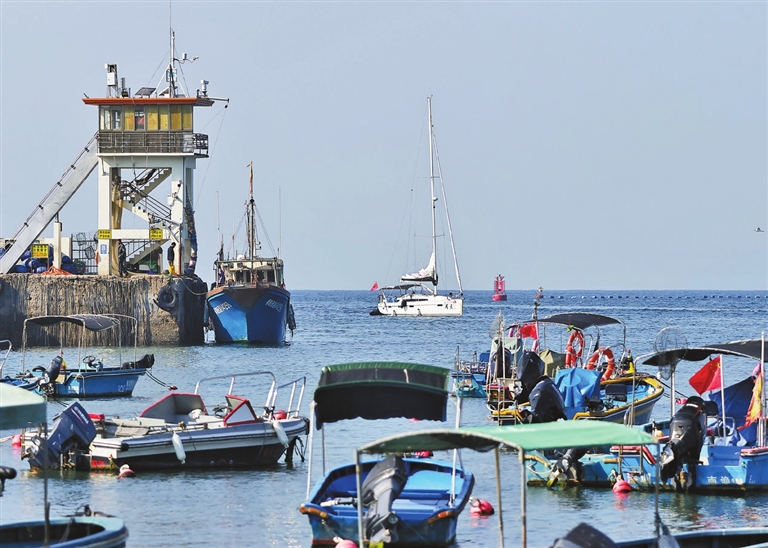
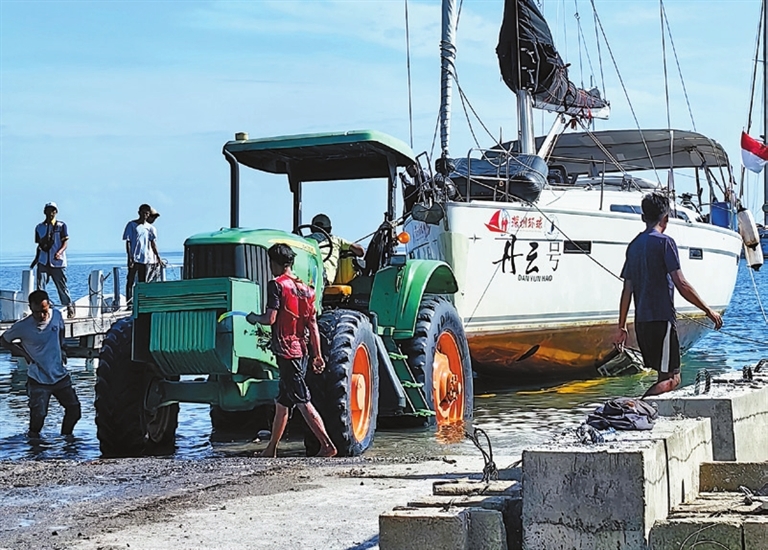
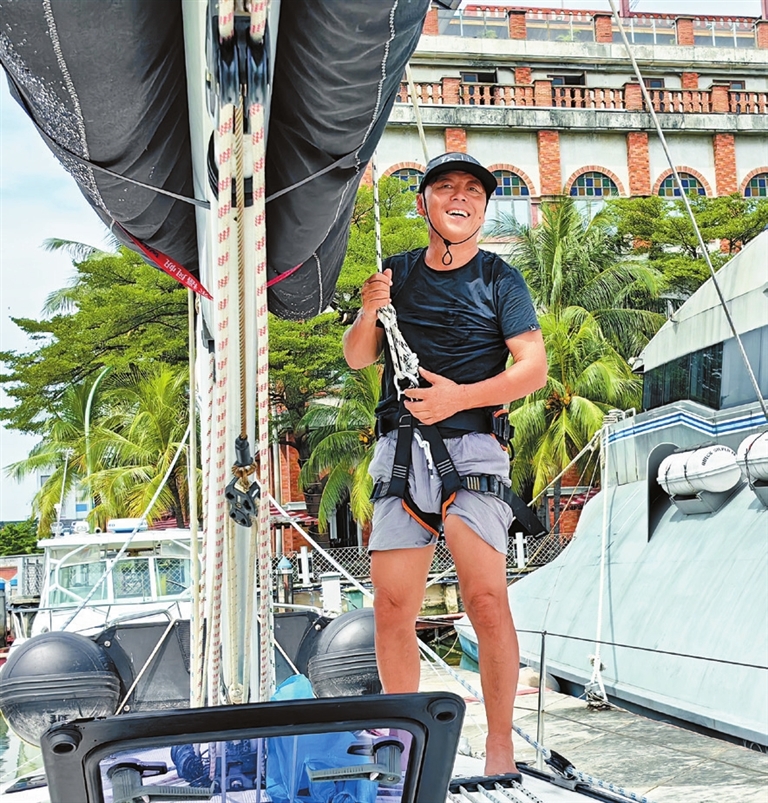
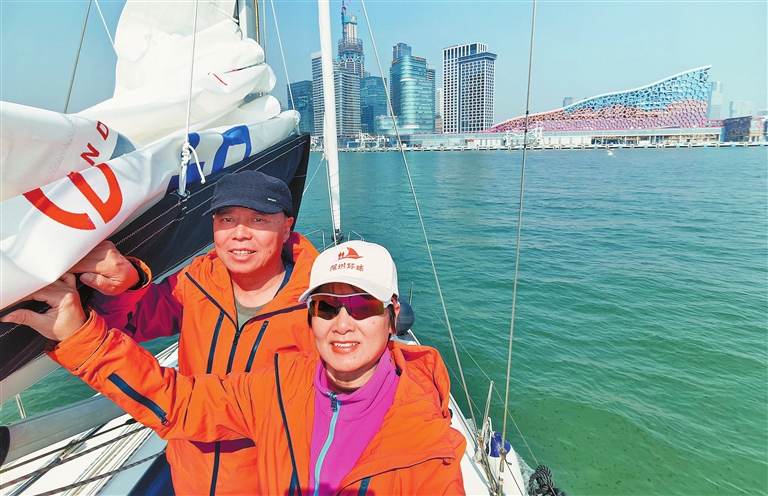

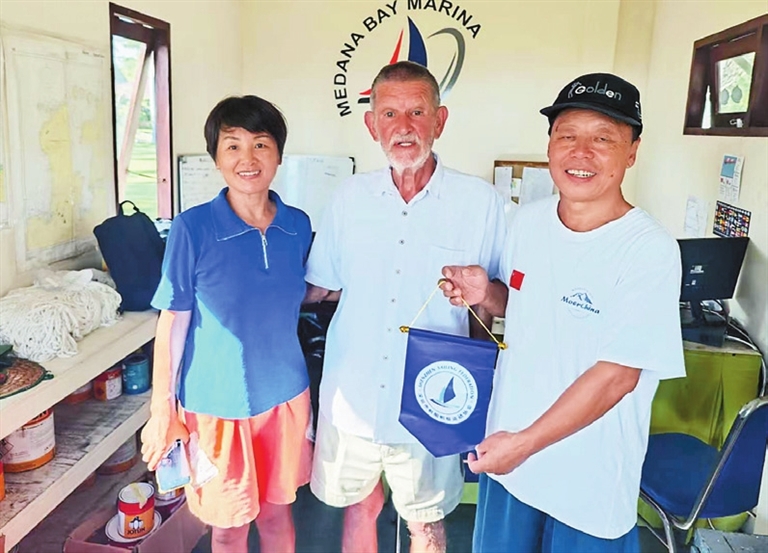
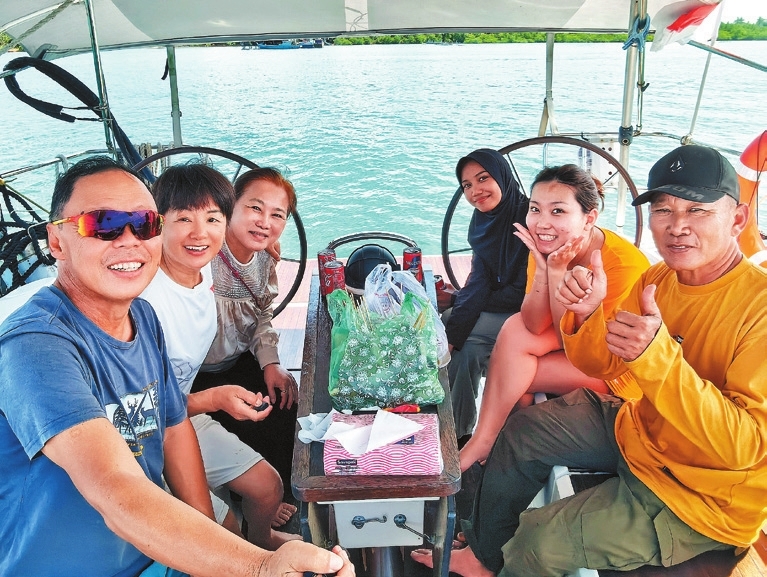



Chen Siqi vankochensq@163.com FOR Yang Wei and Zheng Hong, the 15-meter sailboat Danyun is more than a vessel. It is their floating home, a testament to a life lived on the water rather than in the waiting room of retirement. When they finally stepped back onto solid ground at the Shekou Cruise Home Port in Shenzhen this April, they had just completed a 15-month, 9,000-nautical-mile odyssey over the Pacific. Their route traced a vast arc through the warm waters of Southeast Asia and beyond: from Vietnam and Cambodia to Thailand, Malaysia, Indonesia, Singapore, Palau, and the Philippines. They measured the distance between friends not in miles, but in the compass points of goodwill. At 70 and 65 respectively, Yang and Zheng are China’s oldest active captain and its most senior female sailor, according to available records. Yet age, for them, is merely a number on a logbook. On the day of our interview, the couple invited us aboard to feel the wind in the sails. After a month on the dock, the batteries were low — a minor hiccup quickly resolved by the shore power. “These are just small problems,” Zheng said with a knowing smile, coiling a line with the practiced ease of a seasoned deckhand. “It’s the big ones you meet out there that count.” As the Danyun slipped her moorings and the sea breeze filled the cockpit, it was clear that their daily life on sea was a seamless navigation between these “small” and “big” problems. Yang documents their voyages with a sailor’s stoicism. In one diary entry, he reflected on the humbling nature of the sea: “We have sailed for a decade and crossed countless waters, believing we had grown calm and prepared. But the ocean is infinitely changeable. You can never guarantee that you will single-handedly conquer every danger it throws at you.” The most harrowing test came in the dead of night Feb. 13, while they were sailing from Indonesia towards Palau. The engine began to “cough and wheeze like an asthmatic,” before dying completely. With the wind against them and the vessel drifting helplessly on the periphery of a coral reef, they were alone. Satellite signals vanished, and they couldn’t even send a distress call. For over 20 hours, Yang worked the sails relentlessly through the tempest. It wasn’t until they drifted within 20 to 30 nautical miles of Palau that the signal flickered back to life, allowing him to send a desperate plea for help. The sea state was so perilous that the Palauan government had already declared a prohibition on all shipping. The response was rapid. After receiving the help signal, the Shenzhen Foreign Affairs Office immediately coordinated with the Chinese Embassy in the Federated States of Micronesia — the mission responsible for Palau in the absence of formal diplomatic ties. Hours later, despite the ferocious conditions, Palauan police braved the squall to tow the Danyun safely into port. A local Chinese-run hotel offered the weary sailors immediate refuge and comfort. Afterwards, Captain Yang noted down: “This rescue across the ocean truly showed the bond of our Chinese people — blood thicker than water, standing together in times of need. It also made us feel the strength of our motherland — even thousands of miles away in the Pacific, consular protection had our back.” Yet, beyond the perils of the deep, the voyage was defined by moments of profound warmth. In Mataram, on the Indonesian island of Lombok, which is a sister city of Shenzhen, they arrived to the rhythmic beat of drums and a jubilant crowd. The locals drew a direct line from the past to the present, telling the couple: “It's said that Chinese admiral Zheng He’s fleet once stopped here. And you are the first since Zheng He! We have to give you a very warm welcome.” The city’s mayor officially welcomed them, exchanging gifts and reinforcing a friendship that echoes across centuries. In every port, from Vietnam to the Philippines, the sight of the Chinese flag on the Danyun drew the local Chinese diaspora like a magnet. The local residents were also curious, coming up and asking, “Did you really sail all the way from China?” Yang and Zheng would pull out their phones, tracing digital maps across the ocean to show where they had come from. “We told them about Shenzhen, about how our phones and drones were all made there,” Zheng recalled with a laugh. “Their eyes would go wide with surprise. We felt so proud to be able to represent Shenzhen and China in this small, personal way.” The decision to cast off the lines and become citizen-diplomats was no whim. It was forged in a crucible of personal adversity. In 2011, Yang was diagnosed with cancer. The surgery that saved his life also provided clarity of purpose. “Life cannot wait,” he decided. In 2015, the couple purchased a sailboat and named it after Danyun, which is Zheng Hong’s childhood nickname. Since then, they have educated themselves in meteorology, marine engineering, and navigation. Over the following nine years, they logged over 24,000 nautical miles of experience, with Zheng chronicling their adventures in a book, “Let's Go Sailing After Retirement.” With experience came a grander ambition. “We thought, wouldn’t it be wonderful if ordinary people could participate in the friendship between sister cities?” Yang said. So, they embraced their role as unofficial envoys, visiting Shenzhen’s sister cities to share the story of Shenzhen. Across 9,000 nautical miles of ocean, they met lots of people. “We never encountered anyone hostile,” Yang reflected. “You treat people with kindness, and they treat you the same. Deep down, most people are good.” As 2026 marks the APEC China Year, the couple’s route has serendipitously linked several Asia-Pacific economies that are also APEC members. In their unassuming way, Yang and Zheng have staged a masterclass in people-to-people diplomacy: a dialogue defined by rescue in the storm, embraces on the dock, and applause in a foreign land. More than 600 years ago, Admiral Zheng He commanded a fleet of over 200 ships, spreading the peaceful message of Chinese civilization across Southeast Asia, South Asia, and the Horn of Africa. Today, one silver-haired couple, on their own small boat, are forging a similar bridge across the blue expanse, connecting Shenzhen to the world. | 