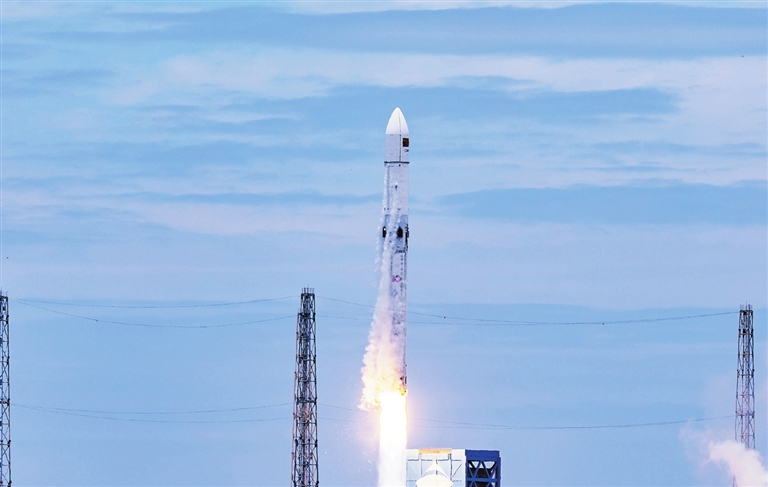
CHINA achieved a historic milestone in spaceflight on Friday with the successful launch and first-ever controlled recovery of the first stage of its new Long March-10B carrier rocket, marking a significant leap forward in the nation’s pursuit of reusable launch vehicle technology. The rocket lifted off at 12:15 p.m. from the Hainan International Commercial Aerospace Launch Center in the coastal city of Wenchang. The 63.6-meter-tall vehicle, powered by seven engines burning liquid oxygen and kerosene, soared through white clouds and delivered its payload into the preset orbit. Roughly two and a half minutes after launch, the rocket’s first and second stages separated above the Karman Line — the internationally recognized boundary between Earth’s atmosphere and outer space. While a single liquid oxygen-methane engine on the second stage ignited to propel the payload toward orbit, the massive first-stage booster began its pioneering journey back to Earth. In a meticulously choreographed sequence, the first stage deployed grid fins and activated its reaction control system to adjust its attitude and fine-tune its trajectory. Select engines reignited twice during the descent, working in tandem with the aerodynamic control surfaces to slow the stage’s fall and guide it precisely toward a recovery ship hundreds of kilometers southeast of Wenchang. In the final seconds of the operation, the booster’s engines cut off. Specialized metal hooks deployed from the stage, successfully engaging a tensioned cable net system aboard the recovery vessel, named Linghangzhe, or Pathfinder. This mission marks China’s first successful controlled recovery of a carrier rocket’s first stage, making China only the second country, after the United States, to possess reliable rocket reusability technology. Notably, it also represents the world’s first recovery of an orbital-class rocket using a wire arrestment recovery system. “The mission was a complete success in both launch and recovery,” stated the China Academy of Launch Vehicle Technology (CALT), a Beijing-based subsidiary of the China Aerospace Science and Technology Corp (CASC) that designed and built the rocket. The Long March-10B is a reusable liquid-fueled commercial launch vehicle and the third in the Long March 10 series. Standing approximately 63 meters tall with a diameter of 5 meters, the rocket has a liftoff thrust of about 890 tonnes and a liftoff mass of approximately 760 tonnes. In its reusable configuration, it boasts a low Earth orbit (LEO) payload capacity of 16 tonnes. Globally, the most famous reusable rocket remains SpaceX’s Falcon 9, which has conducted numerous launches with reused boosters. American commercial rival Blue Origin also recently completed its first successful landing of the first stage of its New Glenn rocket. Friday’s achievement by the Long March-10B follows previous recovery attempts in China by the ZQ-3, developed by commercial firm Landspace, and the Long March-12A by CASC’s Shanghai Academy of Spaceflight Technology. The successful catch of the Long March-10B is expected to significantly reduce launch costs and increase launch frequency, bolstering China’s position in the competitive global commercial space market.(Xinhua, SD-Agencies) | 