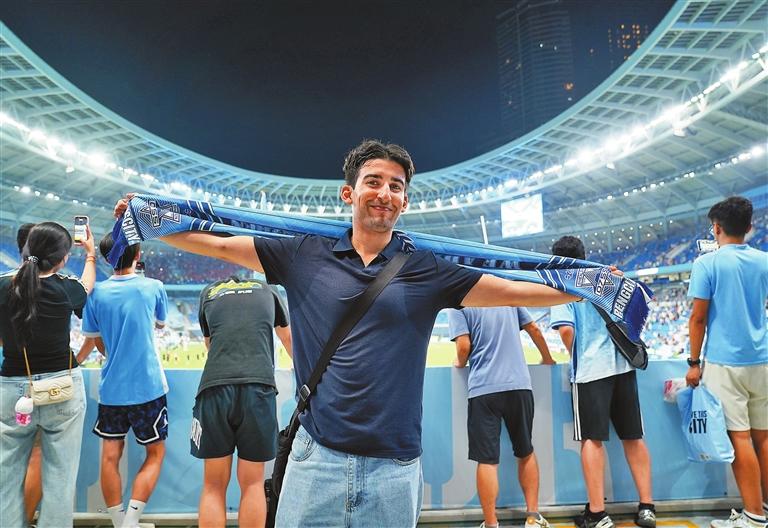

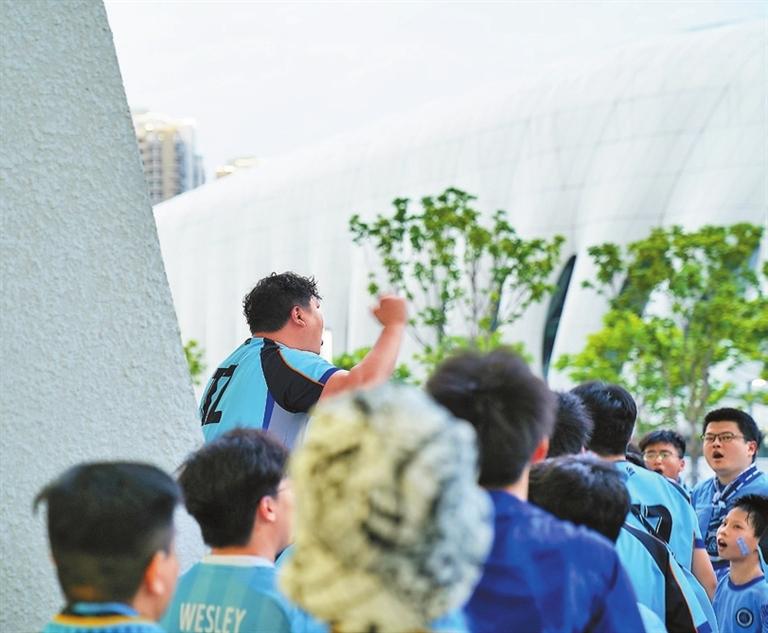
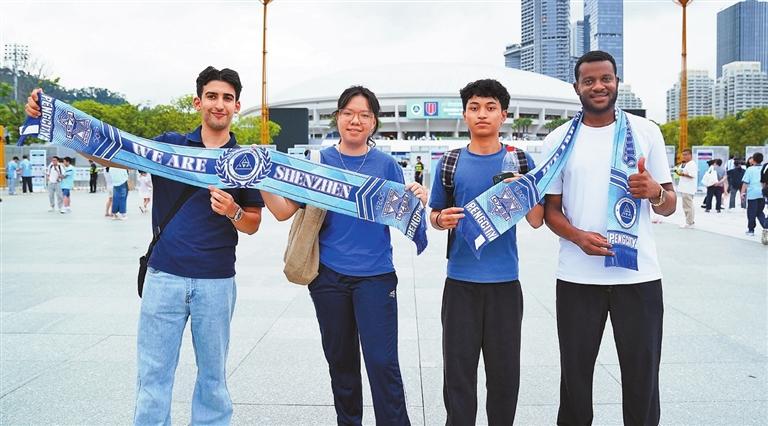
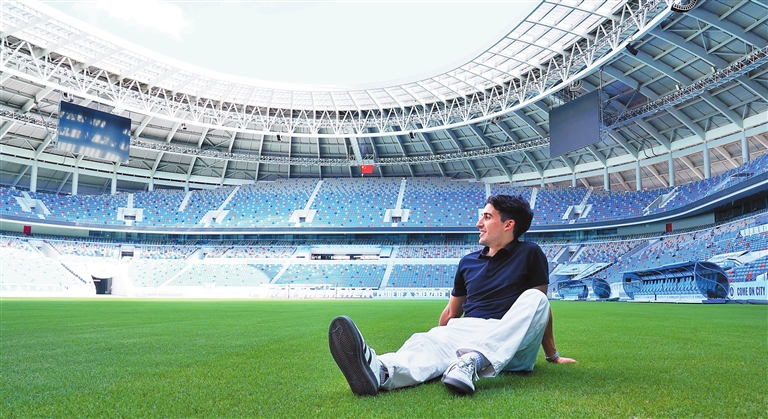
Chen Siqi vankochensq@163.com HOME ground is a phrase Mohamed Amine Amrani has learned to redefine. Born in Casablanca, Morocco, studying in Shenzhen, and cheering for FC Barcelona, he is a man whose football loyalties are scattered across maps. But on a humid June evening in a Shenzhen stadium, surrounded by 25,000 chanting strangers, Amrani found something he hadn’t been looking for: a home ground. That evening, Shenzhen Peng City hosted Chinese Super League leader Chengdu Rongcheng at the city’s newly renovated Shenzhen Sports Center. It was a match that swung from one end to the other: from 0–2 down to a gritty 2–2 equalizer, only to concede a late heartbreaker. The final score read 2–3. But for Amrani, the result was secondary. What stayed with him was the noise: the rhythm of 25,119 voices rising and falling in unison, scarves raised, chanting as if the match depended on them alone. “Vamos, Shenzhen!” the crowd roared before the game even kicked off. The cheer, borrowed from Spanish and now claimed by this corner of China, felt familiar to him in ways he didn’t expect. Growing up with football Long before Shenzhen became part of his story, football had already shaped who Amrani was. “I’ve been watching football since I was 5,” he said. “I mainly support two clubs: FC Barcelona and Wydad Casablanca.” Born and raised in Casablanca, he grew up in a country where football is “most people’s favorite sport.” He recalled the joy of playing football as a child. “We played almost every day with our friends,” he said. “Sometimes we’d play for hours, run home just to drink water, and hope our mothers wouldn’t stop us from going back outside.” From street games, he later joined youth clubs, where coaches taught him tactics and discipline, but also resilience. “You can be winning 2–0 and still lose 3–2,” Amrani said, explaining his love for the sports. “Football teaches you how to deal with disappointment, reflect on your mistakes, improve yourself, and keep going.” Finding a pitch in China When Amrani first arrived in Beijing to study Chinese, he discovered that football was his ticket into the local community. He joined an amateur team, where weekly training sessions doubled as language lessons. “My Chinese wasn’t very good, especially football vocabulary,” he admitted. “Playing with Chinese teammates helped me improve naturally.” Later, he applied for an undergraduate degree in international business at Harbin Institute of Technology, Shenzhen, drawn by the city’s reputation as an inclusive, innovative, and international hub. Within days of arriving, he posted on RedNote, asking if anyone knew places to play near University Town. “Many people invited me to join their games,” he said. “Everyone was very welcoming.” He also joined in the university’s football club. After passing the tryout, he became the only foreign player in the club. Amrani is a player with grit. He started as a striker in his youth, then drifted to the wing, and now plays left back, a role that demands charging forward to support attacks, then sprinting back to track opponents. “In this position, you have to keep going up and down, up to support the attack and downfield to stop counterattacks. For me, I really like this position,” he said, crediting his teammates for helping him fix mistakes and improve his game. Having trained in Morocco and then in China, he noted similarities in coaching systems. “It’s almost like mathematics,” he observed. “You learn the properties, definitions, rules, and exceptions — all theoretical — and then practice later.” He admitted he hadn’t expected football to be so popular in China. “I thought basketball or badminton would be bigger,” he said. But after witnessing the local passion, he changed his view. Football, he now believes, is “definitely big enough to be a major sport here in China.” Shenzhen’s football culture On the evening of June 27, Amrani and his friends went to watch Shenzhen Peng City host league leader Chengdu Rongcheng at Shenzhen Sports Center. The 45,000-seat stadium, the city’s first professional football ground to meet international standards, impressed him. But it was the supporters who left the deepest mark. That night, 25,119 spectators filled the stands. Even though Shenzhen fell behind 0–2 early, the home crowd never stopped singing. Chant leaders kept the energy alive, and the players responded, fighting back to 2–2 before a late heartbreaker. “They kept encouraging the players,” he said. “It was a very high-level match with great intensity.” From the stands, he noticed something familiar. The sky-blue jerseys and home ground atmosphere were unmistakable — they reminded him of Manchester City. He learned that Shenzhen Peng City is part of the same City Football Group. And for Amrani, Shenzhen’s football culture extends beyond one club. He was surprised to learn that European clubs like Eintracht Frankfurt and FC Sevilla have established academies in the city. “When teams at that level install academies here, I see it as an investment that benefits both sides,” he said. “They bring elite experience to develop local youth, and in return, they can recruit and develop young talent. It contributes to a better future for Chinese football.” Redefining home ground Throughout the interview, one question lingered: What is a home ground? For the 2026 FIFA World Cup, home grounds span three countries: the United States, Canada, and Mexico. For a football club, it can be a city. For ordinary people, it can be anywhere they feel they belong. “Home ground is where you feel supported,” Amrani said. “It’s where you can perform at your best.” Living thousands of kilometers from Morocco, homesickness occasionally creeps in. “Sometimes, I miss my mother’s cooking. I miss speaking my own language. I miss home.” When those moments come, he turns to football and other sports — playing with Chinese teammates, hiking with friends from Morocco and Vietnam, or sharing stories about each other’s cultures. Gradually, the loneliness eases. Football, he has discovered, works much like cultural exchange itself. “You don’t always need the same language,” he explained. “You understand each other through the way you play.” The migrant nature of Shenzhen Peng City, formerly Sichuan Jiuniu FC, resonates with him deeply. “A club, a person, or an entity coming to Shenzhen is not something new,” he reflected. “It’s just the nature of Shenzhen. It’s about talent coming from many different parts of China and also the world.” For one Moroccan student, home ground is no longer defined by geography. It is defined by belonging. | 