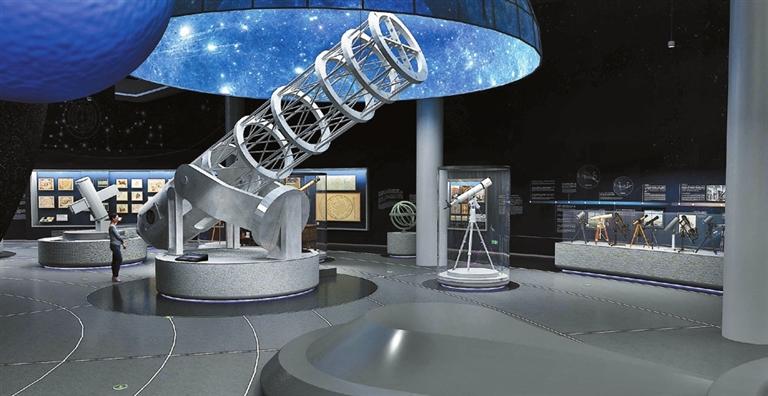
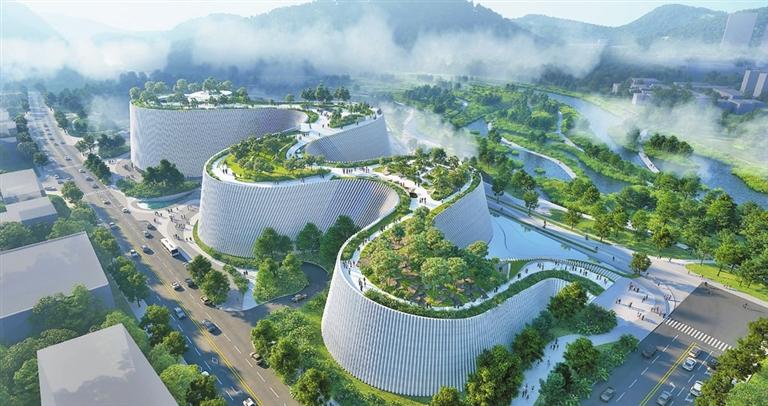
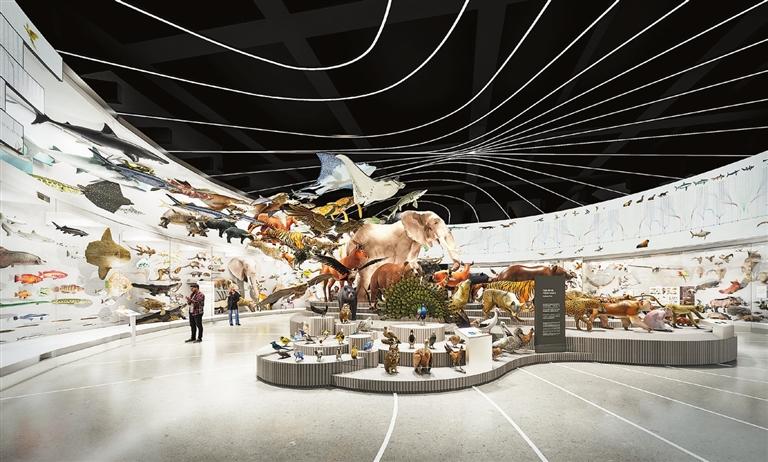
Cao Zhen caozhen0806@126.com AS one of Shenzhen’s major cultural projects, the Shenzhen Natural History Museum is scheduled to open July 28. The site covers about 42,000 square meters, with a total floor area of 105,300 square meters, including roughly 35,200 square meters of exhibition space. It is set to become a world-class comprehensive natural history museum dedicated to collecting, exhibiting, researching, and delivering natural science education. Architecturally, the museum blends the environment with nature. Centered on the concept of a “river,” the project is imagined as a lively new delta, weaving the elemental idea of water into its spatial layout and functional design. Start your exploration in the vast cosmos, journey through 4.6 billion years of Earth’s evolution, and explor countless forms of life, before returning to Shenzhen’s mountains and seas. Cosmos Hall From ancient star charts, astrolabes, and telescopes to meteorite samples from deep space, this hall shows how humanity has sought to understand the cosmos. From galaxies to planets, and from celestial evolution to the formation of the solar system, the distant mysteries of the universe are brought within reach. Earth Hall Step back through Earth’s 4.6-billion-year journey to become the cradle of life. This hall also explores China’s landscapes, helping visitors understand how plate tectonics and natural forces shaped the land we see today — and how rocks and minerals laid the groundwork for the early chapters of human civilization. Evolution Hall Life’s history is a long masterpiece spanning 3.8 billion years. The hall traces the origin of life, the birth of evolutionary thinking, Darwin’s intellectual breakthrough, and key ideas such as genetic variation and adaptive radiation — showing how life developed from its earliest traces to the world we know today, including the arrival of humans. Dinosaur Hall Some creatures may have disappeared millions of years ago, but they still captivate us. This hall features dinosaur fossils, body structures, habits, and the world they dominated during the Mesozoic era. It also highlights major discoveries from Guangdong and Jiangxi, adding local research stories to the dinosaur narrative, while exploring extinction and the current state of Chinese dinosaur studies. Human Hall Tracing primate evolution and connecting important fossil discoveries from Africa, Eurasia, and China, this hall outlines key milestones in the human journey. By looking back at where we came from, it invites a fresh way of understanding ourselves. Fossil findings from Guangdong and Guangxi will also be presented. Biology Hall From flight and camouflage to predation, reproduction, cooperation, and adaptation — life’s wonders take many forms. Using biological classification, this hall explores survival strategies across species, celebrating the richness of life while emphasizing its vulnerability and the reality of extinction. Ecology Hall Forests, grasslands, wetlands, deserts, oceans, polar regions, and mountains — no habitat exists in isolation. This hall examines the intricate and delicate relationships between organisms and their environments. It will also explore natural stories such as predation, defense, courtship, and reproduction — alongside issues like biological invasions — reminding us that nature’s balance is always worth protecting. Homeland Hall After exploring the universe and all life on Earth, we return to Shenzhen, a place we know well. This hall presents the city’s diverse geography and subtropical habitats, where native, endemic, migratory, urban, and protected species come together to tell Shenzhen’s own natural story. It also looks at how the city lives alongside nature — and how it can move toward a more sustainable future. Venue: Shenzhen Natural History Museum, Pingshan District (坪山区深圳自然博物馆) Metro: Line 16 to Shabo Station (沙壆站), Exit C SkyShuttle: Line 1 to Natural History Museum West Station (自然博物馆西站), Exit B | 