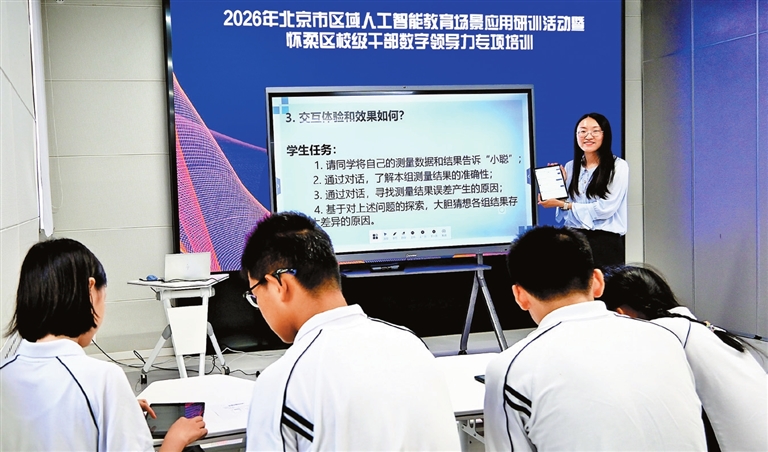
BY the time the math class kicked off at Beijing No. 13 Secondary School, an artificial intelligence (AI)-powered “agent” had already crunched weeks of student data, analyzing each student’s recent classroom participation, homework and quiz results. Within minutes, it generated tailored question sequences for students at different learning levels and personalized after-class assignments, while teachers reviewed and refined the AI-generated content before putting it into use. This scene reflects a broader transformation taking place in the world’s largest basic education system — which serves more than 220 million students — as China turns to AI to improve the quality of basic education and better meet the needs of individual learners, following decades of expanding access to education and narrowing regional disparities. Having largely achieved universal enrollment in compulsory education, China is shifting its focus from ensuring every child’s access to schooling toward providing every child with higher-quality, more personalized education. The country’s 15th Five-Year Plan (2026-2030) calls for leveraging AI to transform educational models and integrating the technology into every element, stage and scenario of education. In April, the Ministry of Education launched an “AI Plus Education” action plan to accelerate AI education in primary and secondary schools, encourage interdisciplinary teaching and expand AI applications in classrooms. These policies are already taking shape nationwide. In Wenzhou, east China’s Zhejiang Province, AI literacy classes were introduced, through which students created digital avatars that introduce the city’s culture in the local dialect using generative AI. In Beijing, the AI “agent” at Beijing No. 13 Secondary School, through analyzing learning data, identifies common learning gaps across a class as well as the strengths and weaknesses of each student. It also provides teachers with new ideas to enrich classroom instruction via AI. These changes were built on years of investment in digital education. China achieved internet connectivity across all primary and secondary schools in 2020, laying the foundation for wider adoption of digital learning tools. Today, AI is increasingly viewed as the next step in this transformation. The technology is also helping bridge what has long been seen as a difficult balance between standardized education and individualized learning. For Wang Jiayi, China’s vice minister of education, this points to the future of education. Instead of a one-size-fits-all model, future education will provide individualized learning pathways tailored to each student, with greater flexibility, learner autonomy, diversified evaluation and personalized instruction becoming increasingly achievable, Wang said. Educators caution, however, that AI remains far from perfect. Current systems may struggle to accurately evaluate certain types of writing, such as travel essays, or assess students’ reasoning processes in some mathematics problems. Data interoperability between different AI platforms also remains a challenge in some areas. For educators, technology is not the ultimate goal. Instead, AI is seen as a tool to help make quality education more accessible while keeping students’ all-around development at the center of learning. As Yao Xiaoying, principal of the Foreign Languages Primary School affiliated with the Shenzhen University Education Group, put it: “Technology is merely the fuse. What we truly want to ignite is every child’s inner motivation, which is the confidence to say, ‘I want to learn, and I can do it.’” (Xinhua) | 