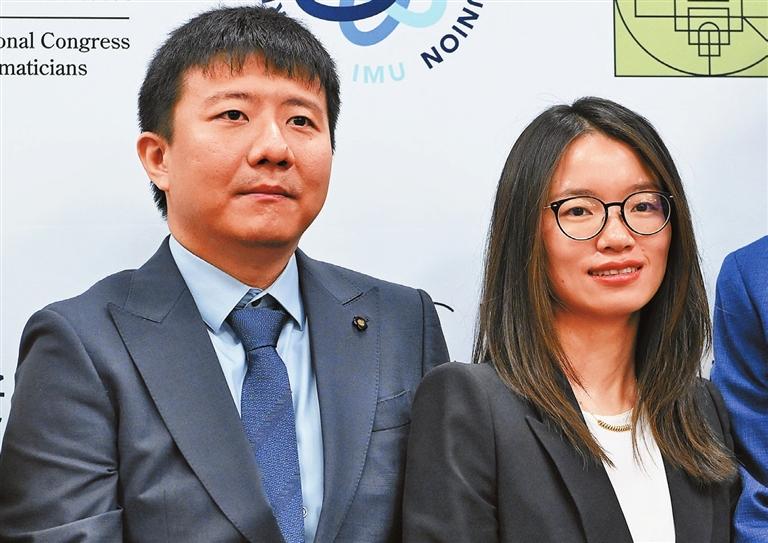
DENG YU, a Shenzhen-born mathematician and professor at the University of Chicago, has won this year’s Fields Medal for his work in partial differential equations (PDEs). The Fields Medal, announced Thursday at the 2026 International Congress of Mathematicians in Philadelphia, the U.S., is awarded every four years to up to four mathematicians under the age of 40 in recognition of their outstanding mathematical achievements in existing work and their promise of future achievement. In the absence of a Nobel Prize for mathematics, the Fields Medal is regarded as the highest professional honor a mathematician can attain. Winning alongside Deng were John Pardon from the U.S., Jacob Tsimerman from Canada, and Wang Hong from China, who happened to be Deng’s classmate in the 2007 cohort at Peking University’s School of Mathematical Sciences. Wang won the medal for her work in harmonic analysis and geometric measure theory. The two were also the first Chinese nationals to win the award. Previously, in 1982 and 2006, mathematicians of Chinese descent — Yau Shing-Tung and Terence Tao — stood on that podium. Wang is also only the third woman to win in the award’s 90-year history, following the late Maryam Mirzakhani in 2014 and Maryna Viazovska in 2022. Deng was honored for addressing one of a famous set of problems laid out more than 125 years ago, at the 1900 International Congress of Mathematicians, by German mathematician and philosopher David Hilbert. These problems have since become benchmarks of progress in the field. Deng’s mathematical roots run deep. Born in 1989, the mathematician is an alumnus of Shekou’s Yucai Primary School and Shenzhen Senior High School. His father, a computer programmer, would take him hiking and pose little combinatorics problems — the branch of mathematics focused on counting — for him to solve along the way. In his youth, Deng displayed a gift for problem-solving, excelling in both math competitions and tournaments of Go, an ancient Chinese strategy game played with black and white stones on a grid. Deng said he entertained the idea of becoming a professional Go player before devoting himself to academia. In 2006, at 16 years old, he represented China at the International Mathematical Olympiad and won a gold medal. The following year, he was admitted to Peking University, later transferring to the Massachusetts Institute of Technology. Deng earned a bachelor’s degree in mathematics in 2011, followed by a Ph.D. from Princeton University in 2015. He joined the University of Chicago in 2024. Though often labeled a child prodigy with a gift for mathematics, Deng has his own understanding of talent.He once said, “Talent is somewhat elusive — it’s not a fully well-defined concept. Effort is always necessary. If you strive and ultimately succeed, that in itself is proof that you possess some degree of talent. But without effort, talent remains invisible and unmanifested.” (SD News) | 