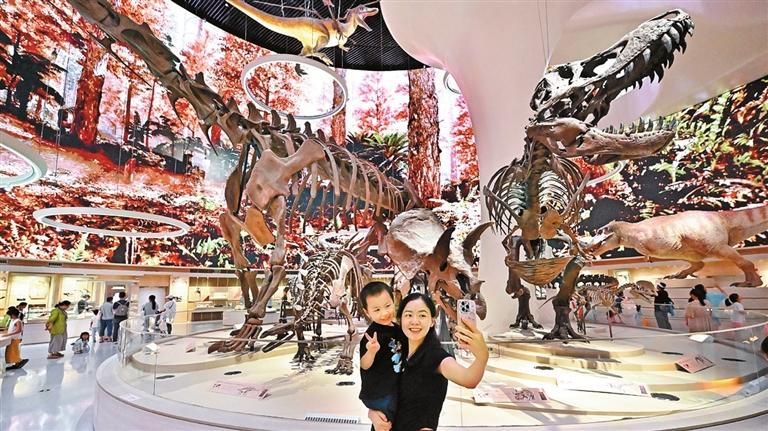
THE Shenzhen Natural History Museum, located in Pingshan District, opened to the public yesterday. As one of Shenzhen’s major cultural projects, the museum marks the debut of South China’s largest comprehensive natural history museum. At a news briefing with the media, Liu Lei, Party secretary and director of the Shenzhen Municipal Culture, Media, Tourism and Sports Bureau, said that the museum is positioned as “South China’s largest innovative natural history museum, a comprehensive indoor-and-outdoor natural history public education center, and a platform for showcasing examples of China’s modern ecological civilization.” The museum’s eight permanent exhibition halls — Cosmos, Earth, Evolution, Dinosaur, Human, Biology, Ecology, and Homeland — tell a continuous story. Visitors will explore the 13.8-billion-year history of the universe, the 4.6-billion-year evolution of Earth, and 3.8 billion years of life’s evolution, before arriving at Shenzhen’s local natural environment. The museum also includes a 1,630-sqm temporary exhibition hall, as well as a nature theater and a dome theater. It displays 7,461 authentic specimens, 338 replicas, and 194 other exhibits. Its collection balances global perspectives with local identity. Visitors can view four restored Western classical star charts, along with representative rocks, mineral crystals, and fossils from around the world. It also presents a rich display of biodiversity, featuring species from six major zoogeographic regions. Key highlights include the Chinese fossil plant Archaefructus, the dinosaur Iguanodon, the feathered dinosaur Anchiornis, an Ichthyosaur fossil, and a Cretaceous dinosaur fossil assemblage from Guangdong and Jiangxi provinces. The Homeland Hall alone features over 1,600 local specimens, ranging from migratory birds in Shenzhen Bay to native plants on Wutong Mountain, from insects in the city’s green spaces to marine life in Dapeng Bay — forming a genuine natural archive of Shenzhen. (Cao Zhen) Ticketing: Official WeChat account “深圳自然博物馆” Venue: Shenzhen Natural History Museum, Pingshan District Metro: Line 16 to Shabo Station (沙壆站), Exit C SkyShuttle: Line 1 to Natural History Museum West Station (自然博物馆西站), Exit B | 