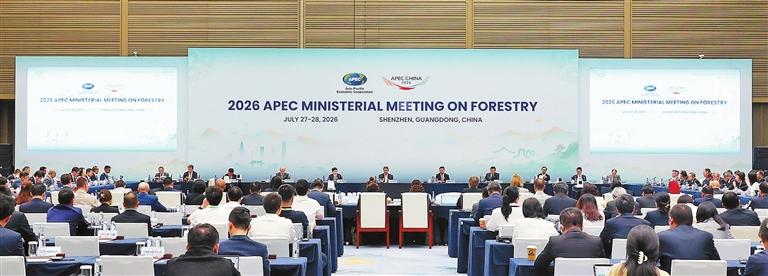
THE two-day 2026 APEC Ministerial Meeting on Forestry concluded in Shenzhen yesterday with the adoption of a joint statement, bringing together high-level representatives, experts, and scholars from 21 APEC economies and seven international organizations. Discussions focused on advancing global forest goals and integrating technological innovation with green industries. The joint statement calls on member economies to bolster biodiversity conservation, intensify law enforcement against the illegal trade of forest products, and incorporate sustainable forest management into national economic plans and policy frameworks. It urges increased investment in forestry development and legal trade, while supporting the value-chain enhancement of forest product processing. The statement also emphasizes regional cooperation in urban forestry and water resource management, using technological innovation to restore ecosystems and mitigate habitat fragmentation. The Asia-Pacific region holds more than half of the world’s forest area, accounting for approximately 60% of global forest product output and 40% of its trade. The region also hosts the world’s most diverse terrestrial and coastal ecosystems, including nearly half of its mangrove resources. As a central player in the region, China has contributed 25% of the world’s newly expanded green space. The country has placed 18% of its land under strict protection within its protected-area system, which includes its first five national parks and a newly established national botanical garden system. China’s forestry and grassland industry reached a total output of 11 trillion yuan (US$1.6 trillion) in 2025, supporting employment for more than 60 million people. China has prioritized Asia-Pacific forestry cooperation, initiating the Asia-Pacific Network for Sustainable Forest Management and Rehabilitation and establishing policy dialogue platforms such as the Meeting of Ministers Responsible for Forestry in Greater Central Asia. To date, China has supported more than 20 member economies in implementing over 50 forestry demonstration projects, investing more than US$45 million to restore over 1,300 hectares of degraded land. Additionally, China has hosted study programs for more than 200 forestry officials and provided specialized training for roughly 440 forestry managers. The meeting is a key event of APEC China 2026 and marks the first APEC meeting with an ecological theme held in China in 15 years. On the sidelines of the meeting, an exhibition showcased China’s progress in ecological civilization. Delegates also participated in field visits in Shenzhen, including mangrove seedling planting, smart forestry demonstrations, and a tour of the Dasha River Ecological Corridor, gaining firsthand insight into the city’s efforts to balance economic development with environmental protection. (SD News) | 