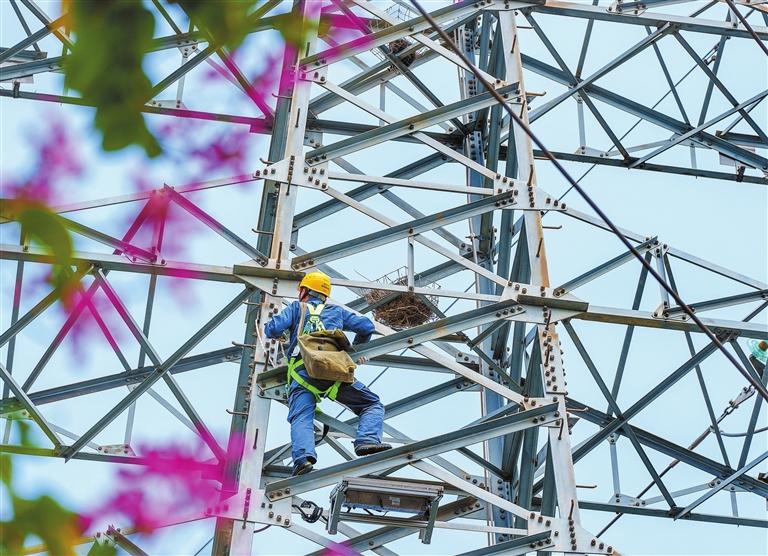
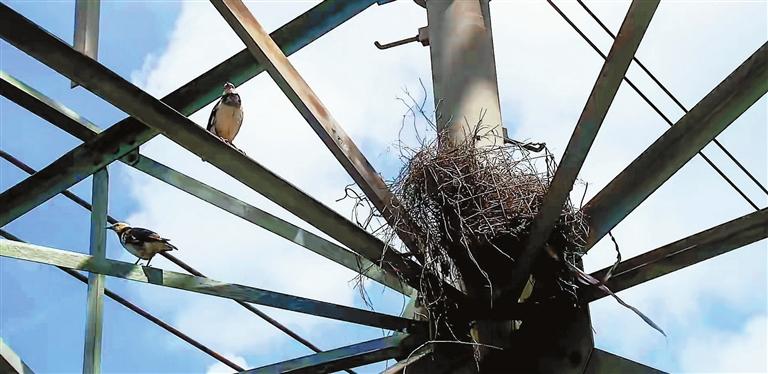
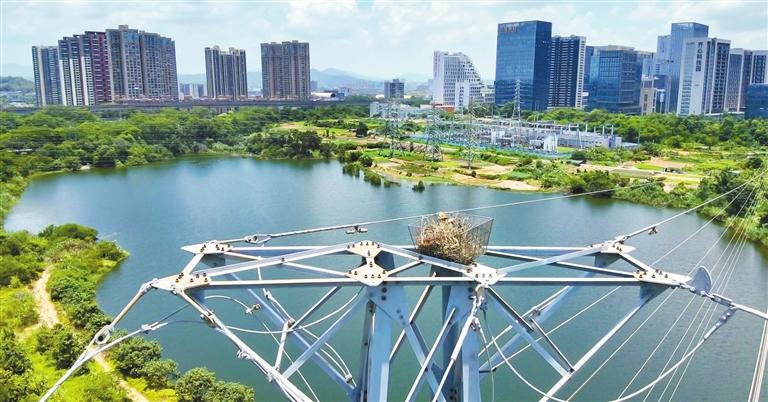
Since 2021, when it began promoting green bird-protection technologies, Shenzhen Power Supply Bureau of China Southern Power Grid Co. has installed over 30,000 bird-protection devices — including artificial nesting platforms and bird spikes — on transmission towers across the city where avian activity is concentrated. These measures guide birds to nest in safe zones away from live conductors, achieving a win‑win outcome for grid reliability and biodiversity conservation, and forging a practical path toward harmonious coexistence between birds and power lines in a megacity. Thanks to sustained efforts, the number of bird nests built in hazardous areas on transmission towers has declined year by year. AT dawn, the tides recede slowly across Shenzhen Bay, and the mangrove mudflats glisten in the early light. Egrets wade through the shallows, while a few small birds dart through the treetops toward the city’s central district. Mangroves face skyscrapers; migratory birds share the neighborhood with rush-hour traffic. In Shenzhen, the cohabitation of urban expansion and ecological preservation is not an ideal — it’s a daily reality. In recent years, as the city’s environment has steadily improved, bird populations have grown. Transmission towers have become favored nesting sites for many species. Yet perching near live wires brings electrocution risks, and the twigs, plastic strings, and metal wires birds carry can easily trigger short circuits and blackouts. How to reconcile avian protection with grid reliability? Shenzhen Power Supply Bureau (SPSB), a wholly owned subsidiary of China Southern Power Grid Co. (CSG), has found a path — one of gentle guidance and shared coexistence. A nest, a tower, and a delicate problem On an ordinary patrol day, a magpie flew in from the mangroves, a twig in its beak, circling a steel transmission tower. Sturdy and cross-braced, the tower stood like a tree that never sways. The bird soon chose a spot close to the conductor side, tucking the branch into a crevice, then returning with a length of plastic rope. Below, a yellow utility vehicle marked “Shenzhen Power Supply Bureau” pulled up. “Another new neighbor — starting its renovation,” said Zhou Xiaofeng, a maintenance operator with SPSB’s Transmission Management Station, raising his binoculars. Among the twigs, he spotted fine wire and plastic string — materials that, if blown against live lines, could cause faults and endanger the bird itself. After confirming the nest held no eggs or chicks, Zhou and his colleagues carefully removed the new structure. The magpie perched on the tower’s peak, head cocked, watching. It probably didn’t understand why its just-built home had been cleared. But removing the nest wasn’t about driving the bird away — it was about finding it a safer place to settle. From deterrence to welcome mat “Birds choosing to nest here shows the ecology is improving. Our job isn’t to reject them, but to steer them away from danger and toward suitable spots,” Zhou explained. The areas near conductors are extremely hazardous. The opposite side of the tower, away from live equipment, is far safer for perching and nesting. So patrol crews installed bird spikes near high-risk zones to discourage roosting, while setting up artificial nesting platforms on secure sections of the tower. These simple measures give birds a stable, protected home — safeguarding their lives while preventing line faults. One side gently says “not here”; the other openly says “welcome.” Small alterations that honor both winged inhabitants and grid security. The magpie returned. It first tried its original spot, saw the spikes, fluttered away, and then noticed the brand-new artificial nest cage on the middle section of the tower. It paused at the entrance, peered in, hopped inside, and circled once. Before long, it flew back toward the mangroves — and when it returned, it was carrying a fresh twig. “Looks like it’s accepted the relocation plan,” the crew below said with a knowing smile. A few days later, Zhou conducted another special inspection. The artificial nest was already lined with fine branches, and the magpie was busily shuttling back and forth. The danger zone near the conductors remained pristine — no new nesting debris at all. Scaling up a simple idea Such heartwarming scenes now unfold along many of Shenzhen’s transmission corridors. Since rolling out its green anti-bird technologies in 2021, SPSB has installed more than 30,000 bird-protection devices — including artificial nests — on towers across the city where avian activity is frequent. Professor Yang Qiong, a senior engineer at the Guangdong Neilingding Futian National Nature Reserve Administration, remarked: “The mangrove ecosystem is thriving, and migratory birds are expanding their range.” “Wetland biodiversity conservation demands multi-party collaboration. The power sector’s innovative, non-invasive approach — guiding birds to safe habitats while maintaining critical infrastructure — offers a valuable model for integrated coastal wetland protection,” he added. A shift in mindset A decade ago, the go‑to response for tower nesting was deterrence and nest removal. Today, SPSB has fundamentally changed its philosophy: prevention first, flexible management, and the integration of biodiversity protection into every phase — planning, construction, and maintenance. From passively responding to bird-related outages to actively building safe avian shelters, this subtle transformation reflects a deeper upgrade in how a state-owned enterprise embraces green development. One tower, two worlds At dusk, sunset spills across the mangrove mudflats. Flocks of returning birds glide past row after row of transmission towers. On one side of each tower, electricity flows steadily to millions of households, powering the city’s life and economy. On the other, a magpie nestles in its artificial cage, quietly preening. One tower. Two worlds, each in its rightful place. Urban-nature harmony doesn’t always demand grand gestures. Sometimes it lives in a man‑made nest, a thoughtful nudge, and a steadfast commitment sustained over years — quiet efforts that work like gentle rain. A modern metropolis need not shut nature out; city growth and ecological stewardship need not be a zero‑sum game. As lights flicker on across the skyline, the birds have their safe haven. That unassuming goodwill, perched high on steel towers, is a living emblem of Shenzhen’s ambition to become a model of modernized harmony between humanity and nature. And it is the quiet responsibility of SPSB to guard both the city’s brilliance and the creatures that share its skies.(Zhu Tingting) | 