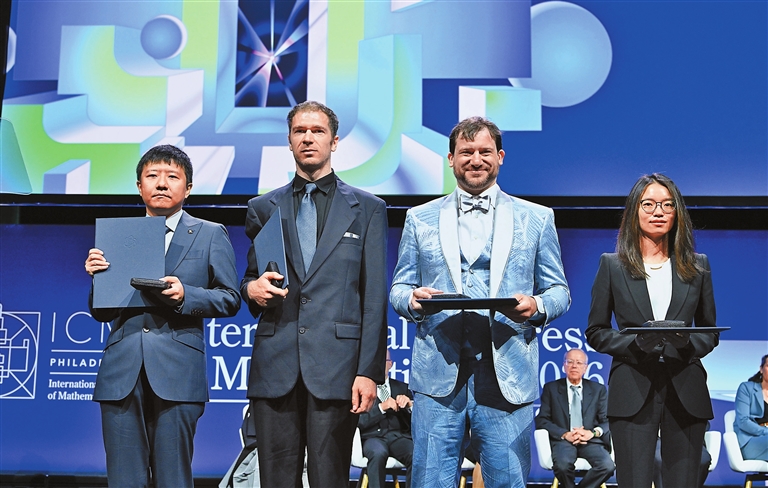
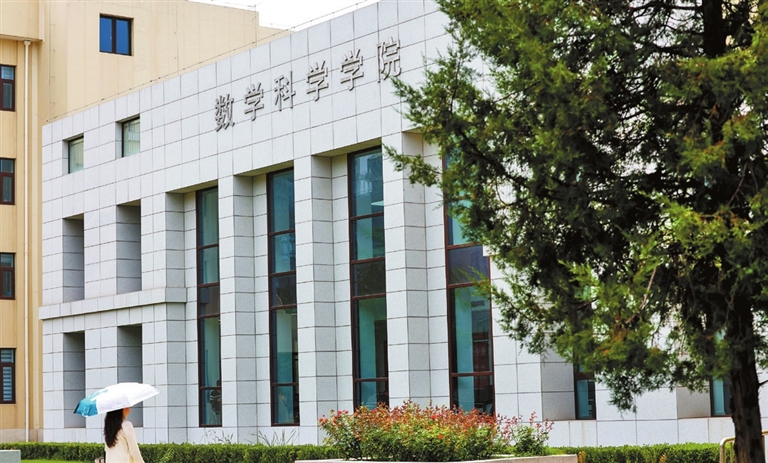
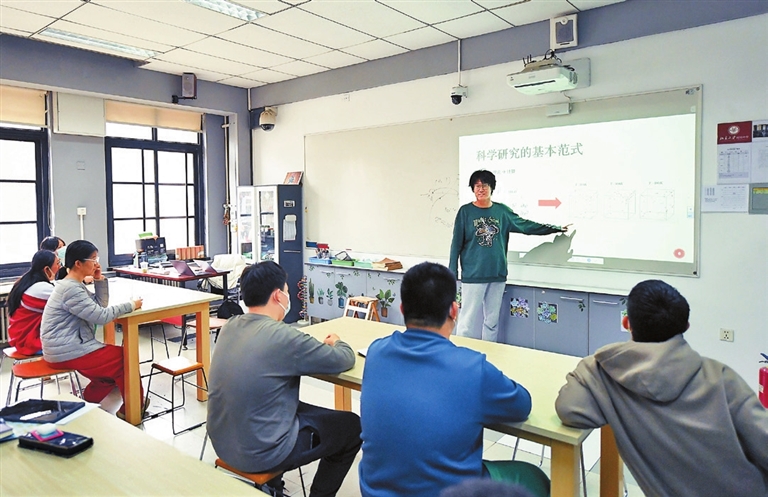
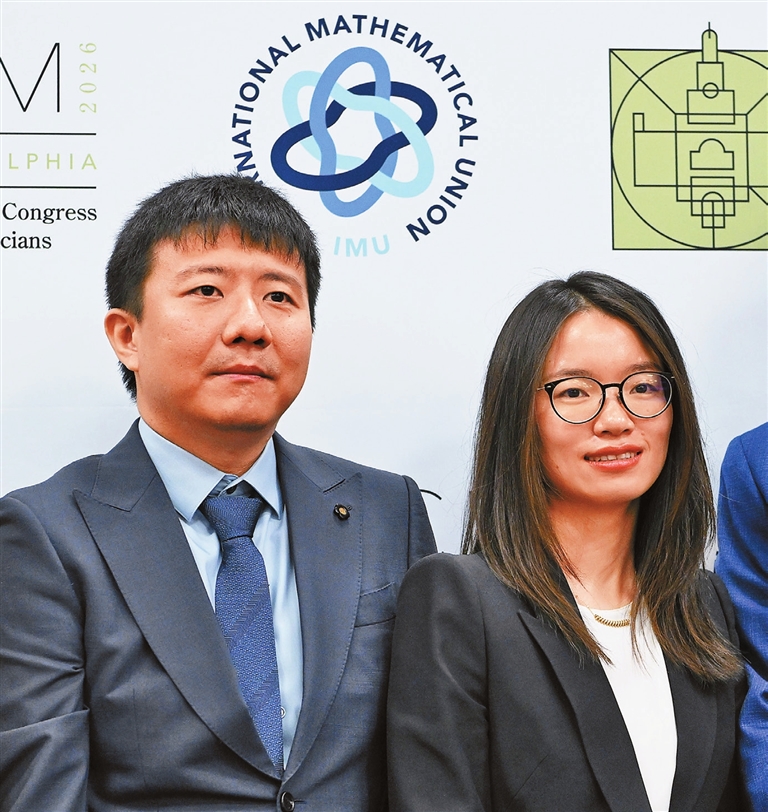
CHINESE mathematicians Wang Hong and Deng Yu have become the first Chinese nationals to win Fields Medals, sparking widespread excitement among scholars, teachers, students and science enthusiasts. Both were honored with the prestigious awards at the opening ceremony of the 2026 International Congress of Mathematicians in Philadelphia on July 23. Their journeys could not have been more different. Deng Yu followed the well-trodden path of a Chinese math prodigy. He won a gold medal at the International Mathematical Olympiad and gained admission to an elite mathematics program at Peking University. He later transferred to the Massachusetts Institute of Technology after two years in Beijing, earning his Ph.D. in mathematics from Princeton in 2015. In a post on Zhihu, he described his life at 21 — his second semester at MIT — where he took five or six math courses, read three books at the same time, and spent more than eight hours a day on his studies. Deng received the prize for his work on partial differential equations. He now serves as a professor at the University of Chicago. Wang Hong took a decidedly different route. She hails from Guilin in southern China’s Guangxi Zhuang Autonomous Region. Despite lacking formal math Olympiad training, she skipped two grades and entered Peking University at the age of 16. She initially enrolled in the School of Earth and Space Sciences but transferred to the mathematics program, driven by her interest in the discipline. Her unconventional streak continued during her graduate studies in France, where she took a brief detour into architecture for six months before returning to mathematics. This experience gave her a chance to reflect on and reaffirm her passion — she realized that compared with architecture, she preferred to leverage her creativity in mathematics, where she could develop her ideas independently. Wang was honored for her contributions to harmonic analysis and geometric measure theory. She serves as a permanent professor at the Institut des Hautes Études Scientifiques, a French institution whose faculty has included many Fields Medalists, and as a professor of mathematics at New York University. Despite their different trajectories, the two mathematicians shared a common academic origin: they were classmates in the 2007 cohort at Peking University’s School of Mathematical Sciences. A cohort of students who enrolled around 2000 has been hailed as Peking University’s “golden generation” of mathematics. Wang and Deng’s own 2007 cohort saw more than a dozen exceptional mathematicians emerge from its ranks. “Chinese mathematics has made continuous progress since the launch of reform and opening-up,” said Shing-Tung Yau, the first mathematician of Chinese descent to receive a Fields Medal. “We were once far, far behind the world’s leading mathematical powers. Today, thanks to the efforts of several generations, we have come close in many respects.” Previous Fields Medalists of Chinese descent were Shing-Tung Yau in 1982 and Terence Tao in 2006. “Seeing the younger generation of mathematicians, those who received a solid basic education in China and went on to do outstanding research overseas, ultimately win the Fields Medal, I feel deeply honored and truly gratified,” said Yau, a chair professor at Tsinghua University. A milestone for Chinese mathematics “The essential part of both laureates’ education was completed in China,” said Efim Zelmanov, a foreign member of the Chinese Academy of Sciences (CAS) and a Fields Medal laureate. “Their remarkable achievement is a powerful recognition of China’s fundamental and rapidly growing role in the world of mathematics,” he added. Prof. Zhang Jiping, an academician of the CAS and a professor at the School of Mathematical Sciences at Peking University, said, “This win by Chinese mathematicians demonstrates that the achievements and capabilities of Chinese mathematicians have been acknowledged and recognized by the global mathematical community. This is a major historic breakthrough for Chinese mathematics and marks a milestone.” For teachers and students from China’s top universities, this breakthrough has made the world’s highest mathematical honors feel less distant. “What struck me the most was when Wang Hong said that in her mathematical research, she would try out every single idea she has,” said Gu Kaiyuan, a student at the same school where both winners once pursued their undergraduate studies. “This courage to tackle difficult problems and the ability to engage in long-term, profound reflection in the face of failure are precisely the hallmarks of a mature mathematician.” Wang and Deng’s achievements are, in part, the fruit of China’s deepened academic engagement with the world over recent decades. It is a stark contrast to more than 40 years ago, when Tian Gang, a professor of mathematics at Peking University and an academician of the Chinese Academy of Sciences, was a math student at Peking University. Tian and his classmates would cycle for more than two hours round-trip just to attend a single lecture by a scholar returning from abroad. Tian noted that Wang studied in a highly competitive environment with many brilliant peers. He said the Fields Medal victories by Wang and Deng could inspire a new generation of Chinese students and scholars, instilling in them the confidence to tackle major mathematical problems. Yet he offered a frank assessment of the current reality: while Chinese scholars are leading the world in some areas and on par with global leaders in others, the overall pool of mathematical talent remains limited. Inspiring a new generation The news also ignited discussions on other social media platforms. A blogger named Hanlu wrote on the microblogging platform Weibo that “Two of the medalists are Chinese nationals — they’ve made history. Salute!” The post had received more than 2,000 interactions. Lu Rui, a Ph.D. candidate in the Department of Automation at Tsinghua University, described it as a historic breakthrough that has deeply inspired him during a live broadcast on the Fields Medal. Lu, who runs a math popularization channel, Meditation Math, on the YouTube-like platform Bilibili with 1.4 million followers, earned over 10,000 interactions across his three Fields Medal-related posts, as online users flooded in to congratulate Wang and Deng in the comments. Comments pouring in under Xinhua and CCTV’s Weibo posts were filled with congratulations: some noted they had witnessed history and praised the prowess of Chinese mathematicians, while others observed Deng had grown into a public role model. Many more regarded Wang as a source of pride and a role model for young women in China. In a phone call with Wang, French President Emmanuel Macron told her: “My admiration for your work can only grow, and for young girls, you’re a wonderful role model.” Looking ahead, Yau said he expected more scholars to return to China and train a new generation of young researchers, adding that he believes Chinese mathematics could reach the global forefront within five years. While welcoming the achievement, Yau also called for greater appreciation of interdisciplinary research in China. He said the country should encourage such research to flourish while enabling mathematicians and theoretical scientists to create original directions and approaches of their own by drawing insights from different disciplines. Deng’s interests extend well beyond mathematics. “If I weren’t a mathematician, I would be a sci-fi writer,” he once said, noting that his favorite work is “The Orthogonal Trilogy” by Australian author Greg Egan. On Chinese social media, many voices remained clear-eyed amid the jubilation, expressing the hope that the younger generation of Chinese mathematicians can achieve even more academic breakthroughs. “I believe there is hope for us in some of the core areas of mathematics,” Tian said. “Chinese mathematicians can make even greater contributions to the world.”(Xinhua) | 