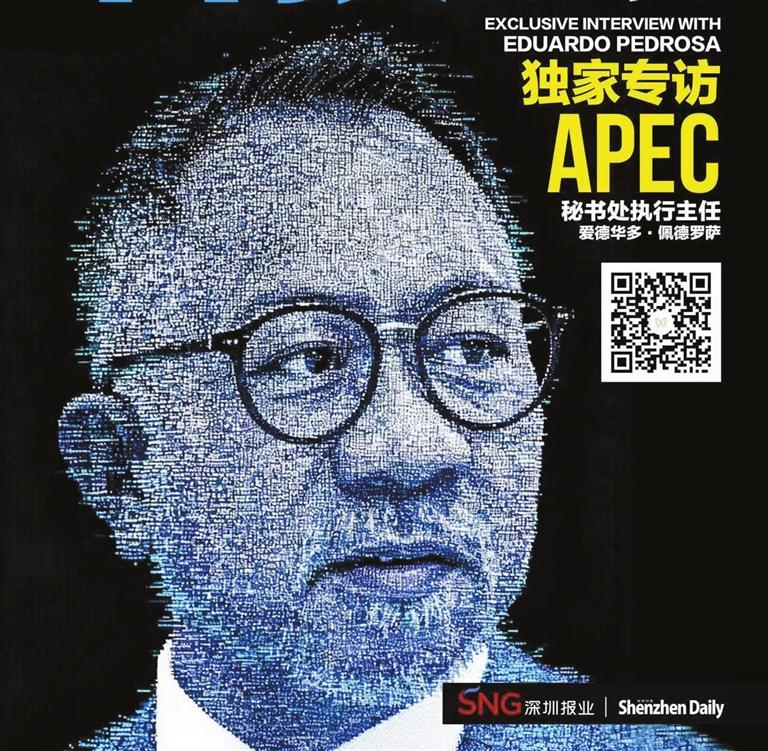
Editor’s Note: With 100 days to go until the 33rd APEC Economic Leaders’ Meeting, Shenzhen Daily presents “APEC 2026 Outlook,” a special feature on the ideas, people and trends shaping this year’s gathering. In an exclusive interview, Eduardo Pedrosa, executive director of the APEC Secretariat, traces the evolution of APEC’s priorities — from trade and investment liberalization in Shanghai in 2001, to cross-border connectivity in Beijing in 2014, and now to technology and people-centered development in Shenzhen. The common goal is to ensure that innovation delivers tangible benefits to people’s everyday lives. The full interview follows. Zhang Yu JeniZhang13@163.com WITH his palm open, Eduardo Pedrosa watched as a gesture-controlled drone hovered steadily before landing gently on his hand. The executive director of the APEC Secretariat let out an unscripted “Wow!” at Shenzhen Bay Culture Square on May 5. The next day, at the APEC China 2026 “Tech for People” Nanshan Day event, he joked about misplacing his glasses. “Please help me find a tracker for these,” he said, waving the frames at the crowd. The drone and tracker-equipped glasses offered small but telling examples of Pedrosa’s core belief: Technology matters when it solves ordinary people’s everyday problems. Ahead of the 33rd APEC Economic Leaders’ Meeting, Pedrosa made two working visits to Shenzhen. He attended APEC-related events, visited companies and research facilities, met young scholars and participated in the APEC Ministerial Meeting on Forestry. His observations portray Shenzhen as a window into China’s high-quality development and an example of how innovation can serve people and benefit communities worldwide. Interoperability over uniformity Pedrosa stressed that economic growth is a means, not an end. Innovation, he said, should expand opportunities, improve living standards and promote inclusive, green growth. Rather than imposing identical regulations on all APEC economies, he advocated interoperability: allowing each economy to retain its own rules while ensuring that digital and trade systems work smoothly across borders. “What APEC really looks at is not harmonization, but interoperability,” Pedrosa said. “To make sure our systems can work together.” Shenzhen’s cross-border industrial cooperation within the Guangdong-Hong Kong-Macao Greater Bay Area (GBA) offers, in Pedrosa’s view, a practical example of mutually beneficial collaboration. City built on connectivity Shenzhen’s urban transformation left Pedrosa astonished. “The city is unrecognizable. Nothing I see today resembles the quiet town I first visited,” he said. He also pointed to improved links between Hong Kong and Shenzhen, including ferries, bridges and high-speed rail, as evidence of deepening regional integration. APEC has long identified three dimensions of connectivity: physical infrastructure, institutional coordination and people-to-people exchanges. Pedrosa’s visit to Qianhai offered firsthand evidence that the third may be the most important. At a technology exhibition there, Pedrosa and his colleagues tried AI simultaneous-interpretation headsets and viewed immersive AI glasses and naked-eye 3D displays. The group tested adjustable ergonomic office chairs, prompting lighthearted banter. “This chair is far more comfortable than the one in my office,” Pedrosa said with a laugh. Fernando Salas, the Secretariat’s communications director, replied: “It’s so cozy you can barely get any work done on it.” Pedrosa later played with SenseTime’s AI Chinese chess robot and joked that developers should build a mahjong robot next. The unscripted moments reflected Qianhai’s approach to innovation: Advanced technology should be intuitive, enjoyable and integrated into everyday life. What impressed Pedrosa most was Qianhai’s integrated innovation ecosystem, which brings together researchers, financial institutions and policymakers to turn lab discoveries into products that improve people’s lives. Pedrosa also highlighted Shenzhen’s efforts to balance urban development with environmental protection. “It’s fascinating to see skyscrapers rise alongside extensive greenery and protected mangroves,” he said at the APEC Ministerial Meeting on Forestry in July. “Geospatial planning and zoning are crucial to ensure we urbanize without losing sustainability.” Innovation takes center stage Pedrosa outlined how APEC’s priorities have evolved during China’s three turns hosting APEC meetings. The 2001 meeting focused largely on trade and investment liberalization. The 2014 meeting broadened the agenda to include cross-border connectivity. In 2026, technological innovation and long-term sustainability are moving to the forefront. Shenzhen’s strength lies in its complete industrial chain, which links research institutions with manufacturers and accelerates commercialization. Its homegrown products include AI chips, smart-home appliances, cleaning robots and augmented-reality glasses, many of which have gained popularity worldwide. Pedrosa singled out the integration of AI and renewable energy as a promising area, particularly for younger generations. He encouraged APEC delegates to explore Shenzhen’s innovation ecosystem before November’s meeting. The evolution of APEC’s agenda, he said, reflects China’s pursuit of high-quality development and gives fresh momentum to the Putrajaya Vision 2040, which aims to build an open, dynamic, resilient and peaceful Asia-Pacific community. At the APEC Study Centers Consortium Youth Scholars Forum in May, Pedrosa emphasized the role of young researchers in building a regional community based on mutual understanding. He also said the GBA’s complementary industrial strengths could offer a model for cooperation across the Asia-Pacific. A new human-tech bond Pedrosa offered a preview of what leaders and observers may see at the 2026 APEC meeting. The world, he said, will not only be impressed by Shenzhen’s rapid urban development but will also witness a new relationship between people and technology taking shape in the city. “Technology ultimately belongs to people,” he said. “It exists to serve humanity, earn their trust and win their affection.” | 