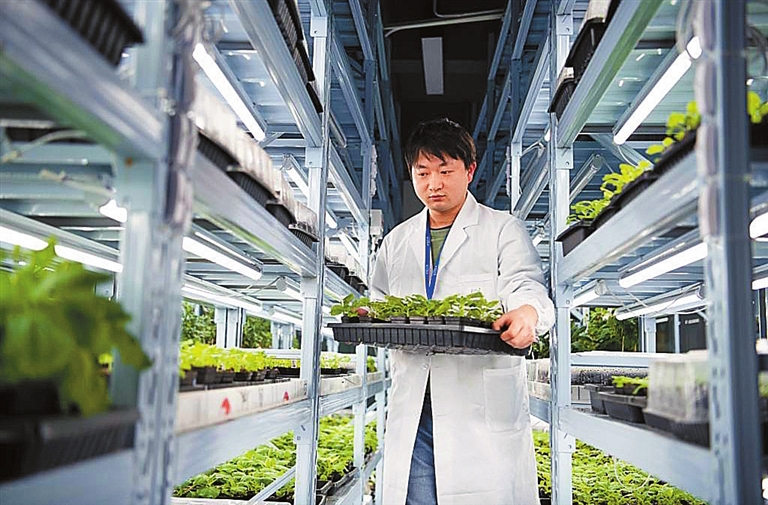
WHAT if your evening stroll came with a soft, natural glow? This fall, Beijing’s Dongsheng Bajia Park will answer that question with a 7,000-square-meter greenhouse filled with bioluminescent decorative plants. Featuring a glowing café and a radiant botanical corridor, the venue promises a surreal after-dark experience that reimagines the classic nature walk. The project, led by Heifei-based Magicpen Biotechnology Co, transforms a childhood dream into public reality — the vision of founder Li Renhan, who grew up fascinated by fireflies. “I wished I could make plants glow in the dark, like fireflies,” Li recalled. That early wonder eventually fueled the company’s breakthrough innovations. As of August, Magicpen has developed over 10 glowing plant varieties, including petunias, tobacco, and poplar. Central to this achievement is Agent VitaMind, an AI platform that accelerates genetic design and metabolic engineering. “Using AI, we boosted the supply of luminescent substrates and enhanced fungal activity in plant cells,” Li explained. “We also prevented gene silencing, so the glow remains stable across generations.” The company is already looking ahead to a third-generation upgrade, aiming for brighter, multicolored light and improved cold and drought tolerance — making these plants viable for parks and tourism sites nationwide. “After modification, the plants grow and look no different from ordinary greenery in the daytime,” Li said, “which paves the way for large-scale commercial use.” Currently, the glow is faint green, visible under a full moon and even clearer on moonless or overcast nights. The next generation, optimized by AI, will maintain steady visibility even under a half-moon. “The garden’s corridors and shaded canopies help reduce moonlight interference, enhancing the viewing experience,” Li added. Safety is a top priority. The company uses sterile or low-pollen varieties, such as double-petal petunias, to prevent crossbreeding with wild plants. Luminescent genes are expressed only in leaves, stems, and flowers — not in seeds or pollen — so accidental dispersal won’t create glowing offspring. Greenhouses are sealed with insect-proof nets, all plant waste is heat-treated, and AI simulations assess ecological impacts on bees, soil microbes, and local animals. “In five years, we expect glowing plants to serve as supplemental night lighting in parks and pathways, reducing electricity use,” Li said. Currently, the glowing plants are on display at Beijing Flower World in Fengtai District, Magicpen’s Bio-Research Base near Hefei, and the Anhui Science and Technology Museum. The concept is part of a global trend — in June, Spanish researchers unveiled transgenic plants that change color when infected by viruses, enabling early pest detection — but Magicpen’s vision is uniquely poetic: turning moonlight into greenery, and childhood wonder into a sustainable, luminous future. (SD-Agencies) | 