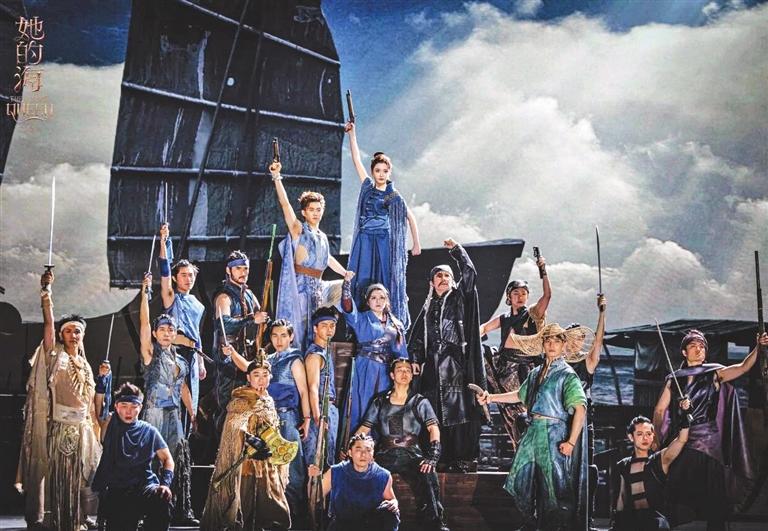
SHI XIANGGU, a fishing girl who rose to become the legendary “Pirate Queen” in the early 19th century during the Qing Dynasty (1644-1911), has long been a figure of fascination. She defended her waters from foreign warships, burned opium ships in the pursuit of justice, and ultimately accepted the Qing court’s amnesty for the well-being of her people. Now, her extraordinary journey is being retold through the musical “The Pirate Queen,” which will be staged in Shenzhen in October. The production, deeply rooted in Guangdong’s maritime culture, centers on Shi’s epic transformation from a pirate’s wife to a ruler of six fleets, weaving together themes of family, freedom and love. It chronicles her struggle and growth amid the constraints of her era — a journey from mere survival to profound awakening — drawing on the rich folk traditions of China’s oceanic heritage to craft an Eastern maritime epic. For director Xu Jun, Shi’s story is not simply about power, but also about survival, resilience and compassion. “There’s a line in the musical that reads, ‘So there really are pirates who don’t care about wealth.’ I think that’s the highest compliment to Shi Xianggu,” Xu said. He explained that Shi sank more than 20 opium ships, refusing to use the wealth gained from wrongdoing for personal benefit, even when her people faced hunger and hardship. For singer and actress Wu Xuanyi, who makes her musical theater debut with the production, Shi’s strength comes from constant transformation through adversity. “She may appear gentle and delicate on the outside, but deep inside she is incredibly resilient,” Wu said. “I hope I can bring her story and that period of history to the audience.” For composer Peter Kam, creating the musical required finding a unique sound that reflected the spirit of the sea. Inspired by the sound of the suona, a traditional Chinese instrument, he created music that captures the pirates’ individuality, their untamed spirit and their courage to brave the waves. For Kam, Shi’s story carries a universal message. “Art should communicate not only what makes us different, but also what we all have in common,” he said. “Fate, hardship and joy know no borders.” Time: 7:30 p.m., Oct. 24; 2:30 p.m., Oct. 25 Venue: Opera Hall, Longgang International Arts Center, Longgang District (龙岗国际艺术中心歌剧厅) Metro: Line 10 to Bei’er Road Station (贝尔路站), Exit D(SD News) | 