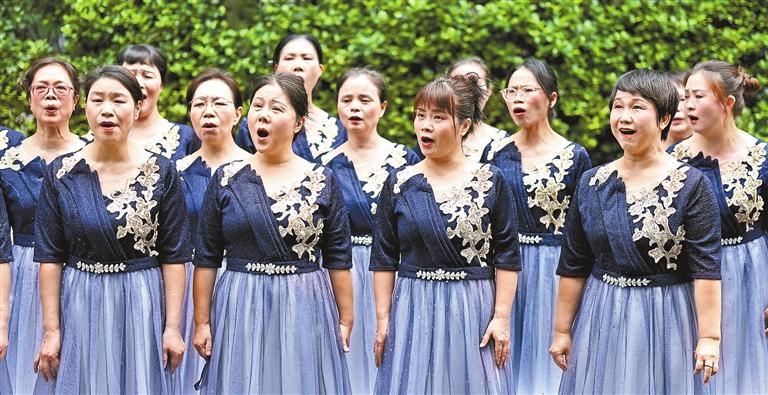
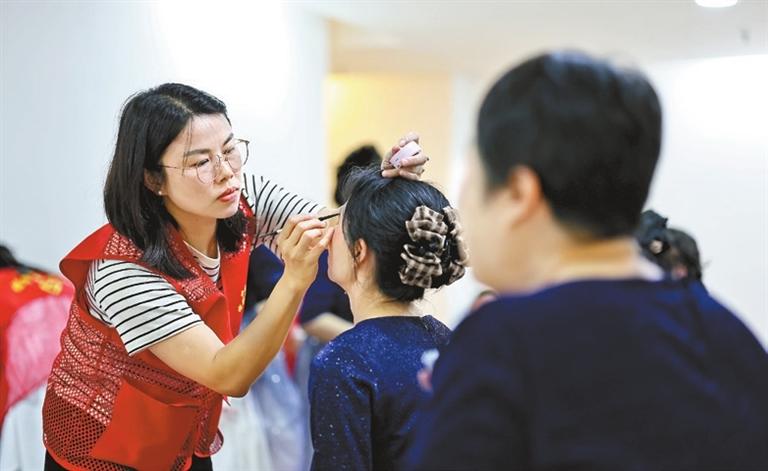
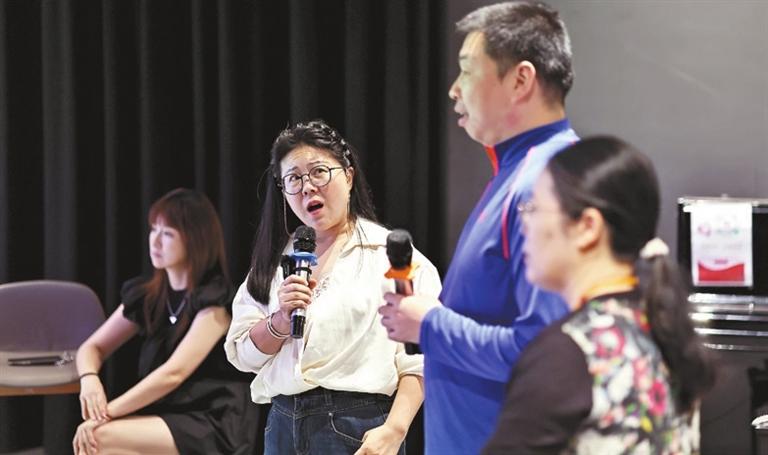
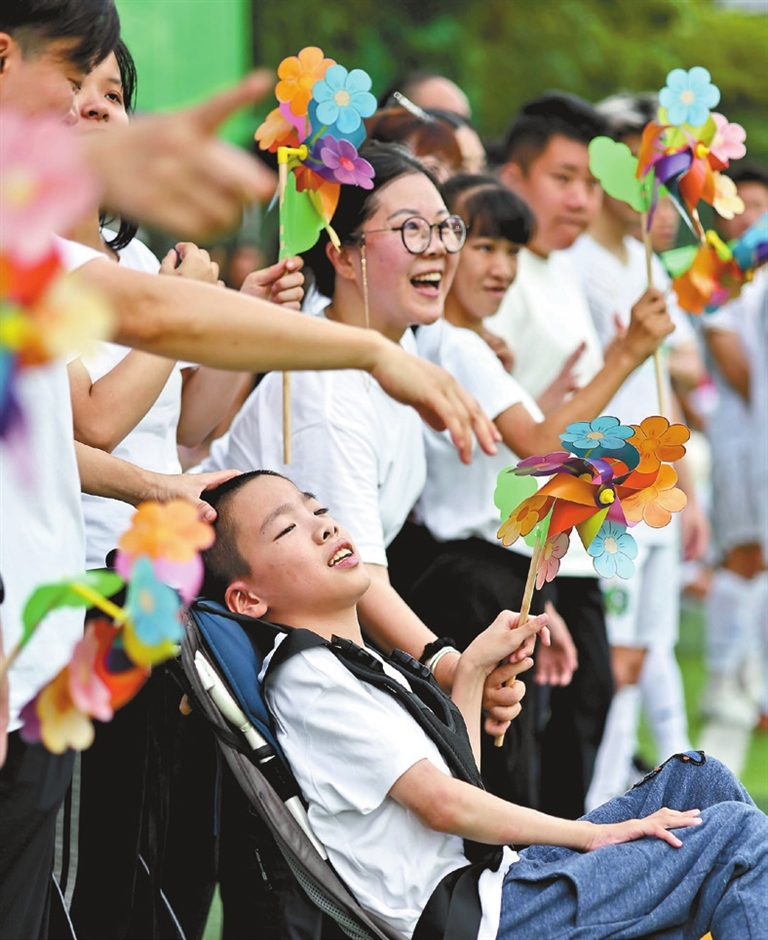
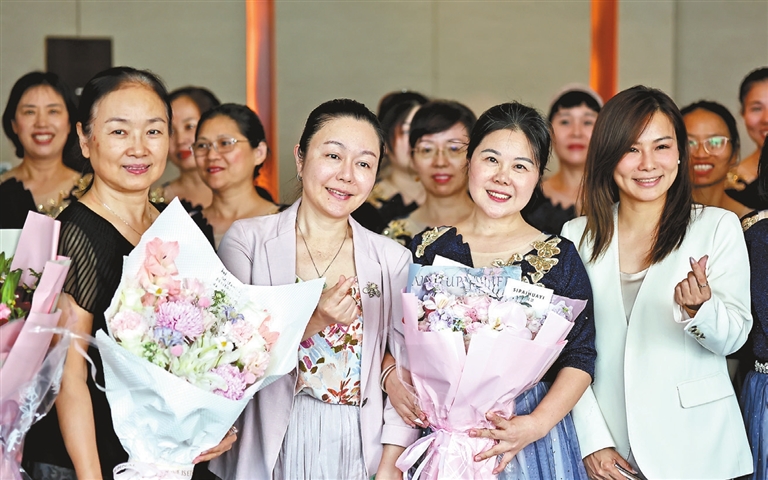
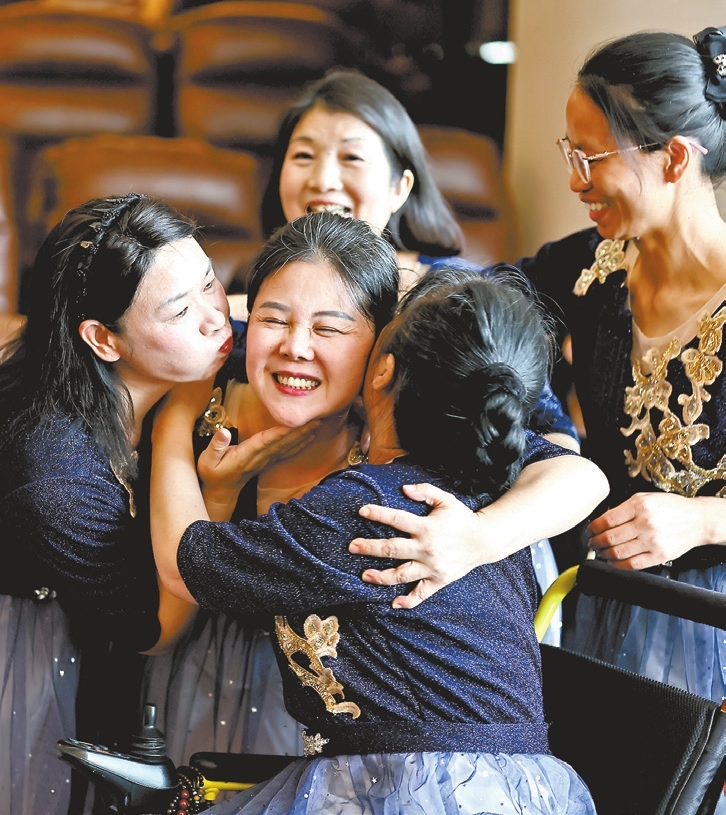
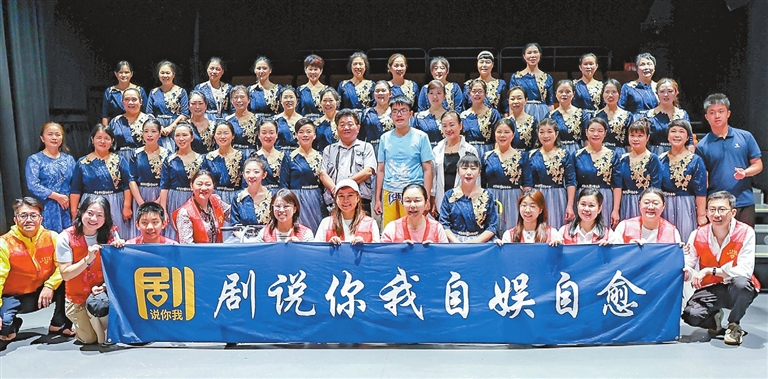
Chen Siqi vankochensq@163.com ON Thursday afternoons, the fluorescent lights of a community service center in Shenzhen flicker to life — and so does a different kind of rhythm. The hum of the air conditioner fades into the background as voices rise together, weaving through the air in search of harmony. A line is rehearsed. A gesture is perfected. Someone laughs; someone wipes a tear away. For a few hours, these women are not defined by their children’s diagnoses. They are not caregivers, therapists, or exhausted mothers navigating the labyrinth of rehabilitation appointments and uncertain futures. They are simply performers. This is Jushuo Ni Wo — “Drama Speaks of You and Me,” an arts troupe made up of mothers of children with autism, intellectual disabilities and cerebral palsy. Founded in July 2024, the group began as a place for mothers to meet and support one another. It has since become a stage for their stories — and a way for them to reclaim themselves and reconnect with society. How the troupe begins For many of these women, becoming a mother also meant becoming a full-time caregiver. “After our children were diagnosed, the course of our lives changed,” said troupe leader Liao Liangcheng. Liao has twin daughters. Her elder daughter has an intellectual developmental disability. From the age of 10 months, Liao took her between hospitals and rehabilitation centers, trying treatment after treatment. “When she was little, we did intensive rehabilitation with her. It felt like we were racing against time,” she said. Even the smallest improvement could bring enormous joy. Peng Haidan, whose child has cerebral palsy after suffering brain damage associated with premature birth, has spent years travelling between Beijing, Guangzhou and Shanghai for treatment. Her days once began at 6:30 a.m., dressing and feeding her child before school, rushing to rehabilitation at lunchtime, then returning home to cook and help with homework. By the time her child went to sleep, it could be midnight. Peng, once outgoing and passionate about music, gradually lost touch with her friends. “There were so many things I could only keep to myself,” she said. Many of the mothers had spent more than a decade living this way, with their lives increasingly centered on their children. “As one parent put it, ‘After my child became autistic, I became autistic too,’” Liao said. It was this isolation that brought them together. Liao and several other mothers in similar circumstances then came together to start Jushuo Ni Wo. “The name means that we use drama to tell the stories of our real lives,” Liao explained. At first, the troupe had no funding or permanent venue. The mothers contributed what they could — 10 yuan (US$1.4) here, 50 yuan there, sometimes 500 yuan. “A few friends who cared about what we were doing sponsored us 8,000 yuan,” Liao recalled. “That was how we started.” Liao handled much of the work herself, from finding rehearsal spaces and teachers to writing applications and editing videos late into the night. Eventually, with support from local organizations, the troupe found a regular rehearsal space at a community service center in Gangxia. Retired teacher Liu Qunxian also volunteered to teach them. “I was truly moved by your maternal love and your determination never to abandon your children,” Liu said. “Whether there is money is secondary. Being able to contribute what I can and have fun together with everyone — I think it is worthwhile.” Learning to sing, and to be together Most of the mothers had no formal training in music or drama. They practice pronunciation, pitch and rhythm, share recordings in group chats and encourage one another to keep practicing. Some have taken on organizing and volunteer roles. Peng is now the leader of the soprano section. “If we can help even a little, we will,” she said. “We have already endured all the difficulties of raising our children,” she added. “How difficult can learning to sing be by comparison?” Their efforts have taken them from local choir competitions to the 12th National Games for Persons with Disabilities. They also won a silver award in the adult category at the 8th Shenzhen Chorus Season. But for the mothers, the biggest change is not the awards. Before Thursday arrives, they are already asking Liao: “Have you booked the venue?” Some come wearing lipstick and their best clothes. For a few hours, they can laugh, sing and forget about the pressures waiting at home. And because everyone in the room understands what it means to raise a child with a disability, they do not have to explain themselves. They exchange information about rehabilitation centers and support policies, but they also listen to one another. Peng remembers sitting in a session listening to another parent share her story and suddenly bursting into tears. Her child noticed. Although he could not use his hands in the same way as most children, he raised his hand and told her: “Mom, don’t cry, don’t cry.” “We sing and dance together, our children become more cheerful, and it feels as though we have reconnected with society,” Peng said. Speaking for their children For Liao, Jushuo Ni Wo was never meant to stop at singing. She sees drama as a more powerful way to tell the complicated stories of families raising children with disabilities. “Drama is one of the most challenging forms of art, but it can bring together language, music and physical movement,” she said. “It allows us to present our stories in a much more complete way.” The troupe is developing a play, “Love Opens a New Journey,” based on the life of autistic pianist Li Hengchang, who won an international Liszt piano competition. Liao wants audiences to see what lies behind such achievements: a mother’s anxiety, the money and effort spent on rehabilitation and music lessons, the child’s moments of frustration, and the family’s struggle to keep going. “I thought, why not turn this child’s journey into a play?” she said. She also wants to tell the stories of families whose children have more severe disabilities — those who use wheelchairs or cannot care for themselves. “They are together 365 days a year, 24 hours a day,” she said. “The parents’ emotions also need to be cared for.” The hope is not simply to win sympathy, but to build understanding. “Maybe you have encountered such a situation on the subway,” Liao said. “The next time you come across it, I hope you won’t overreact.” Finding a way back to themselves Two years after Jushuo Ni Wo was founded, the mothers have discovered that the group has become a kind of rehabilitation of its own. Not for their children, but for themselves. “We may be the people who have walked alongside each other for the longest time in our lives, and who understand each other the best,” Peng said. The challenges have not disappeared. Their children still need care, and the mothers still return to the same demanding lives after rehearsal. But on stage, they are more than caregivers. They are singers, performers, friends and women with voices of their own. And by telling their stories, they hope to make the world around their children a little more understanding. Two years ago, Liao said, they began with a simple purpose: “to keep each other warm, to entertain and heal ourselves.” Now, that purpose has grown — to keep singing for themselves, telling stories for their children, and building a bridge between their families and the wider society. According to China Disabled Persons’ Federation, China recorded more than 85 million people with disabilities, and behind them stand lot of mothers who look after them day after day. For these mothers, there needs to be a way to cope with their emotions. For these mothers in Jushuo Ni Wo, art is not an escape from reality. It is a way of facing it together — and finding, along the way, a way back to themselves. | 