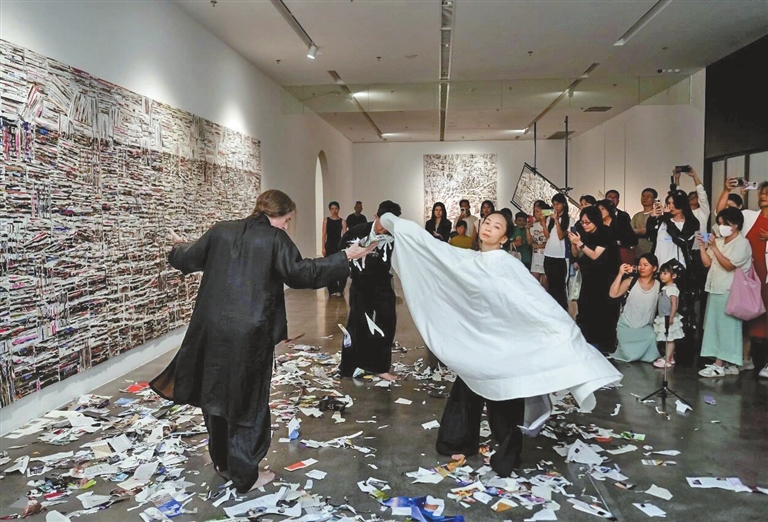
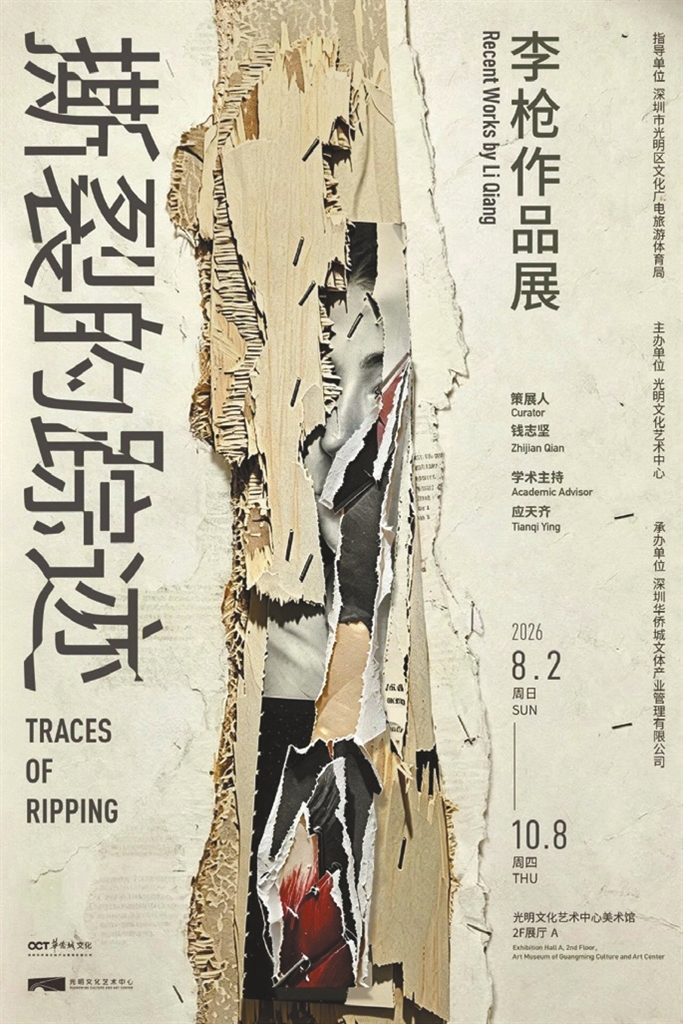
A NEW exhibition at the Guangming Culture and Art Center (GCAC) uses mind-blowing installations to invite visitors to confront and rethink the fragmentation of how we take in knowledge — and its possible consequences. Titled “Traces of Ripping,” the exhibition presents works that contemporary artist Li Qiang has created over the past six years, including a large-scale installation completed on site shortly before the opening. Li, previously known for his prints, began experimenting in 2009 with a unique creative method — ripping books and magazines, then sticking and stapling the fragments together to form new visuals. Curated by art historian and critic Qian Zhijian, the exhibition consists of four sections that focus on major issues of social and cultural life: the blurriness of history, injured nature, distant memory, and the silent passing of knowledge and information. “Li transforms everyday book materials into a highly recognizable visual language. Through ripping and reconstructing, he invites viewers to contemplate the complexity of knowledge and information and their multiple possibilities,” Qian said. In the section titled “Blurred History,” Li’s works represent images of neolithic painted pottery, terracotta warriors, or historical figures from ancient times. Viewed from a distance, these are recognizable figures or objects. But as you walk closer, the images blur and eventually dissolve right in front of you. The experience reminds us that history is constantly rewritten. It also mirrors our perception of history as many disjointedly overlapped layers of fact. The section “Injured Nature” draws our attention to the damage humans have inflicted on the natural world. Here, woods, mountains, and sea are no longer pleasant landscapes; instead, they are remnants and residues left behind by ripping and ravaging. The centerpiece of “Distant Memory” is a series titled “April: Memory of Shenzhen.” Represented either visibly or formlessly, the fragments become symbols of our recollections as they keep distancing themselves from us. The final section, “Silent Passing,” invites audience participation. As visitors pass the torn sheets among themselves, the action symbolizes the responsibility for passing down culture and history — a responsibility that rests on each of us. Dates: Through Oct. 8 Venue: Fine Arts Museum, Guangming Culture and Art Center, Guangming District (光明文化艺术中心美术馆) Metro: Line 6 or 13 to Fenghuang Town Station (凤凰城站), Exit F(Li Dan) | 