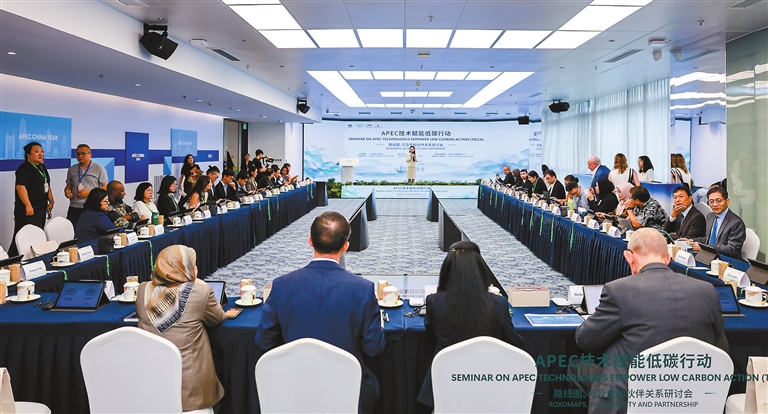
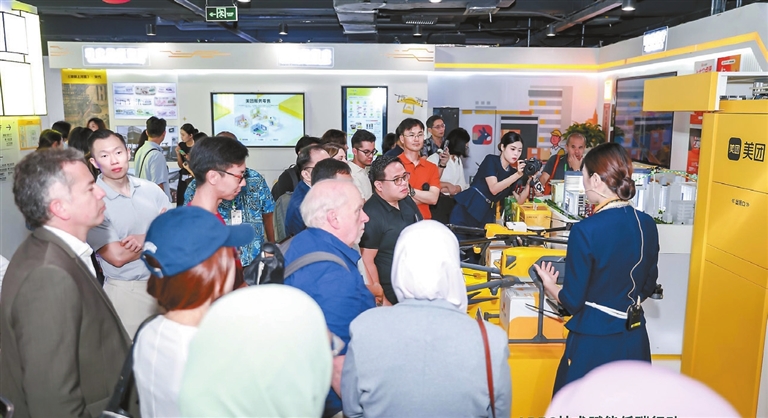
THE Seminar on APEC Technologies Empower Low Carbon Action (TELCA): Roadmaps, Accessibility, and Partnership was held in Longhua District from Sept. 2 to 4. Jointly hosted by the Shenzhen Longhua International Cooperation Center (LICC) and the Beijing International Exchange Association, the seminar is a key project under the APEC Policy Partnership on Science, Technology and Innovation (PPSTI) framework and part of China’s 2026 APEC event series. With APEC member economies accounting for roughly 60% of global carbon dioxide emissions, the Asia-Pacific region faces intense pressure to achieve a green, low-carbon transition while sustaining economic growth. Against this backdrop, the three-day event has brought together more than 40 delegates — including government officials, experts from international organizations, researchers, and corporate executives from 18 APEC member economies — to discuss low-carbon technology roadmaps, technology accessibility, and multi-stakeholder partnerships. Zhang Gaofeng, member of the Standing Committee of the CPC Longhua District Committee and director of the General Office of the CPC Longhua District Committee (Longhua District People’s Government), noted in his opening remarks that the green, low-carbon transition has become a dominant global trend requiring continuous technological innovation and international collaboration. Zhang highlighted Longhua’s recent efforts to embrace green development, develop its renewable energy and new energy storage industries, and integrate low-carbon initiatives into both industrial production and daily life. By hosting this APEC event, Longhua aims to leverage technological innovation to advance the green transition, promote the sharing and application of low-carbon technologies across the region, and bring green energy innovations to a broader public. The opening day featured keynote speeches and parallel sessions covering cutting-edge topics, including cost-sharing in energy transitions, standards and inclusive governance, and investment mechanisms for green technologies. Attendees shared policy insights and practical experiences, reinforcing the importance of equitable technology sharing and a just transition. The second day featured an in-depth discussion of “Accessibility, Green Skills and Empowering Partnerships,” with six keynote speeches and three parallel sessions. Topics included “Climate Technology Innovation: Accelerating Industrial Low-Carbon Transformation in the Asia-Pacific,” “How the Bioeconomy Can Help Achieve Decarbonization Goals” and “Technology and Policy Synergy: How Can Low-Carbon Innovation and Public Policy Work Together?” Addressing these topics, representatives from Chile, Vietnam, China and Thailand shared their experiences and lessons learned in designing low-carbon policy instruments. Xue Shengwei, senior vice president of Capol International & Associates Group, said from the perspectives of urban planning and architectural design that cities can reduce transportation-related carbon emissions by better balancing jobs and housing and strengthening blue-green ecological systems. He recommended retrofitting existing industrial parks and aging residential communities to improve their low-carbon performance, while drawing on international examples such as Singapore’s vertical ecological design and Europe’s integrated low-carbon policies. On the third day, participants toured Shenzhen to explore low-carbon urban solutions. The visits included Meituan’s National Local Services Consumption Big Data Operations Center, Hello Tech Energy, Shenzhen Energy Group, the Futian Mangrove National Nature Reserve and Shenzhen Talent Park. At Meituan’s national local service consumption big data operation center in Longhua, delegates examined a digital-integrated drone delivery system. Olivia Emma Utharntharm, chair of the University of Sydney’s Net Zero Youth Advisory Group, called it “a clean, scalable alternative to petrol-based vehicles,” noting Australia could adopt similar systems to cut urban logistics emissions. At Hello Tech Energy, the Jackery Solar Mars Bot — a world-first autonomous solar-storage robot unveiled at CES 2026 — drew strong attention from Jaime Andrés Peirano Ocharán, low-carbon project manager at Worley Chile. He called Shenzhen’s 15-year rise an innovation hub “a compelling model” for climate-vulnerable communities. He also credited the LICC as a key bridge for cross-border green-tech collaboration. The delegation also visited Shenzhen Energy Group’s clean-power projects and the Futian Mangrove Reserve, the only national-level nature reserve in a Chinese city center, highlighting biodiversity within high-density urban development. The day closed with a light show over Shenzhen Talent Park. This field trip served as a practical extension of the TELCA seminar, offering delegates tangible case studies across digital services, green storage, and ecological conservation.(Chang Zhipeng) | 