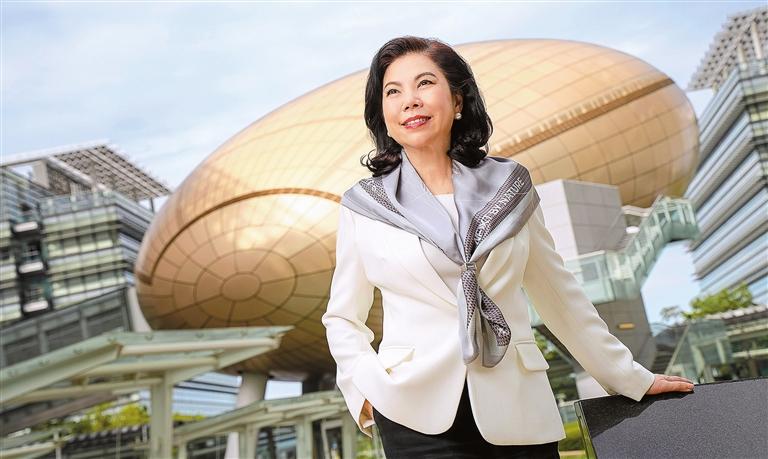
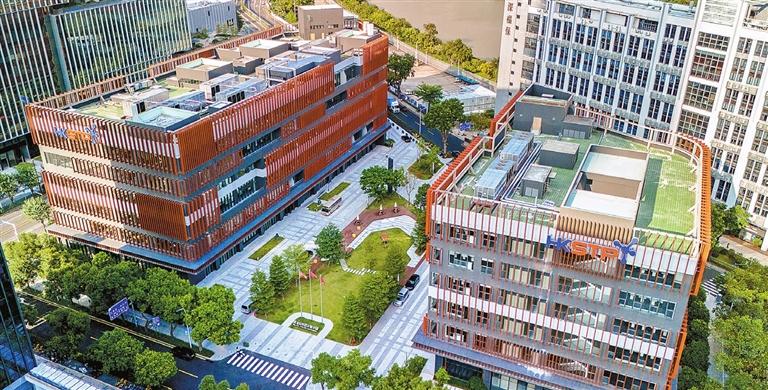
AS the Hong Kong Science and Technology Parks Corp. (HKSTP) marks its 25th anniversary, its Shenzhen Branch in the Shenzhen Park of the Hetao Shenzhen-Hong Kong Science and Technology Innovation Cooperation Zone has become the core bridge of its cross-border “One Ecosystem, Two Cities” strategy. Since its opening in September 2023, more than 100 enterprises have established a presence there; nearly 85% have a “1+1” layout across Hong Kong Science Park and the Shenzhen Branch, with cumulative financing exceeding 900 million yuan (US$135 million) — a genuine two-way flow of enterprises and talent, according to HKSTP chair Cordelia Chung. On her visit to the branch in her new role, Chung called the anniversary a milestone and outlined a four-part vision, “Broad and Deep, Far yet Near,” to guide HKSTP’s contribution to Hong Kong’s innovation and technology (I&T) development. Shenzhen Branch: a cross-border bridge The Shenzhen Branch embodies HKSTP’s “One Ecosystem, Two Cities” strategy, with “One Ecosystem” representing Science Park and “Two Cities” referring to Hong Kong and Shenzhen. It strengthens cross-border collaboration by connecting Hong Kong, the Chinese mainland and global innovation networks, helping Chinese innovators go global while supporting local and international ventures to land in the Guangdong-Hong Kong-Macao Greater Bay Area (GBA). “The core breakthrough of the ‘One Ecosystem, Two Cities’ model lies in upgrading from previous one-way resource matching to a collaborative framework of ‘one ecosystem, dual advantages and two-way empowerment,’” Chung said. “This is our most important strategic deployment in aligning with the opening of the national 15th Five-Year Plan. Enterprises can establish a presence in both Hong Kong and Shenzhen, achieving R&D in Hong Kong and application in the GBA.” She said the two cities were working towards “complementary development” and win-win collaboration. Hong Kong’s unique advantages in law, intellectual property protection and internationally recognized research standards provide the broad platform mainland enterprises need to go global. Shenzhen, meanwhile, brings strong manufacturing and implementation capabilities. “Only by combining the two can we build an I&T high ground with global competitiveness,” she added. A vision in 4 dimensions Under the vision of “Broad and Deep, Far yet Near,” Chung has outlined four priorities for the company’s next phase. Chung believes in building a broad, unstoppable talent ecosystem where people of all backgrounds can use technology to “solve the impossible” and deliver tangible benefits. She added that AI should multiply human potential, not replace it. Deep tech–industry convergence lies at the heart of Chung’s vision. She sees HKSTP not merely as a science park, but as an epicenter where breakthroughs meet real-world application. She wants park companies to build a global footprint and earn a world-class reputation “respected and envied around the world.” Her focus is on drawing the future nearer. Citing the national and Hong Kong’s five-year plans, she urged immediate action: “Let’s make things happen now, not wait.” Supporting Hong Kong as an international I&T hub HKSTP said Sept. 16 that it would support the Hong Kong government’s first Five-Year Plan by advancing innovation, technology development and talent cultivation. Hong Kong Chief Executive John Lee unveiled the city’s first socioeconomic development blueprint the same day, prioritizing the Northern Metropolis, AI integration across industries, new industrialization and an international high-calibre talent hub. Chung said HKSTP, Hong Kong’s largest I&T platform, would help implement both. “We will continue to provide I&T enterprises with one-stop, end-to-end support, enabling research outcomes to be translated into applications and put into practice,” she said. “By leveraging HKSTP’s capabilities, we will work hand in hand with major I&T parks to promote the industry, support Hong Kong in accelerating its development into an international I&T center and contribute to national technological self-reliance and new quality productive forces.” Building Hong Kong’s largest I&T ecosystem HKSTP’s roots reach back further than its own 25 years. Its industrial estates — today’s InnoParks — first laid the groundwork for Hong Kong’s industrialisation, giving manufacturing the space and infrastructure to grow, before the corporation was founded in 2001 to support Hong Kong’s next economic engine: I&T. Across 240 hectares spanning the science park, InnoCenter, three modern InnoParks and the Shenzhen Branch, HKSTP has built Hong Kong’s largest I&T ecosystem. Its working population exceeds 25,000, 60% of whom are researchers, alongside 2,500 tech firms from 26 countries and regions. It has supported 14 unicorns and works with more than 500 universities, investors and major corporations. Looking ahead, Chung envisions a fully integrated GBA science-park network and HKSTP as the world’s largest innovation ecosystem, where a day at Hong Kong Science Park feels like being at the world’s leading science and technology hub — “a true superpark.” (SD News) | 