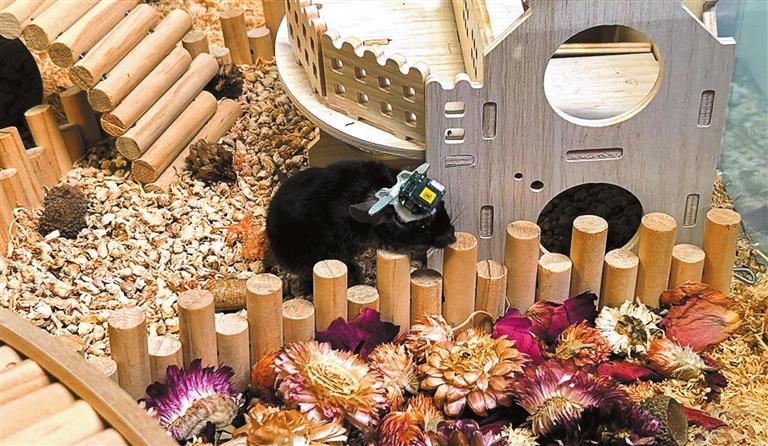
CHINESE scientists have developed a wireless microscope weighing just 1 gram that can record neural activity in the mouse cerebral cortex with single-cell resolution in natural environments, according to a study published in Nature. Named Airscope, the device was developed by a team led by Dai Qionghai, an academician of the Chinese Academy of Engineering and a professor at Tsinghua University, in collaboration with researchers from other institutions. Dai said the microscope provides a new tool for understanding the neural basis of intelligence and will drive optical brain-computer interfaces toward more precise neural detection, with future applications potentially extending to other fields. Research on how the brain regulates behavior in complex natural environments has long been constrained by a trade-off between the throughput of neural observation in freely behaving animals and the weight of the microscope. Existing benchtop microscopes capable of resolving individual neurons require the mouse’s head to be fixed or tethered with a cable, while head-mounted devices that allow free movement typically have a field of view of less than 1 mm. Through integrated design and systematic optimization, Airscope weighs only 1 gram and achieves single-cell resolution of about 4 to 6 micrometers over a 6 mm field of view. Mounted directly on a mouse’s head, it uses a 2-megapixel image sensor to perform on-device compression, enabling megapixel-level images to be transmitted wirelessly. Mice wearing the device showed no significant difference in travel distance, speed or path tortuosity compared with mice not wearing it, and recorded signal quality was comparable to conventional benchtop microscopes. Combined with a neuron-extraction algorithm previously developed by the team, Airscope can simultaneously record more than 8,500 neurons across 14 cortical areas in one cerebral hemisphere of a single mouse — about 25 times more than existing wireless imaging devices — and can record at the same site for more than 200 days. The team used the device to complete experiments previously difficult due to cables or equipment weight, including simultaneously recording cortical activity in multiple mice exploring a 5-square-meter natural habitat and tracking mice over long periods in a large maze with 32 ends. In the habitat, mice moved more than twice as fast as in standard cages and displayed 16 categories of behavior. The study found that cortical activity changed systematically with the terrain area the mouse was in, and a deep-learning model could determine the mouse’s location using cortical neural activity alone with accuracy far above chance.(SD-Agencies) | 