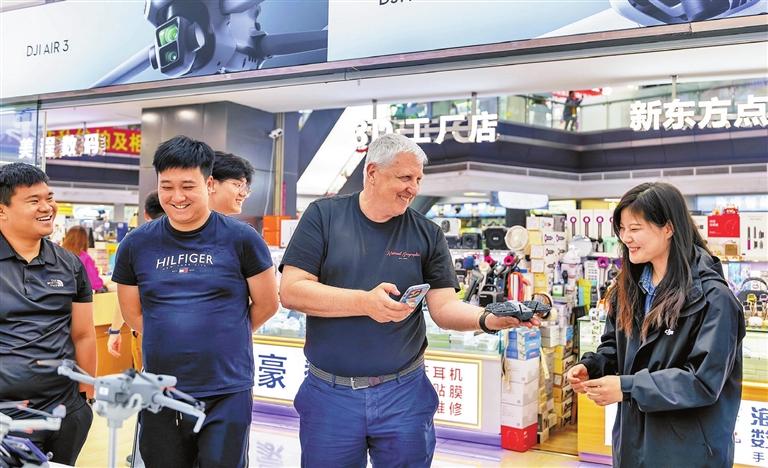
OVERSEAS travelers to Shenzhen can navigate malls with bilingual signage, pay with overseas e-wallets at Huaqiangbei electronics markets and claim departure tax refunds in seconds on their smartphones, as the city works to improve the shopping environment for international visitors ahead of the APEC meetings. The city is upgrading services for international visitors in commercial districts, expanding cross-border payment options and streamlining departure tax refunds. At a HEYTEA store in UpperHills on Oct. 18, Australian tourist Emily and a friend ordered drinks using a Chinese-English menu. Emily, who is from Sydney, said the mall’s bilingual signs were clear and the experience was “great.” She planned to rest before visiting the duty-free shops downstairs. Bilingual signs and restaurant menus have become common in these areas. UpperHills has installed more than 2,000 Chinese-English signs and nearly 100 signs in Chinese, English, Japanese and Korean. A total of 108 restaurants there offer bilingual menus, and the information desk has translation devices and earphones. Shenzhen MixC is rolling out MeetChina, a digital visitor platform, and smart shopping guides, while merchants in Universiade World, Coastal City and Uniwalk offer bilingual menus and signage. Shenzhen Bay MixC has bilingual directional signs and electronic wayfinding. Huaqiangbei has added multilingual signs in locations popular with international visitors. The city is also supporting volunteer teams in commercial districts, including volunteers who speak foreign languages and those equipped with handheld AI translators. “It is so convenient! No need to download a new app — just scan and pay directly,” a South Korean tourist said after paying at Shenzhen MixC with Hana Pay, a South Korean e-wallet. The seamless payment experience underscores Shenzhen’s broader effort to improve its cross-border payment system. Shenzhen has about 41,000 merchants that accept foreign bank cards and 51,000 point-of-sale terminals, across the airport, ports and major commercial districts. UnionPay, WeChat Pay and Alipay accept foreign cards, while WeChat Pay has connected with nearly 50 overseas e-wallet providers. More wallets from APEC economies are expected to join. Eight service centers at transport hubs and commercial districts, including the airport, Shenzhen Bay, Futian, Luohu, and Huanggang ports, and Futian Railway Station, offer currency exchange, payment advice and multilingual guidance. Shenzhen launched 10 convenient payment commercial districts in August 2024, including the airport and Shenzhen MixC. At present, domestic and foreign bank cards are accepted at all three-star-and-above hotels, national 5A-level scenic spots, and national-level tourism and leisure districts in the city. Shenzhen makes it easier for overseas visitors to claim departure tax refunds. As one of China’s first cities to introduce the policy, it allows shoppers to get an immediate refund and collect it at any port of departure in the country without returning to the store. As of the end of June, six Shenzhen ports offered departure tax refunds, more than in any other Chinese city. The city has more than 2,500 tax-refund stores. Fifteen commercial districts and more than 1,000 stores offer immediate tax refunds, the most in the country. Shenzhen was selected in 2025 as a national pilot city for building a world-class consumption environment. In April, it introduced financial support measures targeting quality consumer goods, payment services for international visitors and better services for overseas shoppers. The city is also promoting new shopping experiences, including low-altitude delivery, unmanned stores and technology-focused shops. Robots, AI glasses and AI watches have become popular purchases among inbound tourists. Shenzhen is developing consumption linked to culture and tourism, parks and sports, and encouraging brands to open their first stores in the city. The push is showing results. From January to August, foreign nationals made 143 million transactions in Shenzhen, worth 21.086 billion yuan (US$3.14 billion). The figures were up 18.64% and 26.58%, respectively, from a year earlier.(Li Jing) | 