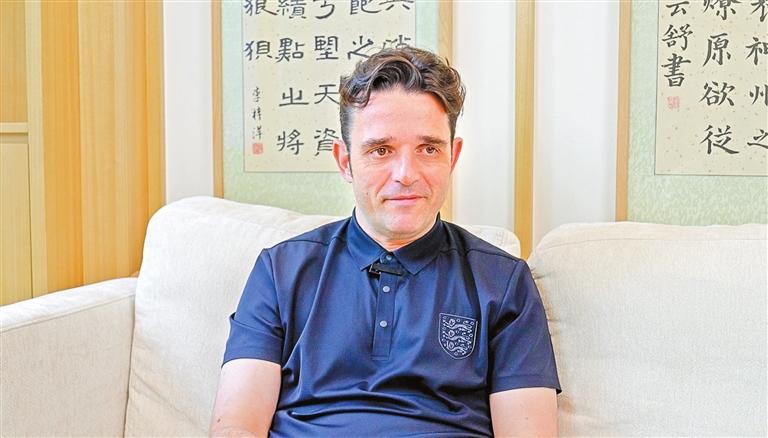
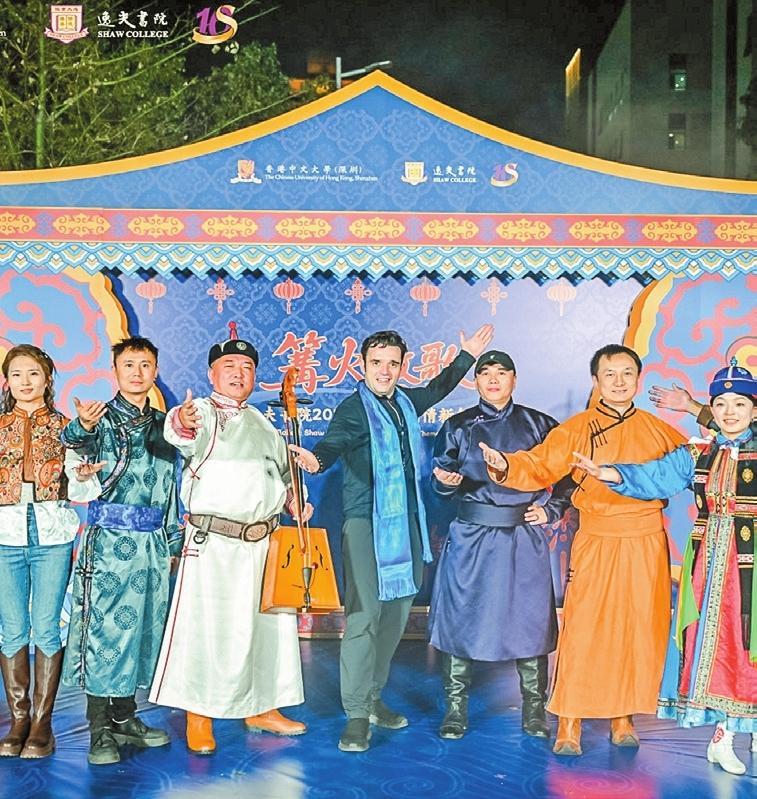
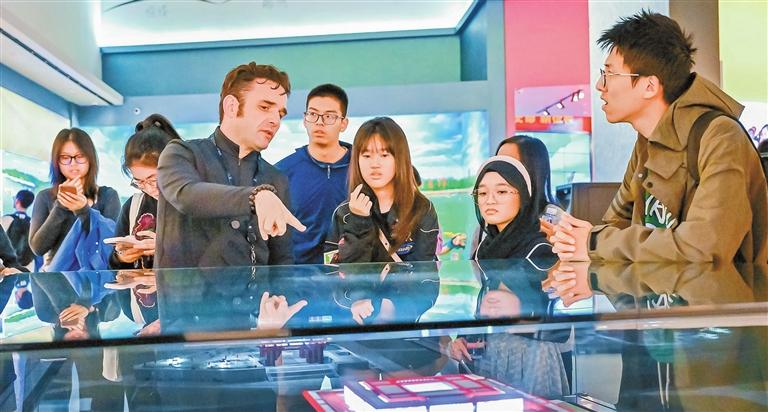

Editor’s note: “Once you arrive, you are a Shenzhener.” Many expats from fellow APEC economies have already settled down, built their careers, and found a sense of belonging in Shenzhen. They are both pioneers of a new era and familiar faces in local neighborhoods. In transitioning from “foreign visitors” to “fellow Shenzheners,” they have fully unleashed their potential and forged a mutually rewarding journey alongside this vibrant city. Beginning today, Shenzhen Special Zone Daily, Dute News and Shenzhen Daily under Shenzhen News Group, together with the Shenzhen Municipal Talent Affairs Bureau, are jointly launching a special series: Right Here in Shenzhen: Stories of International Residents from APEC Economies. Through candid lenses and heartfelt narratives, we will chronicle their Shenzhen stories and preserve the warmth of this remarkable city. We invite you to stay tuned. Xu Song, Wu Xumei, Chen Siqi vankochensq@163.com ON the wall of Laurie Pearcey’s office hang five framed maps: Sydney, New Delhi, Shenzhen, Guangzhou and Hong Kong. Shenzhen sits in the middle. Sydney is where he grew up. New Delhi left him with questions he still carries. His wife and two children live in Guangzhou. Hong Kong is where a formative chapter of his career unfolded. Shenzhen, he said, is home. “The middle is the center,” he said, gesturing at the wall. “This is my own small universe.” Pearcey, 42, is known by his Chinese name, Jin Jiang. He is an adviser to the president and master of Shaw College at the Chinese University of Hong Kong, Shenzhen (CUHK-Shenzhen). Born in the U.K. and raised in Australia, Pearcey is a British-Australian dual national. But when he first visited China at 17, he decided that one day he would settle in the country. Pearcey first visited China in January 2002. He recalled that at the time, China had just joined the WTO and Beijing had just won the Olympic bid. Fresh out of high school, Pearcey traveled through Shandong Province and Beijing with a school group. Standing on the Great Wall in the snow, he shouted that he wanted to stay in China. From ‘ni hao’ to ‘Jin Jiang’ When Pearcey returned to Australia, he started learning Chinese with only “ni hao” and “xie xie” in his vocabulary. He later secured an exchange opportunity at Tsinghua University. Four years later, he won the best presenter award at the Chinese Bridge Chinese Proficiency Competition for Foreign College Students. Seven years later, in 2013, he returned to the competition as a judge, joining CCTV anchor Hai Xia, cross-talk performer Mark Rowswell (known in China as Dashan), and Xiao-xiangyu, a renowned Chinese Yuju Opera artist, on the panel for that year's final. His fluency in Chinese was not forged in classrooms alone. During the exchange year at Tsinghua University, he skipped the international dormitory and rented a flat in an old Beijing neighborhood. He chatted with the elderly locals, haggled in wet markets, practiced his tones with Teresa Teng songs, and learned Chinese history from the TV series “Yongzheng Dynasty.” He gave himself the Chinese name Jin Jiang, where Jiang means “river” in English, suggesting something like “a river surging forward, endless and alive.” A bridge made of ordinary things Language, for Pearcey, is not merely a communication tool but a key to a different way of thinking. “When you speak another language, you almost take on another personality,” he said. Chinese conversation is thick with chengyu — four-character idioms that carry entire histories inside them. Behind every phrase is a whole cultural universe — Confucius, Mencius, centuries of argument and poetry, said Pearcey, adding that “Chinese civilization has evolved over thousands of years into what it is today.” Before CUHK-Shenzhen, Pearcey led China strategy at the University of New South Wales, served as foreign dean of its Confucius Institute, ran international affairs as a pro vice-chancellor, and, at 25, became the youngest-ever chief executive of the Australia China Business Council. The bridge he describes is not a metaphor of concrete and steel, but of shared meals, long flights, hugs and arguments — the unglamorous labor of actually knowing people. He joined CUHK in 2021 as associate vice president, and moved to its Shenzhen campus in 2024. The fit, he said, is almost preordained: the academic depth of a Hong Kong university meeting Shenzhen, an “open, young and dynamic” city. “One side gives you rigor and tradition. The other gives you restlessness and the future. I stand at the point where they meet,” he said. Selling Shenzhen without a sales pitch Pearcey first visited Shenzhen in 2006, on a youth delegation visit to a liquefied natural gas terminal in Dapeng New Area. In his memory, the city was at that time still “a high-tech park and a construction site.” Two decades later, when recruiting overseas students for CUHK-Shenzhen, he always asks a simple question: “Who has used a Huawei phone, a DJI drone, a BYD car?” Hands inevitably go up. “These companies grew out of Shenzhen,” he then tells them. The city’s business card needs no more than that single question, according to him. With APEC leaders due to gather in Shenzhen on Nov. 18-19 — China’s third time hosting the forum, and the first in 12 years — Pearcey sees an excellent opportunity for the city to speak for itself. He has been organizing university presidents’ forums and bringing executives from Huawei, Tencent and DJI into classrooms to talk about the future of industry and talent. “These companies are Shenzhen’s storybooks,” he said. But his pitch to foreign visitors is deliberately low-key. “A thousand words of description are worth less than one look,” he said, paraphrasing a Chinese idiom. “Shenzhen is not two characters in a news bulletin. It is a drone delivery. It is students of different nationalities drinking tea in a college common room. It is me going home to put my children to bed before I open my laptop again.” A home grown from ordinary days Pearcey’s wife is Chinese; his children are growing up in China. He used to describe himself as a son-in-law of the country. “Now I am more like a member of the household,” he laughed. “Not on paper — in the small habits of daily life.” His schedule would exhaust a diplomat: a morning meeting in Shenzhen, an afternoon discussion in Hong Kong, an evening train back to Guangzhou for bedtime. High-speed rail, the Metro and the low-altitude economy have stitched the Guangdong-Hong Kong-Macao Greater Bay Area into a zone where one can commute between cities within an hour. “Running through three or four cities in a day is not a business trip,” he said. “It is just a normal routine.” His parents, who speak no Chinese, visit from Australia and walk around his neighborhood unaided. “The best thing about Shenzhen is that foreigners are not ‘looked after.’ We are allowed to build an ordinary life,” he said. Pearcey calls himself a person shaped by China's reform and opening-up. “This country gave me a career, a family, a set of values,” he said. “I am not Chinese. But high-level opening-up is tied to my whole life.” A print of migrating birds, picked up from an exhibition at Shenzhen Bay Culture Square, hangs near the five maps. For a man who has lived in five cities and calls none of them entirely foreign, the old Chinese line feels less like a cliché than a description: Where the heart is at peace, there is home. | 